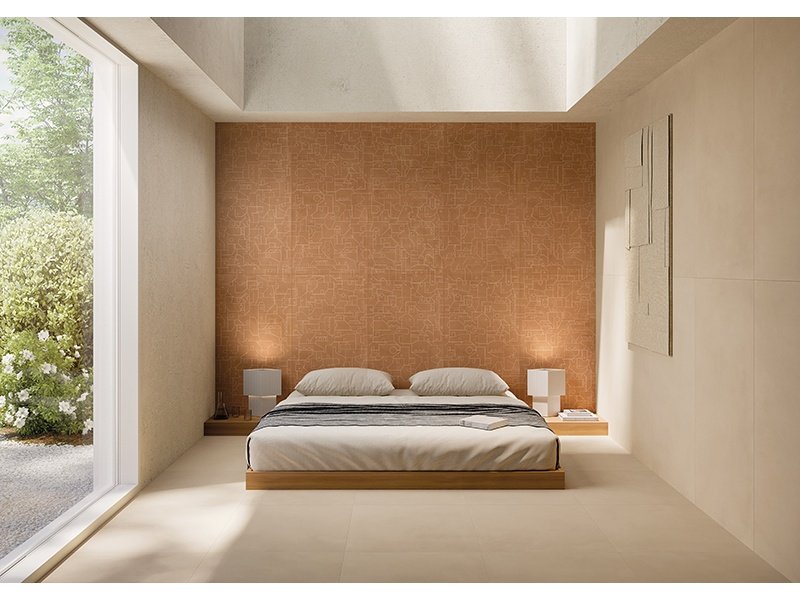

A bedroom should feel restful, but calm does not have to mean anonymous. The most successful interiors often combine visual quiet with enough material depth, contrast, and personality to avoid becoming flat or overly neutral.
A bedroom should feel restful, but calm does not have to mean anonymous. The most successful interiors often combine visual quiet with enough material depth, contrast, and personality to avoid becoming flat or overly neutral.
In this balance, bedroom tiles can contribute far more than a practical flooring surface. Color, texture, scale, and the way the material interacts with textiles, furniture, and light all influence how comfortable and visually settled the room feels.
Calm interiors do not need to rely on neutral colors
Soft beige, warm gray, and other understated tones are often associated with relaxing bedrooms, but tranquility is not created by color alone. Deeper shades, mineral tones, or warmer earthy palettes can also produce a restful atmosphere when they are used with control.
What matters is the overall balance. A darker floor can give the room a more grounded feeling, while lighter surfaces may make it appear more open and airy. Bedroom tiles can therefore support very different moods without requiring the entire interior to stay within a narrow neutral palette.
Texture brings depth without adding visual noise
A calm bedroom can still benefit from material variation. Subtle texture gives surfaces more depth and prevents large areas from appearing overly uniform. Stone-inspired tiles may introduce gentle tonal movement, while wood interpretations can bring a warmer visual rhythm.
Concrete effects can create a quieter, more architectural base when paired with softer furnishings. The key is restraint. Texture should enrich the room rather than compete with the bed, lighting, artwork, or other elements that already attract attention.
Balancing hard surfaces with soft materials
Comfort in a bedroom is strongly influenced by contrast. Ceramic surfaces naturally have a more defined architectural presence, while curtains, upholstered headboards, bedding, rugs, and cushions introduce softness.
Bringing these materials together can make the room feel more layered. A precise tiled floor may provide structure beneath a large rug, while a more textured surface can contrast with smooth fabrics or simple furniture. Rather than attempting to make every material feel soft, the design can use the difference between them to create balance.
Light changes how surfaces are perceived
Bedrooms are experienced under very different lighting conditions throughout the day. Morning sunlight, filtered daylight, bedside lamps, and warmer evening lighting can all change the appearance of the same surface.
Matte finishes tend to diffuse light more gently, while more pronounced textures can create small variations of shadow and depth. Color also shifts according to the intensity and temperature of the light.
Considering these changes helps avoid designing the room around a single fixed impression. The surface becomes part of an atmosphere that evolves naturally from morning to night.
Creating comfort through balance rather than uniformity
A restful bedroom does not need every element to disappear into the same palette. Comfort can emerge from controlled differences: a warmer floor against lighter walls, a textured surface beside smooth fabrics, or a deeper tone balanced by soft lighting and natural materials.
Bedroom tiles can support this approach by providing a stable architectural foundation while leaving room for softer, more personal elements to shape the character of the interior. The result is a space that feels calm without becoming generic: visually balanced, materially rich, and comfortable.
Designing with porcelain beyond conventional boundaries: Ceramiche Keope
Porcelain stoneware is increasingly used as more than a flooring material. In contemporary interiors, it can become part of the architecture itself, moving across horizontal and vertical surfaces and contributing to the identity of a room. Ceramiche Keope explores this broader potential through Italian design culture, technological research, and industrial expertise.
Founded in 1995 and part of the Concorde Group, Ceramiche Keope develops porcelain surfaces for residential and architectural projects. Its work spans different formats, finishes, colors, and material interpretations, giving designers the freedom to create coordinated or contrasting compositions while relying on porcelain stoneware performance.
In the bedroom, this flexibility opens up possibilities beyond conventional flooring. Ceramiche Keope tiles can be used on walls as well as floors, while large porcelain slabs can transform the wall behind the bed into a strong architectural feature.
A wide range of textures and colors supports both calm, enveloping interiors and more distinctive compositions. Porcelain stoneware also offers practical advantages in sleeping areas, as its surfaces are easy to clean, do not absorb moisture or odors, and help support hygienic indoor environments.
Surface innovation extends these possibilities further. ULTRAsilky provides a smooth, velvety satin feel with enhanced slip resistance for wet interior areas. ULTRAmatt offers a deep extra-matt appearance, soft uniform touch, easier maintenance, and R10 A+B performance for residential and commercial floor and wall applications.
Responsible manufacturing is another part of the company’s approach. Ceramiche Keope reuses process water, recovers fired ceramic waste, and reintegrates raw-material residues through a closed-cycle system. Around 75% of its energy is generated internally, with the remainder supplied exclusively by certified renewable sources.
ISO 17889, WELL Building Standard V2, Declare, and the Environmental Product Declaration (EPD) reinforce the company’s commitment to sustainability, material transparency, and verified environmental performance.
By combining design freedom, technical research, and responsible production, Ceramiche Keope continues to expand the role of porcelain stoneware across contemporary residential and architectural spaces.