

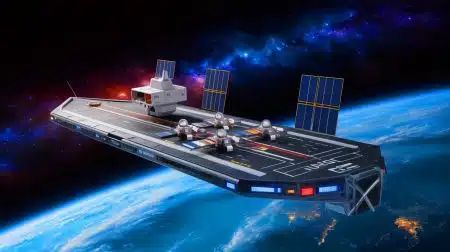

As humanity stretches its reach beyond the blue skies and into the infinite expanse of space, a new frontier of warfare is emerging. Enter the era of the Space Force Orbital Warship Carrier—an ambitious concept that could redefine how nations protect their interests among the stars. Imagine colossal vessels equipped to launch satellites, intercept threats, and engage in combat all from orbit. This idea isn’t just science fiction; it’s a glimpse into our possible future where battles take place far above Earth’s atmosphere. With technology evolving at breakneck speed, understanding what a Space Force Orbital Warship Carrier entails becomes essential for grasping modern military strategy as we head towards an age where celestial conflicts may become reality.
What is a Space Force Orbital Warship Carrier?
A Space Force Orbital Warship Carrier represents a groundbreaking leap in military technology. This futuristic vessel is designed to operate beyond Earth’s atmosphere, providing strategic advantages over traditional naval forces.
Unlike conventional aircraft carriers, an orbital warship carrier can deploy various spacecraft and drones from low Earth orbit. It serves as a mobile command center, equipped with advanced weaponry and communication systems tailored for space combat scenarios.
The concept integrates cutting-edge propulsion technologies, allowing it to maneuver efficiently among celestial bodies. With its robust shielding and defense mechanisms, it aims to protect assets against potential threats in outer space.
Moreover, the design incorporates modular components that facilitate quick repairs and upgrades. This adaptability ensures that the carrier remains at the forefront of evolving warfare strategies in an increasingly contested domain: space itself.
The Need for a Space Force Orbital Warship Carrier
As humanity pushes deeper into space, the need for a Space Force orbital warship carrier becomes increasingly evident. The expansion of satellite technology and space exploration opens new frontiers, but it also invites potential threats.
Countries worldwide are investing in their own military capabilities beyond Earth’s atmosphere. This arms race necessitates a dedicated platform designed specifically for defense and strategic operations in orbit.
An orbital warship carrier would serve as a formidable deterrent against hostile actions from adversaries. It could also provide crucial support during defense missions or emergency situations involving critical satellites.
With growing reliance on space-based assets, protecting these investments is essential. A well-equipped carrier can safeguard vital infrastructure while ensuring that any aggression is met with swift countermeasures.
The complexity of modern warfare demands innovative solutions to address evolving challenges in the cosmos. An orbital warship carrier fits right into this narrative of preparedness and security.
Capabilities and Features of the Space Force Orbital Warship Carrier
The Space Force Orbital Warship Carrier is designed to dominate the vastness of space. Equipped with advanced propulsion systems, it can maneuver swiftly between orbits and respond quickly to threats.
This carrier boasts an array of weaponry, including laser defense systems and missile launchers. These weapons provide both offensive and defensive capabilities, ensuring protection against a variety of adversaries.
Communication systems on board facilitate real-time coordination with ground forces and other spacecraft. Enhanced sensors allow for early detection of potential dangers in the vicinity.
Furthermore, the design prioritizes modularity. This means that different mission modules can be swapped out depending on operational requirements, enhancing versatility in various scenarios.
With its state-of-the-art technology, the orbital warship carrier represents a significant leap forward in space military operations. Its presence could redefine strategies in modern warfare beyond Earth’s atmosphere.
Potential Uses and Applications
The potential uses of a Space Force orbital warship carrier are vast and varied. One significant application is the ability to act as a mobile command center during conflicts that extend beyond Earth’s atmosphere. This would allow for coordinated military operations on a global scale.
Additionally, these carriers could serve as platforms for satellite defense systems. They may intercept threats before they reach critical infrastructure or civilian satellites.
Research and development missions also benefit from such technology. The ability to deploy scientific instruments at high altitudes can lead to breakthroughs in space exploration.
Humanitarian aid presents another avenue where these carriers could shine by providing support in disaster-stricken areas worldwide. With their advanced capabilities, they can deliver resources rapidly across borders and oceans.
Furthermore, training exercises conducted aboard these vessels would prepare personnel for real-world scenarios in outer space environments, enhancing operational readiness significantly.
Challenges and Criticisms
The development of a Space Force orbital warship carrier isn’t without its hurdles. Critics argue that the vast investment required could divert resources from pressing terrestrial military needs.
There are also concerns about the militarization of space. Many fear this could lead to an arms race in orbit, escalating tensions between nations rather than fostering cooperation.
Technological limitations pose another challenge. Current propulsion systems and life-support technologies may not be advanced enough for sustained operations beyond Earth’s atmosphere.
Moreover, operational logistics can complicate missions significantly. The complexities of deploying and maintaining such vessels in unpredictable environments raise questions about their practicality.
Environmental impacts cannot be ignored either. Launching large spacecraft contributes to space debris, which poses risks to both existing satellites and future missions.
Public opinion is mixed as well. Some view these initiatives as necessary for national security; others see them as unnecessary expenditures during times of global uncertainty.
Future of Space Warfare and the Role of the Space Force Orbital Warship Carrier
As nations continue to explore the cosmos, the landscape of warfare is evolving. The Space Force Orbital Warship Carrier stands at the forefront of this transformation. It symbolizes a shift from traditional combat methods to advanced space-based strategies.
With its agility and firepower, this carrier could redefine military engagements in orbit. It might serve as a command center for coordinating operations across vast distances, enhancing situational awareness like never before.
Moreover, technological advancements promise to integrate artificial intelligence into these carriers. This could revolutionize decision-making processes during conflicts in space.
The carrier’s presence would also act as a deterrent against potential aggressors. In an era where geopolitical tensions extend beyond Earth’s atmosphere, maintaining peace through power projection becomes essential.
The Space Force Orbital Warship Carrier represents not just innovation but a new paradigm in defense strategy that embraces both exploration and security.
Conclusion
The emergence of a Space Force Orbital Warship Carrier signals a pivotal shift in the landscape of modern warfare. As nations recognize the strategic importance of space, this advanced vessel could become essential for defense and deterrence. Its unique capabilities may help secure national interests beyond our planet.
While challenges and criticisms surround its development, including cost and ethical concerns, the potential benefits are significant. This carrier could enhance surveillance, support satellite operations, and even engage in offensive maneuvers if necessary.
As technologies evolve rapidly, so too will strategies around space combat. The Space Force Orbital Warship Carrier is not just an idea; it represents an evolving battlefield where humanity’s reach into space meets the realities of conflict. With international tensions on the rise, investing in such technology might be more crucial than ever before.
The future of warfare lies not only on land or sea but also among the stars. It’s clear that as we venture further into uncharted territories, tools like orbital warship carriers will play a vital role in shaping global security dynamics for generations to come.


