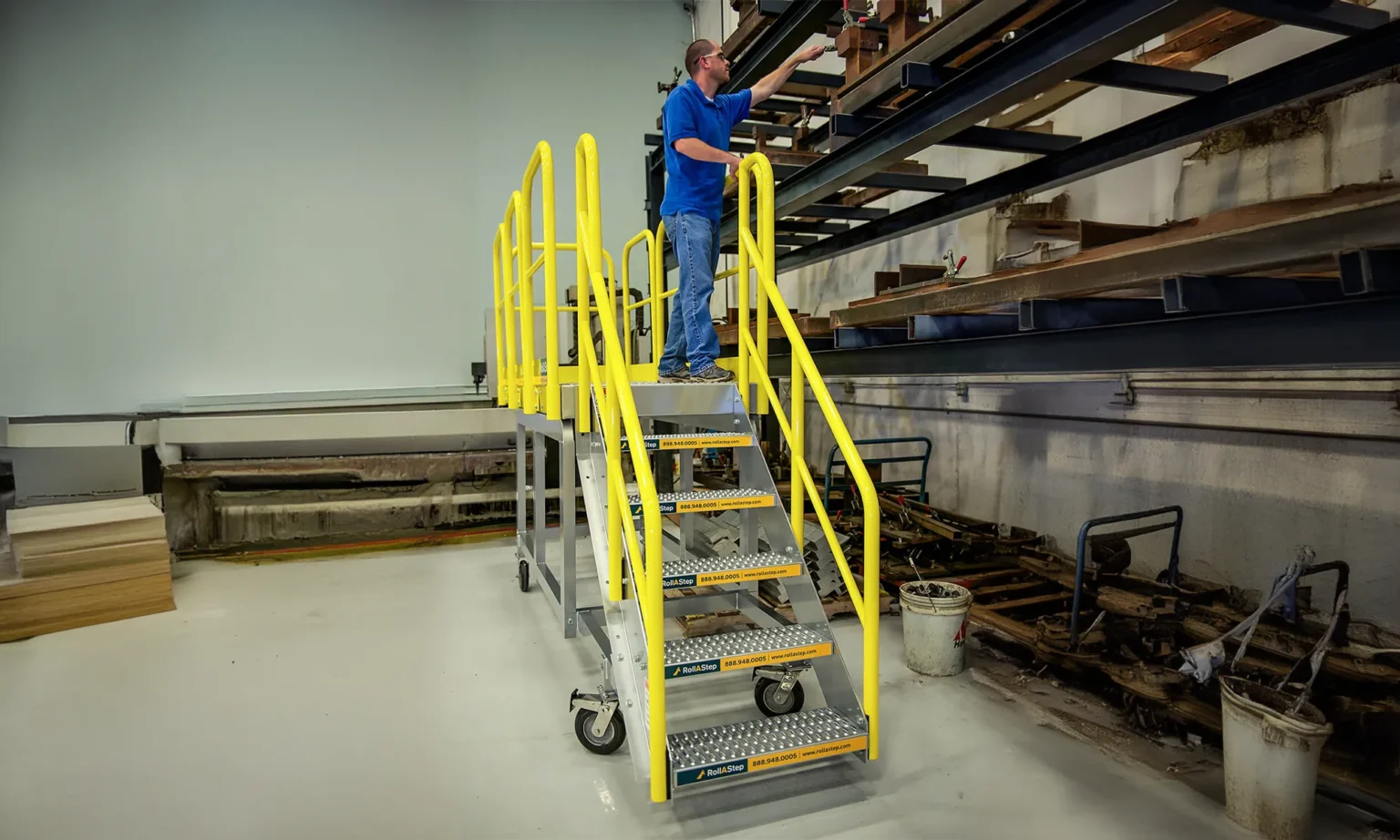

For organizations that rely on field workers operating at height, ladder safety is not a formality. It is a daily operational concern tied directly to injury prevention, regulatory compliance, and workforce continuity. Yet for many companies, the way ladder safety is delivered has remained largely unchanged for decades — a scheduled classroom session, a printed handout, and a sign-off sheet.
The problem is not that classroom instruction lacks value. The problem is that field workers do not encounter ladders in classrooms. They encounter them on job sites, in warehouses, on service vehicles, and in environments where conditions change by the hour. When training is disconnected from the environment where the skill is applied, the gap between knowing and doing tends to widen over time.
As industries face increasing pressure to reduce incident rates, meet compliance standards, and minimize unplanned downtime, the format of safety training has become as important as its content. Mobile delivery models are addressing some of the core limitations that classroom-based instruction has never been able to solve for workers who spend most of their time in the field.
1. Training That Reaches Workers Where the Risk Actually Exists
One of the most persistent challenges in workplace safety is the transfer gap — the distance between where a worker learns something and where they are expected to apply it. For field-based roles, this gap is significant. A worker who completes a ladder safety course in a conference room on a Tuesday morning is expected to apply that knowledge across a range of real-world conditions that were never part of the training environment.
Mobile delivery changes this by bringing instruction to the point of work. Organizations looking to address this directly have found that structured mobile ladder safety training can be conducted on-site, within the actual environments where ladders are used, rather than requiring workers to leave their operational context entirely. This matters because context reinforces retention. When a worker sees the type of ladder they use every day, on the surface they stand on, in the conditions they regularly encounter, the instruction connects more directly to behavior.
The Operational Cost of Disconnected Training
When training is location-dependent, it introduces logistical friction that often leads to delays, incomplete participation, or sessions that are rescheduled repeatedly because field crews cannot be pulled off active assignments. Over time, this creates uneven coverage across teams — some workers receive timely instruction while others operate on outdated knowledge. Mobile delivery reduces this friction by working around the operational schedule rather than against it, meaning fewer delays, fewer gaps, and more consistent coverage across dispersed workforces.
2. Consistency Across Teams That Work in Different Conditions
A recurring issue with classroom-based delivery is variability in instruction quality. When multiple instructors deliver the same program at different locations and different times, the content tends to drift. Emphasis shifts, examples change, and the depth of practical demonstration varies depending on who is running the session that day. For safety-critical topics, this inconsistency carries real risk.
Mobile training programs built around standardized delivery frameworks reduce this variability. The content, sequence, and practical components remain consistent regardless of where the training takes place. This is particularly relevant for companies operating across multiple sites or regions, where a uniform safety baseline is necessary for both compliance purposes and internal accountability.
Why Standardization Matters More Than Frequency
Many organizations focus on how often training is delivered, but frequency without consistency does not build a reliable safety culture. If workers across different teams receive instruction that varies in depth or emphasis, the organization cannot reasonably expect uniform behavior in the field. Standardized mobile delivery ensures that every worker, regardless of location or team, receives the same foundational instruction. This creates a shared reference point that supervisors can build on and that compliance records can accurately reflect.
3. Practical Demonstration Over Passive Learning
Classroom instruction, by its nature, tends to be passive. A worker sits, listens, watches a video, and answers a few questions. For procedural safety tasks — the kind that involve physical equipment, body positioning, and environmental judgment — passive learning has well-documented limitations. According to guidance published by the Occupational Safety and Health Administration, effective safety training must address the specific hazards workers actually face in their work environments, not hazards presented in a generalized format.
Mobile ladder safety training allows for hands-on demonstration using the actual equipment workers operate daily. An instructor can walk through setup procedures, angle adjustments, load considerations, and descent techniques in real time, with real ladders, in real environments. This is a fundamentally different learning experience than observing a diagram or watching a recorded demonstration.
The Role of Repetition in Physical Skill Development
Safe ladder use involves a set of physical habits — how weight is distributed, how the body is positioned relative to the rails, how footing is confirmed before each step. These habits are not formed through a single viewing of instructional material. They develop through guided repetition. Mobile instruction makes repetition possible within the training session itself, rather than leaving it to chance once a worker returns to the field. This is a meaningful distinction when the skill being practiced directly affects whether a worker goes home safely at the end of the day.
4. Scheduling Flexibility That Supports Operational Continuity
Traditional classroom courses operate on fixed schedules. A training date is set, workers are pulled from their assignments, and the session runs regardless of whether site conditions, project timelines, or staffing changes make that timing ideal. For field-based organizations, this model creates recurring tension between operational demands and compliance requirements.
Mobile delivery allows training to be scheduled around active work rather than in opposition to it. Sessions can be organized for smaller groups, conducted during natural breaks in project cycles, or coordinated to coincide with equipment delivery or site orientation. The result is a training model that fits within the operational rhythm of field work rather than interrupting it.
Managing Compliance Without Disrupting Productivity
For operations managers, the challenge is not a lack of commitment to safety — it is finding a way to maintain compliance without creating workflow gaps that affect project delivery or customer commitments. When mobile training can be deployed to a site or scheduled in smaller, rolling cohorts, it becomes possible to maintain safety standards continuously rather than in periodic bursts. This approach also reduces the administrative burden of tracking who attended a centralized session, because training records can be tied directly to site visits and on-site verification rather than attendance sheets at a remote facility.
5. Relevance to the Specific Equipment and Environments Workers Use
Generic ladder safety content covers general principles that apply across a range of equipment types and settings. This is useful as a starting point, but it falls short for workers whose daily tasks involve specific ladder types — extension ladders used on uneven exterior surfaces, step ladders in confined utility spaces, mobile platform ladders in warehouse settings. Each of these scenarios carries its own risk profile, and general instruction does not always address the nuances that matter most in context.
Mobile training can be tailored to the equipment a specific workforce actually uses. An instructor on-site can reference the organization’s own ladders, address the conditions specific to that facility or job type, and incorporate any company-specific procedures into the session. This relevance is not a cosmetic improvement — it is a functional one. Workers retain information more effectively when it connects directly to their daily tasks, and they are more likely to apply safe practices when those practices have been demonstrated in context rather than in the abstract.
Addressing Equipment-Specific Risk Without Overcomplicating Instruction
There is a tendency in safety training to generalize broadly in order to cover every possible scenario. The unintended consequence is instruction that feels distant from the work a particular team actually does. By focusing on the specific equipment and environments in scope for a given workforce, mobile training keeps instruction grounded and actionable. Workers leave with clear, applicable knowledge rather than a broad overview of concepts they may or may not encounter on the job.
Closing Thoughts
The case for mobile delivery in ladder safety training is not built on novelty. It is built on a straightforward operational reality: field workers perform better when their training reflects the environments, equipment, and conditions they actually encounter. Classroom instruction serves a purpose in many learning contexts, but for physically-grounded safety skills applied in varied field conditions, it carries structural limitations that affect retention, consistency, and real-world application.
Organizations that have shifted toward mobile formats report clearer compliance coverage, stronger behavioral consistency across teams, and fewer logistical conflicts between training schedules and operational demands. These are practical outcomes, not theoretical ones.
For safety managers, operations directors, and field supervisors evaluating how to improve their ladder safety programs, the format of training is worth examining as carefully as its content. The two are not separate decisions. Where and how instruction is delivered shapes what workers actually take with them when they return to work.