
In today’s fast-paced digital landscape, companies rely heavily on developers who can work across the entire technology stack. From designing intuitive user interfaces to building scalable server-side logic and managing databases, a full stack developer plays a critical role in delivering robust digital products. This versatility is one of the main reasons organizations actively look to hire full stack developer capable of handling both frontend and backend responsibilities.
However, not every developer who claims to work on both sides of the stack truly performs at a high level. High-performing full stack developers possess a distinct set of skills that allow them to build efficient, secure, and scalable applications while collaborating effectively with teams. Understanding these key competencies can help businesses identify the right professionals and help developers understand what it takes to excel in this role.
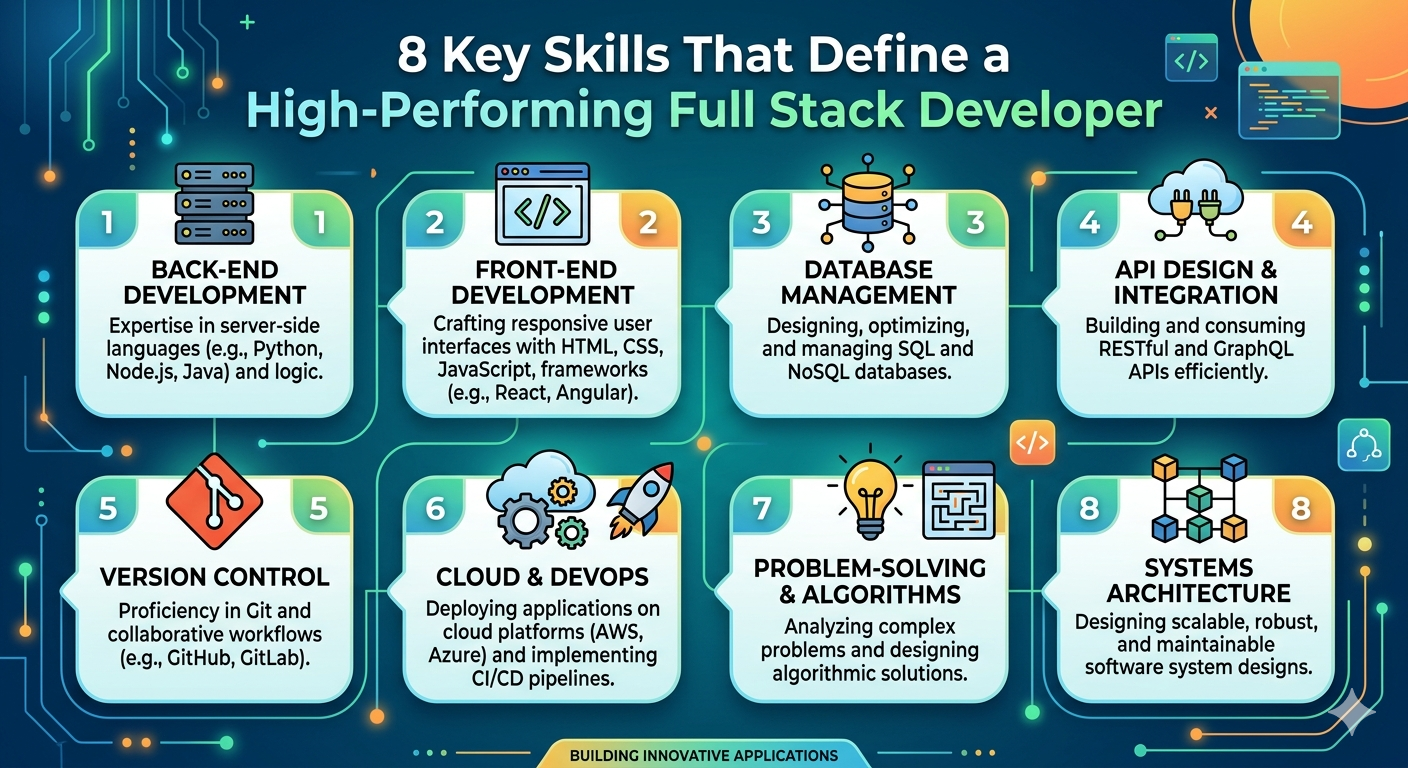
Below are eight essential skills that define a high-performing full stack developer.
-
Strong Proficiency in Frontend Technologies
A high-performing full stack developer must have a deep understanding of frontend technologies. This includes core web technologies such as HTML, CSS, and JavaScript, which form the foundation of modern web development.
Beyond the basics, experienced developers are proficient with modern frameworks and libraries like React, Angular, or Vue.js. These tools help create dynamic, responsive, and interactive user interfaces that improve user experience.
Frontend expertise also involves understanding browser behavior, performance optimization, accessibility standards, and responsive design. Developers who master these aspects can build interfaces that function smoothly across devices and platforms.
-
Backend Development Expertise
While frontend skills focus on user experience, backend expertise ensures the application functions properly behind the scenes. A high-performing full stack developer is comfortable working with server-side languages such as Node.js, Python, Java, PHP, or Ruby.
Backend development involves creating APIs, managing authentication systems, implementing business logic, and ensuring seamless communication between the client and server. Skilled developers design backend systems that are efficient, secure, and scalable.
Organizations often seek professionals with strong backend knowledge when they plan to hire full stack developer because the backend architecture determines how well an application performs under real-world workloads.
-
Database Management and Data Modeling
Modern applications rely heavily on data, which makes database expertise a critical skill for full stack developers. High-performing developers understand both relational databases (such as MySQL and PostgreSQL) and NoSQL databases (such as MongoDB).
This skill includes designing efficient database schemas, optimizing queries, ensuring data integrity, and implementing indexing strategies for better performance.
Beyond simply storing data, developers must understand how data flows through an application and how to structure it effectively for scalability and reliability.
-
Understanding of API Development and Integration
APIs serve as the bridge that allows different software systems to communicate with each other. A skilled full stack developer knows how to design and integrate APIs effectively.
This includes working with RESTful APIs, handling API authentication, managing endpoints, and integrating third-party services such as payment gateways, cloud platforms, or analytics tools.
High-performing developers also ensure that APIs are secure, well-documented, and optimized for performance. These capabilities become particularly important when businesses want to scale their applications or integrate multiple services within their technology ecosystem.
-
Version Control and Collaboration Skills
Software development is rarely a solo effort. High-performing full stack developers understand how to collaborate effectively with other developers, designers, product managers, and DevOps teams.
Version control systems such as Git play a crucial role in this process. Skilled developers use Git platforms like GitHub or GitLab to manage code changes, track revisions, and collaborate efficiently.
Understanding branching strategies, pull requests, and code reviews ensures that development workflows remain organized and that code quality remains high across the project lifecycle.
-
Problem-Solving and Debugging Ability
One of the defining traits of a strong full stack developer is the ability to troubleshoot complex issues across different layers of an application.
Problems may occur in the frontend interface, backend logic, database queries, or third-party integrations. High-performing developers possess strong analytical thinking skills that allow them to identify the root cause of problems quickly.
Effective debugging involves using development tools, analyzing logs, and testing various scenarios to ensure the system behaves as expected. Organizations often prioritize these skills when they hire full stack developer because problem-solving abilities directly impact development speed and product stability.
-
Knowledge of DevOps and Deployment Processes
Modern development environments emphasize continuous integration and continuous deployment (CI/CD). As a result, high-performing full stack developers often possess working knowledge of DevOps practices.
This includes familiarity with tools such as Docker, Jenkins, Kubernetes, and cloud platforms like AWS, Azure, or Google Cloud. Developers who understand deployment pipelines can build applications that move smoothly from development to staging and production environments.
This knowledge helps reduce deployment errors, improve automation, and ensure faster release cycles—an important factor for companies that need to deliver updates quickly.
-
Adaptability and Continuous Learning
Technology evolves rapidly, and the tools that dominate today may become outdated tomorrow. High-performing full stack developers understand the importance of continuous learning and adaptability.
They regularly explore new frameworks, programming languages, development methodologies, and security practices. This proactive approach helps them remain relevant and ensures they can adopt modern technologies when projects require them.
Companies that plan to hire full stack developer often value adaptability as much as technical expertise because it ensures developers can keep pace with evolving business needs and technological trends.
Final Thoughts
Full stack developers are valuable assets in modern software teams because of their ability to work across multiple layers of application development. However, the difference between an average developer and a high-performing one lies in the depth of their skills and their ability to apply those skills effectively.
From mastering frontend and backend technologies to understanding databases, APIs, deployment pipelines, and collaborative workflows, high-performing full stack developers bring a combination of technical expertise and problem-solving capabilities.
For organizations planning to hire full stack developer, focusing on these eight key skills can significantly improve hiring outcomes. Developers who possess these competencies are better equipped to build scalable, high-quality applications and contribute meaningfully to modern software development teams.