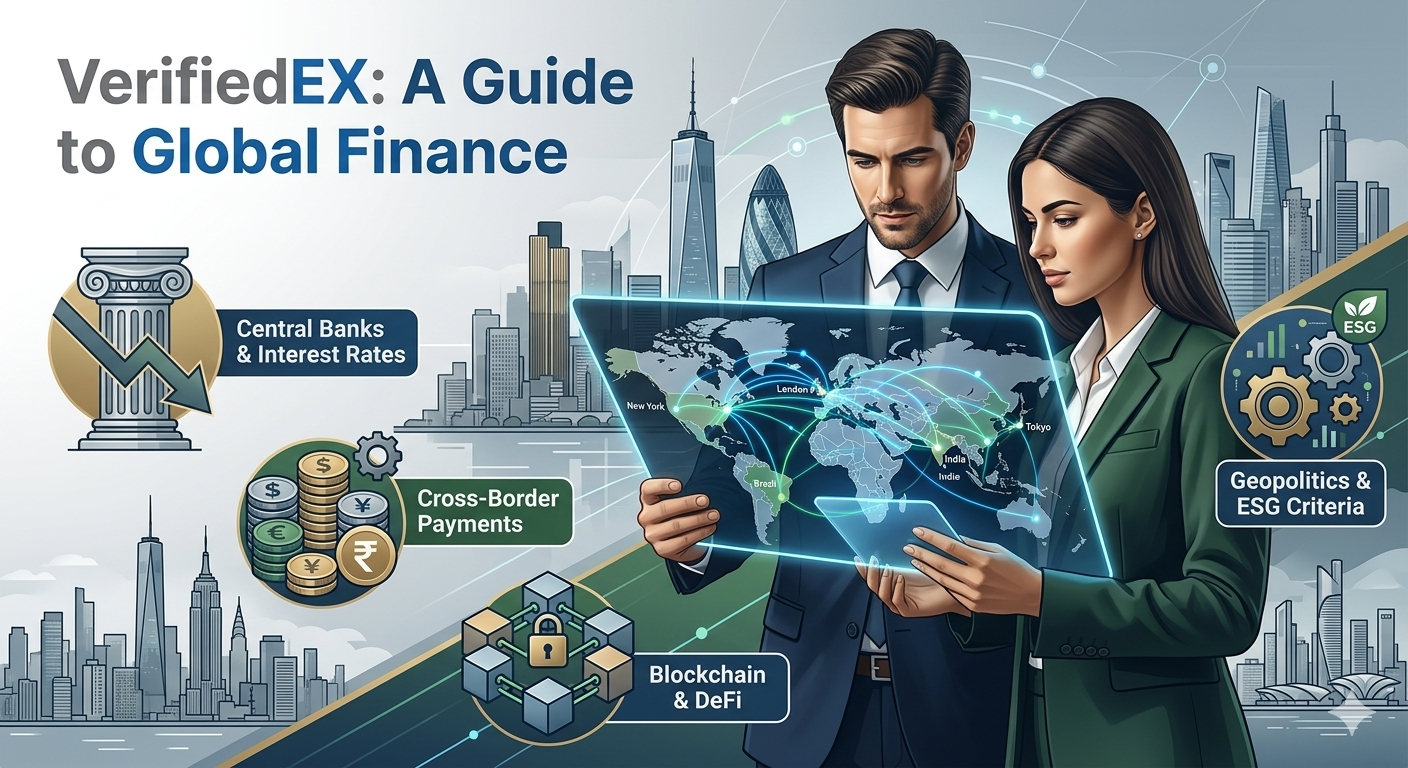

The landscape of global finance is no longer the exclusive playground of institutional titans and high-net-worth individuals hidden behind the mahogany doors of private banks. In the current era, the democratization of capital, fueled by technological integration and the breakdown of traditional borders, has opened a world of opportunity for the informed investor.
However, with opportunity comes complexity. Navigating international markets requires more than just a passing interest in the stock ticker; it demands a strategic understanding of how geopolitical shifts, currency fluctuations, and digital innovations interconnect. This guide, https://verifiedex.com/, serves as your comprehensive roadmap to mastering the principles of global finance in a rapidly evolving 21st-century economy.
The Foundation of Global Financial Systems
To understand global finance, one must first grasp the infrastructure that allows money to move across borders. At its core, global finance is the study of monetary interactions between two or more countries. This includes foreign direct investment (FDI), currency exchange rates, and the balance of payments.
The Role of Central Banks and Interest Rates
Central banks, such as the Federal Reserve (Fed) in the United States, the European Central Bank (ECB), and the Bank of Japan (BoJ), act as the architects of the financial environment. By adjusting interest rates, these institutions control the cost of borrowing and, by extension, the pace of economic growth.
For an investor, the “carry trade” is a fundamental concept born from these variations. It involves borrowing money in a currency with a low interest rate to invest in a currency with a higher return. While lucrative, it underscores the inherent risks of global interconnectedness—if the low-interest currency strengthens suddenly, the gains can evaporate instantly.
The Foreign Exchange (Forex) Market
The Forex market is the largest and most liquid financial market in the world, operating 24 hours a day, five days a week. Unlike a centralized stock exchange, Forex is a decentralized network of banks, brokers, and financial institutions.
-
Spot Markets: Immediate exchange of currencies.
-
Forward and Futures Markets: Contracts to exchange currencies at a specific price on a future date, used primarily for hedging risk.
Strategic Asset Allocation in an International Context
A common pitfall for many investors is “home country bias”—the tendency to invest the majority of one’s portfolio in domestic equities. While comfortable, this leaves a portfolio vulnerable to local economic downturns. Global finance offers the ultimate hedge through geographical diversification.
Developed vs. Emerging Markets
Investing globally requires a distinction between different tiers of economies:
-
Developed Markets (DM): Countries like the US, Canada, Germany, and Japan. They offer stability, high liquidity, and robust regulatory frameworks, but often feature slower growth rates.
-
Emerging Markets (EM): Nations like India, Brazil, and Vietnam. These regions often boast younger demographics and rapid industrialization, offering high growth potential but carrying higher political and volatility risks.
-
Frontier Markets: Less established than emerging markets, these are the “high-risk, high-reward” territories of the financial world, such as parts of Sub-Saharan Africa or Central Asia.
The Impact of Currency Risk
When you invest in a foreign stock, you are making two bets: one on the company’s performance and one on the currency. If you buy a German stock in Euros and the Euro weakens against your home currency, your total return may be negative even if the stock price goes up. Understanding “hedged” vs. “unhedged” investment vehicles is crucial for managing this layer of volatility.
The Digital Frontier: Fintech and Blockchain
We cannot discuss global finance today without addressing the digital revolution. Financial Technology (Fintech) has streamlined cross-border payments, reducing the “friction” that once made international trade expensive for individuals.
The Rise of Neobanks
Neobanks and digital-first platforms have bypassed the traditional SWIFT banking system’s delays. By providing multi-currency accounts and real-time exchange rates, they have empowered the “global citizen” to manage wealth across continents from a smartphone.
Blockchain and Decentralized Finance (DeFi)
Blockchain technology is moving beyond the speculative nature of cryptocurrencies into the realm of functional utility.
-
Stablecoins: Digital assets pegged to a fiat currency (like the USD) allow for near-instant global transfers without the volatility of Bitcoin.
-
Smart Contracts: These self-executing contracts with the terms directly written into code are beginning to automate complex international trade agreements, reducing the need for intermediaries.
Geopolitics: The Invisible Hand
In global finance, politics is not just background noise; it is a primary driver of market sentiment. Trade wars, sanctions, and diplomatic shifts can reconfigure supply chains overnight.
Globalization vs. Regionalization
For decades, the trend was toward total global integration. However, recent years have seen a shift toward “friend-shoring” or regionalization—where countries focus trade within blocks of allied nations. This shift affects where corporations build factories and which stock markets receive the most capital inflow.
ESG and Global Mandates
Environmental, Social, and Governance (ESG) criteria have become a global standard. European regulations often lead the way, but these mandates now dictate where institutional “big money” can be parked. For the sophisticated investor, aligning a portfolio with global sustainability trends is no longer just ethical—it’s a matter of risk management.
Risk Management: Protecting Your Global Wealth
High-level finance is as much about avoiding losses as it is about chasing gains. In a globalized system, a crisis in one region can trigger a “contagion” effect.
Hedging Strategies
To protect against the unpredictability of global markets, professionals use several tools:
-
Diversification: Spreading assets across different industries, countries, and asset classes (stocks, bonds, real estate, gold).
-
Options and Put Contracts: Buying insurance against a market drop.
-
Gold and Hard Assets: Historically, gold serves as the ultimate “safe haven” when global currencies are in turmoil.
Understanding Inflation and Deflation
Inflation is currently a global phenomenon, but it hits different regions with varying intensity. Understanding the “Real Interest Rate”—the nominal rate minus inflation—is essential. If your bank gives you 5% interest but inflation is 7%, you are effectively losing 2% of your purchasing power every year.
The Future of Global Finance
Looking toward the next decade, several themes will dominate the financial discourse:
-
AI in Algorithmic Trading: Artificial Intelligence is now capable of processing vast amounts of global data—from satellite imagery of shipping ports to sentiment analysis of social media—to make split-second investment decisions.
-
The Shift to the East: As GDP growth in Asia continues to outpace the West, the center of gravity for global finance is steadily moving toward hubs like Singapore, Hong Kong, and Mumbai.
-
CBDCs (Central Bank Digital Currencies): Governments are currently developing their own digital currencies, which could fundamentally change how international reserves are held and how taxes are collected.
Navigating the VerifiedEX Portal
To truly master these global strategies, having access to real-time data and institutional-grade analytics is essential. Our interactive platform provides the tools you need to track currency volatility, monitor emerging market trends, and execute trades with precision. If you are ready to transition from theory to practice and begin building your international portfolio with our expert-led resources, simply click here to access the premium dashboard. This portal offers a seamless interface designed for the modern investor who values both depth of information and ease of use in a fast-paced financial environment.
Conclusion: Developing a Global Mindset
Mastering global finance is not a destination, but a continuous process of learning and adaptation. The “VerifiedEX” approach emphasizes that the modern investor must be a polymath—part economist, part political scientist, and part technologist.
By diversifying geographically, embracing digital efficiency, and remaining vigilant about geopolitical shifts, you can move from being a passive participant in the economy to an active architect of your financial future. The world is smaller than ever, and for those who understand its financial pulse, the opportunities are boundless.