
The quality of a banking app directly impacts customer trust, engagement, and retention. In an industry where security breaches, poor user experience, or technical failures can have severe financial and reputational consequences, following established best practices is not optional. It is essential for delivering applications that customers rely on and regulators approve.
Banking apps operate in a uniquely challenging environment. They must balance stringent security requirements with seamless user experience, comply with complex regulations, integrate with legacy systems, and perform flawlessly under high transaction volumes. Achieving this balance requires disciplined engineering, thoughtful design, and continuous attention to quality throughout the development lifecycle.
This article outlines the best practices that separate successful banking apps from those that struggle with adoption, security issues, or operational problems. Whether you are building a new app or improving an existing one, these principles provide a roadmap for delivering excellence.
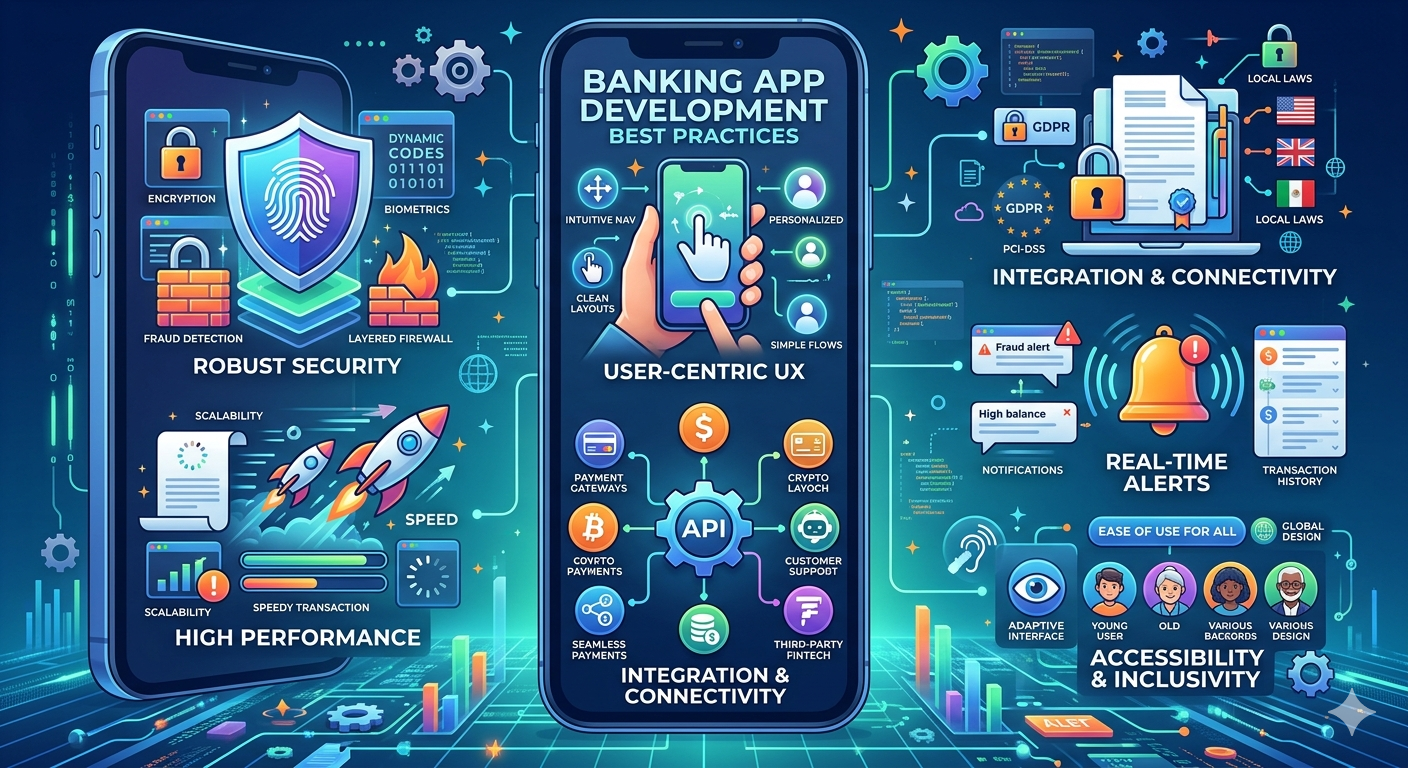
Prioritise security at every layer
Security is the foundation of any banking application. Customers entrust financial institutions with their most sensitive data, and any compromise can result in direct financial loss and irreparable damage to reputation.
Best practices for security include:
- Implement multi factor authentication: Require at least two forms of verification, combining biometrics, passwords, one time codes, or hardware tokens. This dramatically reduces the risk of unauthorised access.
- Use end to end encryption: All data transmitted between the app and backend systems must be encrypted using current standards such as TLS 1.3. Sensitive data stored on devices should also be encrypted.
- Apply the principle of least privilege: Grant users and system components only the minimum permissions necessary to perform their functions. This limits the potential damage from compromised accounts or components.
- Conduct regular security audits: Schedule penetration testing, code reviews, and vulnerability assessments throughout development and after launch. Address identified issues promptly.
- Implement fraud detection: Use behavioural analytics, device fingerprinting, and transaction monitoring to identify and prevent suspicious activity in real time.
- Plan for incident response: Establish clear procedures for detecting, containing, and recovering from security incidents. Regular drills ensure teams can respond effectively under pressure.
Security must be embedded in the architecture from the beginning rather than added as an afterthought.
Design for the user, not the system
Many banking apps fail because they reflect internal organisational structures rather than customer needs. User centred design puts the customer first.
Key design practices include:
- Simplify complex workflows: Break multi step processes such as loan applications or international transfers into clear, logical stages with progress indicators.
- Reduce cognitive load: Present only essential information on each screen. Use clear labels, familiar icons, and consistent patterns throughout the app.
- Provide contextual help: Offer tooltips, explanations, and support links where users might need guidance without cluttering the interface.
- Test with real users: Conduct usability testing throughout development with customers who represent your target audience. Observe where they struggle and iterate based on feedback.
- Ensure accessibility: Support screen readers, adjustable text sizes, high contrast modes, and voice commands. Accessibility benefits all users and is often a legal requirement.
- Optimise performance: Fast loading times and smooth interactions create a perception of quality and reliability. Aim for sub second response times for common actions.
Good design reduces support costs, increases engagement, and builds customer loyalty.
Build for scalability and reliability
Banking apps must handle traffic spikes during peak periods, maintain high availability, and process transactions accurately without fail.
Best practices for scalability and reliability include:
- Use cloud infrastructure: Cloud platforms provide elastic scaling, geographic distribution, and managed services that reduce operational complexity.
- Implement microservices architecture: Breaking functionality into independent services allows you to scale components individually and isolate failures.
- Design for failure: Assume that components will fail and build redundancy, fallback mechanisms, and graceful degradation into the system.
- Monitor proactively: Implement comprehensive monitoring and alerting for performance metrics, error rates, and system health. Detect and address issues before they impact customers.
- Load test regularly: Simulate peak traffic and stress conditions to identify bottlenecks and validate that the system can handle expected and unexpected loads.
- Plan for disaster recovery: Maintain backups, document recovery procedures, and test them regularly to ensure you can restore service quickly after major incidents.
Reliability builds trust and reduces the cost and disruption of outages.
Ensure regulatory compliance from the start
Financial services are heavily regulated, and non compliance can result in fines, legal action, and loss of operating licenses.
Compliance best practices include:
- Understand applicable regulations: Identify all regulations that apply to your jurisdiction and customer base, such as GDPR, PSD2, PCI DSS, and local banking laws.
- Build compliance into architecture: Design systems to support audit trails, data protection, customer consent management, and reporting requirements from the beginning.
- Implement strong customer authentication: Meet regulatory requirements for transaction authorisation and account access with appropriate authentication mechanisms.
- Maintain comprehensive documentation: Document data flows, security controls, compliance measures, and system changes to support audits and regulatory reviews.
- Engage compliance teams early: Involve legal and compliance experts throughout development to identify and address requirements before they become costly problems.
- Stay current with regulatory changes: Monitor evolving regulations and update systems proactively to maintain compliance.
Treating compliance as a core requirement rather than a checkbox exercise reduces risk and accelerates approvals.
Adopt continuous integration and delivery
Modern banking apps require frequent updates to add features, fix bugs, and address security vulnerabilities. Manual deployment processes are too slow and error prone.
Best practices for CI/CD include:
- Automate testing at all levels including unit tests, integration tests, and end to end tests
- Use version control for all code, configuration, and infrastructure definitions
- Implement automated build and deployment pipelines that run tests and deploy to staging environments
- Use feature flags to enable gradual rollout and quick rollback if issues arise
- Monitor deployments closely and establish clear rollback procedures
- Maintain separate environments for development, testing, staging, and production
Automation increases deployment frequency, reduces errors, and allows teams to respond quickly to issues.
Partner with experienced banking app development services
The best practices outlined above require expertise across multiple disciplines including mobile development, backend engineering, security, compliance, and financial services. Many organisations benefit from partnering with specialists who bring proven experience.
Experts in banking app development services can guide you through the entire process, from requirements definition to production deployment and ongoing optimisation. WislaCode Solutions focuses on NextGen fintech solutions development and helps organisations transform their digital landscape. The team develops multifunctional mobile and web applications that fast track businesses and redefine user experiences, with comprehensive full stack capabilities covering data storage, backend, middleware, frontend architecture, design, and development.
Banking app development best practices: delivering trusted financial applications
Following best practices in banking app development is essential for delivering applications that customers trust, regulators approve, and businesses benefit from. Security protects customer assets and data. User centred design creates intuitive experiences. Scalable architecture ensures reliability under load. Compliance prevents regulatory issues. Continuous delivery enables rapid improvement.
Each practice reinforces the others, creating a comprehensive approach to quality. When implemented consistently throughout the development lifecycle, these best practices result in banking apps that stand out in a competitive market and deliver lasting value to both customers and financial institutions in an increasingly digital banking landscape.