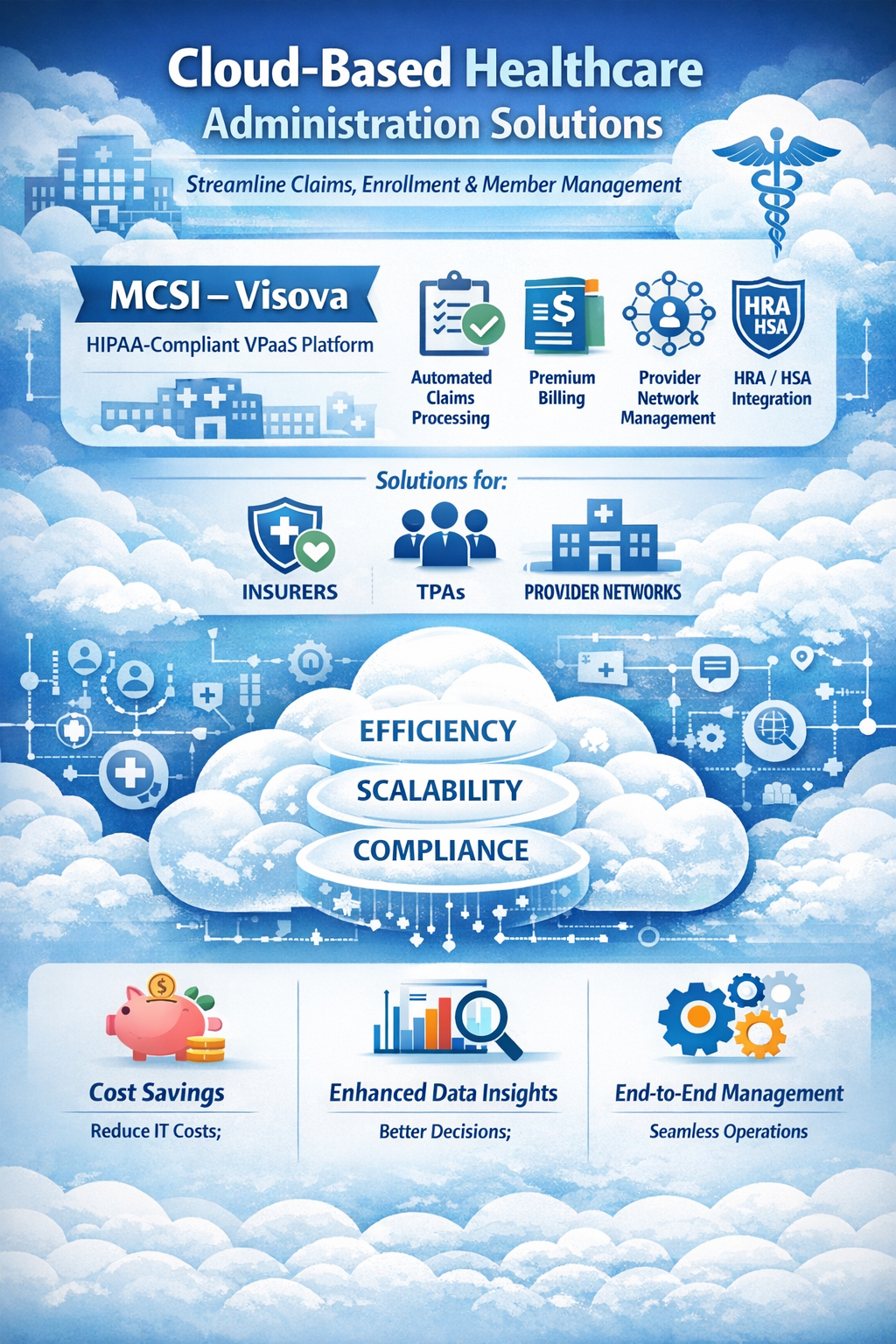

The healthcare industry is undergoing a rapid digital transformation, and cloud-based administration solutions are at the forefront of this shift. Organizations today require scalable, secure, and efficient systems to manage increasingly complex operations. One standout example is MCSI – Visova, a leader in delivering cloud-native solutions. Their advanced vpaas (Virtual Platform as a Service) offering provides a HIPAA-compliant environment for automated claims processing, enrollment, and member management. With capabilities such as premium billing, provider network management, capitation, and HRA/HSA integration, MCSI – Visova empowers insurers, third-party administrators (TPAs), and provider networks to streamline workflows, improve efficiency, and manage healthcare operations end-to-end.
The Growing Need for Cloud-Based Healthcare Administration
Healthcare administration has traditionally been burdened by manual processes, fragmented systems, and regulatory complexities. From handling claims to managing patient data and provider networks, organizations often struggle to maintain efficiency while ensuring compliance.
Cloud-based solutions address these challenges by offering:
- Centralized data management
- Real-time access to information
- Improved collaboration across stakeholders
- Enhanced security and compliance frameworks
By moving to the cloud, healthcare organizations can eliminate legacy inefficiencies and adopt a more agile, scalable approach to operations.
What is VPaaS in Healthcare?
Virtual Platform as a Service (VPaaS) is a cloud-based framework that enables healthcare organizations to build, deploy, and manage applications without the need for extensive on-premise infrastructure.
In the context of healthcare administration, VPaaS solutions provide:
- Automated claims adjudication and processing
- Member enrollment and lifecycle management
- Integrated billing systems
- Provider network management tools
- Financial models such as capitation
- Seamless integration with HRA (Health Reimbursement Arrangements) and HSA (Health Savings Accounts)
This comprehensive approach allows organizations to unify their administrative processes under one scalable platform.
Key Features of Cloud-Based Healthcare Administration Solutions
1. Automated Claims Processing
Cloud platforms significantly reduce the time and effort required to process claims. Automation minimizes errors, accelerates reimbursements, and improves overall accuracy.
2. Enrollment and Member Management
Managing member data becomes more efficient with centralized systems that provide real-time updates and easy access to information.
3. Premium Billing and Financial Integration
Integrated billing systems streamline premium collection, invoicing, and reconciliation, ensuring financial transparency and accuracy.
4. Provider Network Management
Healthcare organizations can efficiently manage provider contracts, credentialing, and performance tracking within a unified platform.
5. Compliance and Security
Cloud-based systems are designed to meet strict regulatory requirements such as HIPAA, ensuring data protection and privacy.
Benefits for Insurers, TPAs, and Provider Networks
Improved Efficiency
Automation and centralized workflows reduce administrative overhead and allow staff to focus on higher-value tasks.
Scalability
Cloud solutions can easily scale to accommodate growing membership, expanding provider networks, and increased transaction volumes.
Cost Savings
Eliminating on-premise infrastructure reduces IT costs, maintenance expenses, and resource allocation.
Enhanced Data Insights
Advanced analytics tools provide actionable insights, enabling better decision-making and improved patient outcomes.
End-to-End Management
From enrollment to claims processing and billing, cloud-based platforms offer a seamless, integrated experience.
Why Cloud Adoption is Critical for the Future
The healthcare landscape is becoming more complex, with increasing regulatory requirements, rising patient expectations, and the need for cost efficiency. Cloud-based administration solutions provide the flexibility and innovation required to meet these challenges.
Organizations that adopt these technologies gain a competitive edge by:
- Delivering faster, more accurate services
- Enhing member and provider satisfaction
- Reducing operational risks
- Staying compliant with evolving regulations
The Role of Innovation in Healthcare Administration
Innovative platforms like those offered by MCSI – Visova demonstrate how technology can transform healthcare administration. By leveraging cloud-native architectures and VPaaS models, organizations can move beyond traditional limitations and embrace a more efficient, connected ecosystem.
These solutions not only streamline operations but also enable organizations to adapt quickly to industry changes, ensuring long-term sustainability and growth.
Conclusion
Cloud-based healthcare administration solutions are no longer optional—they are essential for modern healthcare organizations seeking efficiency, scalability, and compliance. With advanced platforms like MCSI – Visova’s VPaaS, insurers, TPAs, and provider networks can automate complex processes, reduce costs, and deliver better outcomes.
As the industry continues to evolve, embracing cloud technology will be the key to staying competitive and providing high-quality, patient-centric services.