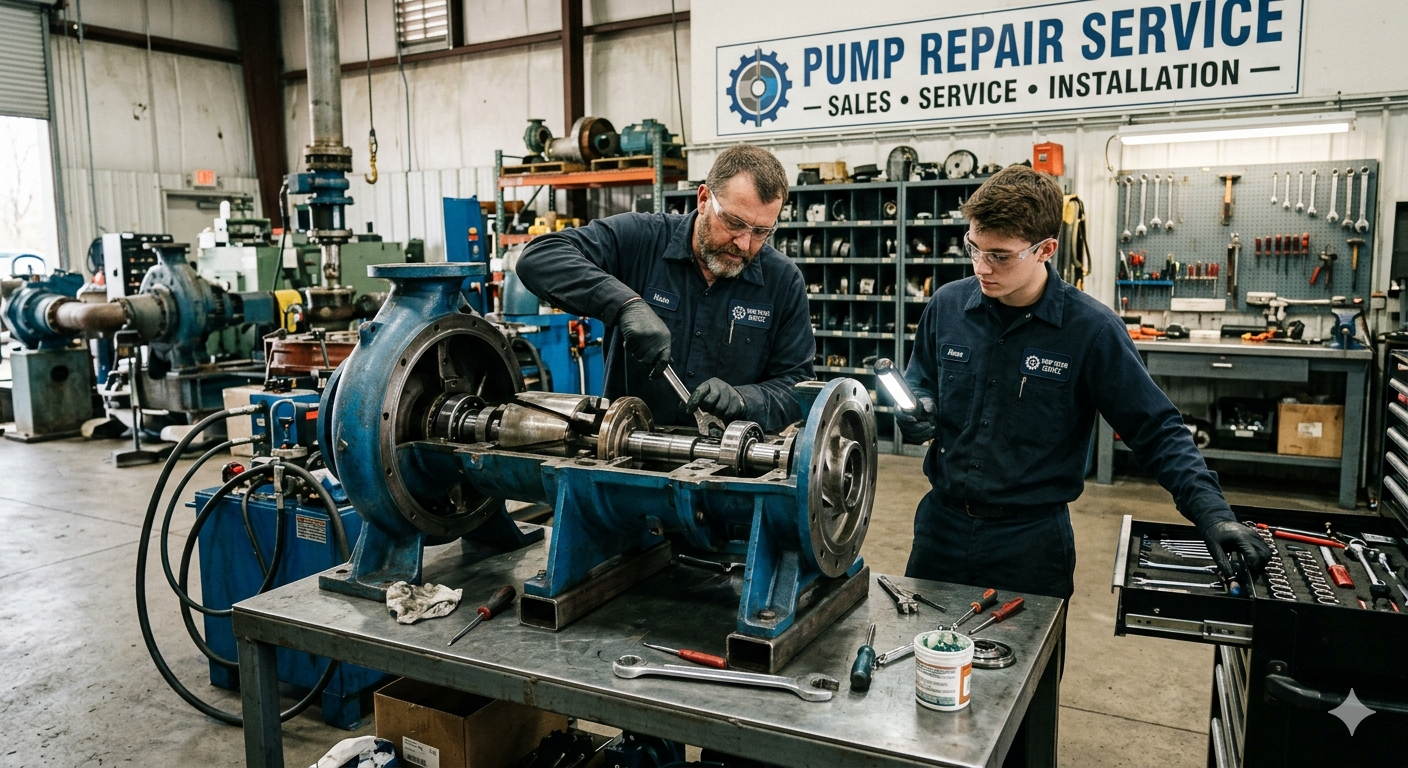

When a pump fails or begins showing signs of wear, the instinct is often to move quickly. Production schedules, irrigation cycles, HVAC systems, and fluid transfer operations don’t pause for equipment problems. That urgency, while understandable, can lead facility managers and procurement teams to hand off critical equipment without asking the questions that actually matter.
Pump repair is not a commodity. The quality of the work, the competence of the technician, the availability of parts, and the standards used during inspection all vary significantly from one provider to the next. A repair completed without proper diagnosis may restore short-term function but leave the root cause unaddressed, which tends to result in a faster return failure and higher cumulative costs over time.
This article is written for those who manage, maintain, or procure repair services for pumping equipment in industrial, agricultural, commercial, or infrastructure settings. The goal is to give you a structured set of questions that help you evaluate a provider before committing your equipment to their shop.
Why the Questions You Ask Before Repair Matter More Than Price
Most conversations about pump repair start with cost. That’s a reasonable place to begin, but price without context is a poor decision-making tool. A lower quote may reflect a narrower scope of work, the use of non-OEM components, or an inspection process that skips diagnostic steps. Understanding what a provider actually does — not just what they charge — is the foundation of a sound repair decision.
When evaluating a pump repair service, the questions you ask upfront tell you a great deal about how the provider operates. Do they ask about the application before quoting? Do they have experience with your specific pump type? Do they perform a teardown inspection before committing to a price? These are procedural signals that reflect whether a provider treats pump repair as a diagnostic discipline or a volume-driven transaction.
According to the International Organization for Standardization, maintenance processes that incorporate structured evaluation and documentation consistently produce more reliable equipment outcomes over time. That principle applies directly to how pump repair providers approach their work.
The Cost of Skipping Diligence Upfront
Sending equipment to a provider without vetting them creates real operational risk. If the repair fails prematurely because the root cause was misdiagnosed, you face not only a second repair cost but also the downtime associated with another removal, transport, and reinstallation cycle. In systems where the pump is load-bearing or mission-critical, that second failure may carry safety implications as well. Taking a few hours to ask the right questions before the first repair is far less disruptive than managing a second failure weeks later.
Question 1: Do You Specialize in My Type of Pump?
Pump technology is not uniform. Centrifugal pumps, piston pumps, vane pumps, gear pumps, and hydrostatic units each have distinct internal geometries, wear patterns, and failure modes. A shop that primarily services centrifugal pumps for municipal water systems may not have the tooling, training, or component inventory to properly rebuild a hydrostatic transmission pump used in heavy mobile equipment.
Why Specialization Affects Outcomes
Technicians who work regularly on a specific pump type develop diagnostic instincts that general repair shops simply don’t have. They recognize abnormal wear patterns quickly, they know which components are commonly undersized for certain applications, and they understand the performance tolerances that matter. Asking directly about specialization — and requesting examples of similar equipment they’ve serviced — gives you a reliable indicator of technical depth.
Question 2: What Does Your Inspection Process Look Like Before You Quote?
A reputable provider will not quote a firm price until they’ve inspected the pump. A quote given over the phone, based solely on a model number and a description of symptoms, is a rough estimate at best. Internal wear, seal degradation, shaft damage, and contamination are conditions that can only be assessed through physical teardown and measurement.
What a Thorough Inspection Should Include
A pre-repair inspection should involve full disassembly, cleaning, and component-by-component evaluation. The technician should be able to identify the primary failure cause, note any secondary damage, and document what replacement parts are needed and why. If a provider can’t describe their inspection process clearly, that’s a meaningful gap in their process.
Question 3: Will You Identify the Root Cause of the Failure?
Replacing worn or damaged components without understanding why they failed is a common shortcut in pump repair. If a seal failed because of excessive heat caused by a system pressure imbalance, replacing the seal without addressing the pressure issue will produce another seal failure in short order.
Root Cause Analysis as a Standard Practice
A provider that includes root cause analysis as part of their standard process is demonstrating a commitment to durable repairs rather than fast ones. Ask them directly: after inspection, will you tell me why this pump failed? If the answer is vague or conditional, consider what that suggests about the depth of their diagnostic work.
Question 4: Do You Use OEM or Aftermarket Parts, and How Do You Decide?
This is not a question with a single correct answer. OEM components are manufactured to the original design specifications and are generally the safest choice for applications where performance tolerances are tight. Aftermarket parts can be appropriate in certain contexts, particularly when the OEM part is discontinued or the application is less demanding. The issue is transparency.
Understanding the Implications of Parts Sourcing
A provider who uses aftermarket components without disclosing it — or who defaults to the cheapest available part without assessing fit-for-purpose — introduces risk into the repair. Ask specifically what parts will be used, whether they’re OEM or aftermarket, and what the provider’s rationale is. A good provider will have a clear, reasoned answer.
Question 5: What Are Your Quality Control Steps After Reassembly?
Reassembly is not the end of the repair process. Before a pump is returned to service, it should be tested under conditions that reflect its actual operating environment. Pressure testing, flow testing, and leak checks are standard expectations for a competent repair operation.
Testing as a Reliability Gate
Post-assembly testing exists to catch problems before reinstallation, not after. A pump that passes pressure and flow tests in the shop is significantly less likely to fail immediately upon return to service. Asking about quality control steps also reveals whether the provider has the test equipment and procedures to back up their work.
Question 6: Can You Provide Documentation of the Work Completed?
Repair documentation is a practical asset for any maintenance program. It records what was found, what was replaced, and what the pump’s measured condition was before and after repair. That information supports future maintenance decisions, helps identify recurring failure patterns, and provides a record in the event of a warranty dispute or insurance claim.
Documentation and Long-Term Equipment Management
Facilities running multiple pumps benefit considerably from maintaining repair histories on each unit. If a provider cannot or will not supply written documentation of their work, that gap limits your ability to manage your equipment intelligently over time. It also raises questions about their internal process discipline.
Question 7: What Is Your Turnaround Time, and How Do You Handle Delays?
Turnaround time matters because downtime has a cost. But a provider who commits to an unrealistic schedule and then fails to meet it creates more disruption than one who gives an honest, longer estimate upfront. The more important question is how they communicate when parts are delayed or when the inspection reveals work beyond the original scope.
Communication Standards as a Reliability Indicator
Providers who communicate proactively when schedules change are generally more operationally organized than those who go silent and deliver late. Ask about their notification process and what triggers an update call or message to the customer. The answer tells you how much they’ve thought about the customer’s operational needs, not just the repair itself.
Question 8: Do You Offer Any Warranty on Parts and Labor?
A warranty is a provider’s expression of confidence in their own work. The scope and duration vary, but some form of coverage on both parts and labor is a reasonable expectation from any serious pump repair operation. A provider who offers no warranty is placing all post-repair risk on the equipment owner.
Reading the Terms of a Repair Warranty
Ask specifically what the warranty covers, how long it lasts, and what conditions would void it. Some warranties exclude failures caused by improper installation or system conditions outside the provider’s control — those are reasonable exclusions. Broad exclusions that effectively cover nothing are not.
Question 9: Have You Worked on Equipment in My Industry Before?
Application context shapes how a pump is used, what stress it experiences, and what failure modes are most common. A pump used in a food processing facility operates under different constraints than one used in a hydraulic system on a construction machine or a chemical transfer line in a manufacturing plant. Industry experience means the provider understands not just the pump itself but the environment it works in.
Why Application Knowledge Changes the Repair Approach
A technician familiar with your industry will ask different diagnostic questions, pay attention to different wear indicators, and make different recommendations about replacement intervals. That contextual awareness leads to repairs that hold up better in real operating conditions.
Question 10: What Happens If the Repaired Pump Fails Again Shortly After Return?
This question is not pessimistic — it’s practical. Understanding the provider’s process for handling post-repair failures tells you about their accountability and their confidence in their own work. Do they diagnose the cause of the second failure before doing additional work? Do they charge full price again, or does the warranty apply? Do they take responsibility if the root cause was misdiagnosed?
Accountability as a Signal of Operational Integrity
A provider who has a clear, fair process for handling post-repair issues is one who has thought seriously about quality. That clarity is worth asking about before the first repair, not after a second failure has already disrupted your operations.
Making a More Informed Decision Before Equipment Leaves Your Facility
Pump repair decisions are often made under pressure — a system is down, production is waiting, and the impulse is to find a provider and move quickly. But the information gathered before a pump leaves your facility has a direct bearing on what comes back and how long it holds up in service.
The ten questions above are not a checklist for eliminating all risk. They are a framework for separating providers who approach repair work as a technical discipline from those who treat it as a transaction. A provider who can answer these questions clearly, specifically, and without hesitation is one who has built their process around quality rather than volume.
Taking the time to ask them is not a bureaucratic exercise. It’s a straightforward way to protect your equipment, your budget, and the systems that depend on that equipment functioning reliably. The questions cost nothing to ask. The answers tell you nearly everything you need to know.