
Municipal waste collection and private hauling operations depend on consistency above almost everything else. Residents expect pickup on a schedule. Commercial accounts require reliable service windows. Regulators track disposal compliance. When a fleet misses a route, arrives late, or fails to document a service event, the consequences move quickly from operational to contractual.
Over the past decade, fleet managers in waste hauling have adopted GPS tracking tools at a reasonable pace. Most of these tools were built for delivery fleets, field service vehicles, or long-haul trucking. They handle basic location tracking and reporting well enough for those use cases. But garbage truck operations carry a different set of requirements — and those differences matter more than most fleet technology vendors acknowledge.
This is not an argument against GPS technology. It is an argument for understanding why applying general-purpose tracking tools to a specialized operation consistently produces gaps that compound over time.
The Core Problem With General-Purpose GPS in Waste Collection
Most GPS platforms were designed around the logic of point-to-point movement: a vehicle leaves a depot, travels to a destination, and returns. That model works for courier services, sales teams, and service technicians. Garbage truck operations do not follow that logic. A single collection route involves hundreds of individual stops, repeated service events at fixed intervals, weight-based compliance documentation, and route sequencing that must account for access constraints, bin placement, and resident behavior.
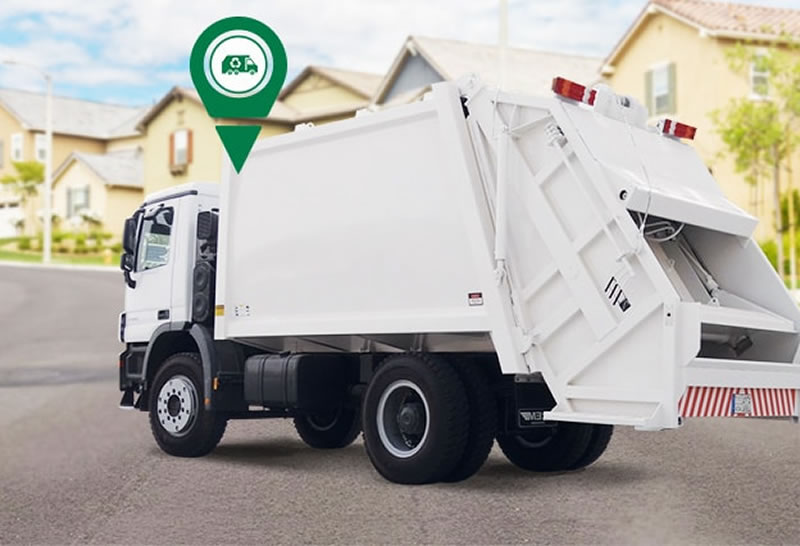
The way gps integration for garbage truck fleets platforms functions in purpose-built systems reflects this fundamental difference — stop-level data, service verification, and route adherence are treated as core features rather than add-ons bolted onto a general tracking interface.
Generic tools capture vehicle position. They log speed, idling, and geofence crossings. But they have no framework for distinguishing between a truck that serviced a stop and one that simply passed it. That distinction, seemingly minor, becomes a serious operational gap when a customer disputes a missed pickup or a supervisor needs to reconstruct what happened on a route two days ago.
Stop-Level Visibility Is Not the Same as Route Tracking
Fleet managers sometimes assume that if they can see where a truck is at all times, they have sufficient operational visibility. Route tracking confirms that a vehicle traveled a certain path at a certain time. Stop-level visibility confirms that a specific service event occurred at a specific location. These are different things, and conflating them creates accountability problems.
When a commercial customer calls to dispute a missed pickup, a timestamp showing that a truck was in the general vicinity is not adequate documentation. Purpose-built platforms record when a vehicle stopped, for how long, and whether the stop matches a scheduled service point. That granularity is what separates defensible service records from vague positional data.
Route Optimization Built for Linear Delivery Fails in Cyclical Collection
Routing logic in general GPS platforms typically optimizes for travel time and distance between destinations. For a fleet making deliveries, that approach produces reasonable efficiency. For a waste collection operation, it produces routes that look efficient on paper but create real problems in the field.
Garbage truck routing must account for factors that have nothing to do with driving distance. Trucks fill up and require disposal runs mid-route. Access to certain streets is restricted by time of day or vehicle weight. Some containers require specific equipment or cannot be serviced in a certain sequence because of neighboring access constraints. Generic routing tools do not carry this operational context by default.
Disposal Facility Trips Break Standard Routing Assumptions
A delivery driver completes a route when all packages are dropped. A garbage truck completes a route only after the vehicle has been emptied — sometimes multiple times within a single shift. Each disposal run to a transfer station or landfill represents an unplanned interruption in the route sequence if the system is not designed to expect it.
Purpose-built platforms treat disposal trips as predictable events that need to be scheduled into route logic, not logged as anomalies. They account for estimated load accumulation, flag disposal run timing, and allow supervisors to track whether a truck returned to its route at the correct point after emptying. Generic tools record the departure and return but cannot interpret what happened or whether it was operationally appropriate.
Compliance Documentation Requires More Than Location History
Waste haulers operate under regulatory requirements that vary by region and contract type. Landfill weight compliance, hazardous material handling records, and service verification for municipal contracts all require documentation that goes beyond where a truck was and when. The Resource Conservation and Recovery Act establishes federal standards for waste handling that operators must be prepared to document on request.
Generic GPS platforms are not built to produce compliance-grade records. They generate location history and event logs, which can be exported and interpreted manually. But the work of connecting GPS data to service verification, weight ticket records, and container-level documentation falls entirely on the fleet manager or dispatcher when the system was not designed to hold that structure.
Manual Documentation Gaps Accumulate Silently
When fleet staff must pull data from a GPS system and reconcile it with paper records or a separate dispatch log, errors accumulate gradually. A stop that was serviced but logged incorrectly, a disposal run that was not properly timestamped, a route deviation that was never explained — each of these gaps is small on its own. Over a quarter, they represent a fragile audit trail.
Purpose-built gps integration for garbage truck fleets platforms closes this gap by treating compliance documentation as part of the operational workflow, not a separate reporting task. Service records are created at the point of event, tied to route data automatically, and available for review without manual reconstruction.
Driver Behavior Monitoring Needs Industry-Specific Context
Most GPS platforms include driver behavior scoring. They track hard braking, rapid acceleration, speeding, and idling time. For highway and urban delivery fleets, these metrics provide useful safety and efficiency signals. For garbage truck drivers, the same raw metrics produce misleading scores that erode trust between supervisors and drivers.
Garbage trucks operate at low speeds, stop constantly, and idle frequently while equipment is engaged. A driver collecting bins on a residential street will register high idling time and frequent braking events as a routine part of the job. Applying a standard driver scoring model to that behavior generates poor scores for drivers who are doing everything correctly.
Misaligned Scoring Creates Operational and Cultural Problems
When drivers are scored poorly under a system that does not account for the nature of their work, the consequences extend beyond inaccurate data. Drivers who feel unfairly evaluated become less receptive to feedback on behaviors that actually matter — equipment misuse, unsafe approach angles near pedestrians, or failure to follow stop-arm protocols on routes near schools. A scoring system that does not distinguish routine collection activity from genuine risk events loses its ability to improve the behaviors that actually affect safety.
Purpose-built gps integration for garbage truck fleets platforms applies behavior thresholds that are calibrated to collection work. Idling during an active lift cycle is not flagged as inefficiency. Braking patterns at residential stops are interpreted against the expected service cadence rather than compared to highway driving norms.
Integration With Dispatch and Customer Systems Requires a Shared Data Model
Waste collection fleets operate within a broader service ecosystem. Dispatchers manage route assignments and exception handling. Customer service teams respond to missed pickup reports. Billing systems require service confirmation before invoicing. Each of these functions depends on accurate, timely data from the field.
Generic GPS platforms generate data that was not designed to move through a waste operations workflow. Connecting location events to service tickets, route completion records, and billing triggers requires custom integration work that is expensive to build and fragile to maintain.
Data Silos Create Response Delays That Affect Service Quality
When a customer reports a missed pickup and the dispatcher must check three separate systems to verify what happened on that route, response time increases. The driver has moved on, the route supervisor is managing another issue, and the window for a same-day resolution closes. By the time the data is assembled, the best outcome is a credit or a rescheduled pickup — neither of which satisfies an account that expected service on a specific day.
Purpose-built platforms share a data model across dispatch, service verification, and customer-facing functions. A missed stop generates an alert that reaches the right person before the truck leaves the area, not after the customer calls. That structural difference, more than any individual feature, is what separates a platform built for waste operations from a general tracking tool applied to one.
Across the industry, fleets that have moved from generic GPS tools to purpose-built gps integration for garbage truck fleets platforms consistently report the same improvements: fewer disputed service events, stronger compliance documentation, and dispatch workflows that reflect what is actually happening in the field rather than what a general-purpose dashboard can approximate.
Closing Thoughts
The case against generic GPS tools in waste collection is not technical. It is operational. The features that make general platforms useful for other fleets — route optimization, driver scoring, location history — are present in purpose-built systems too. The difference is that purpose-built platforms apply those features within a framework that understands how garbage trucks actually work.
Waste haulers deal with high stop volume, cyclical routes, mid-shift disposal runs, compliance obligations, and customer service accountability that few other fleet types share. A platform designed for that environment treats each of these factors as a core design requirement. A generic platform treats them as edge cases to be managed around.
Fleet managers evaluating GPS tools should not ask whether a platform offers tracking and reporting. Most do. The better question is whether the platform was built to understand the operational model of waste collection — and whether it can produce the documentation, integration, and service verification that the work actually demands. That distinction is where most generic tools fall short, and where purpose-built platforms begin to earn their place in an operation.