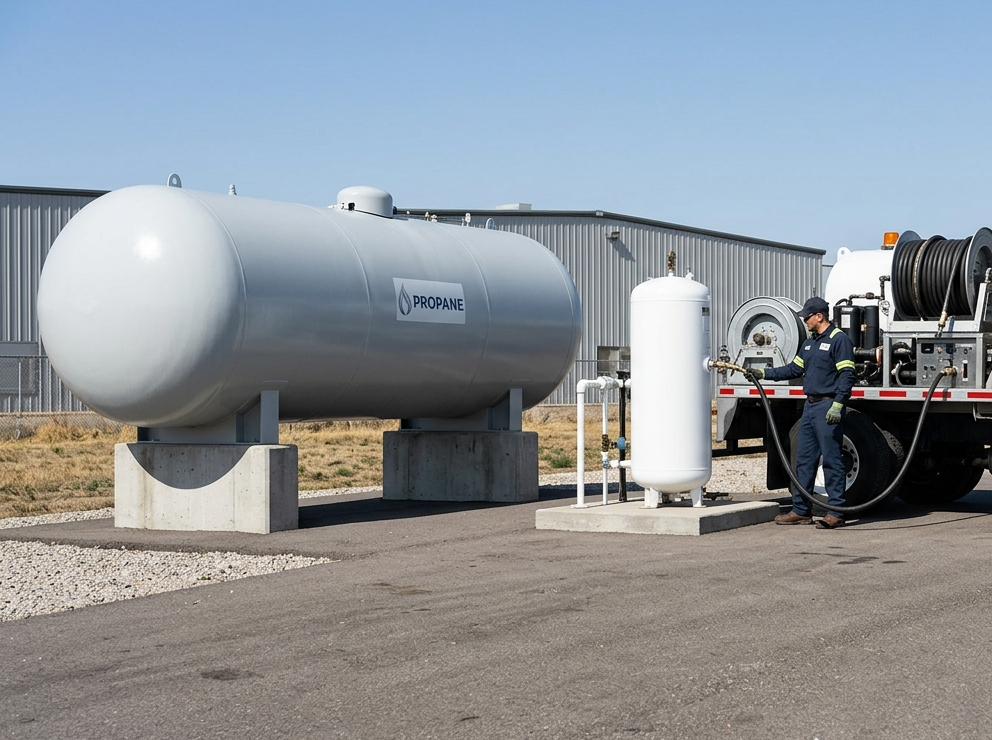

Propane remains one of the most widely used energy sources in commercial operations across the United States. From agricultural facilities and food processing plants to fleet fueling stations and industrial manufacturing sites, the demand for reliable propane supply and storage infrastructure continues to grow. What often goes unrecognized, however, is how much operational risk is embedded in the management of that infrastructure.
As federal and state regulatory frameworks tighten heading into 2025, many facility managers and operations teams are reassessing how they handle inspection cycles, tank integrity, documentation, and service provider qualifications. The pressures are not abstract. A non-compliant tank or a missed service interval can lead to facility shutdowns, insurance complications, or incidents that carry serious liability. Understanding what a complete compliance and safety framework looks like — and where gaps typically form — is essential for any commercial operation that relies on propane storage and distribution.
What Commercial Propane Tank Services Actually Cover
The term commercial propane tank services refers to a broad range of technical, regulatory, and maintenance activities that support the safe storage and distribution of propane in non-residential settings. This includes initial tank installation and commissioning, routine inspections, pressure testing, valve and fitting maintenance, interior lining assessments, leak detection, and decommissioning procedures. Each of these activities is tied to specific compliance requirements that vary depending on tank size, location, and the nature of the facility it serves.
For facility operators, understanding the full scope of what these services cover is foundational. Many organizations manage inspection and maintenance reactively, responding only when a visible problem emerges. This approach introduces compounding risk. Tanks that appear structurally sound on the outside may have internal corrosion, coating degradation, or sediment accumulation that compromises both safety and fuel quality. Providers offering structured commercial propane tank services typically work across this full spectrum — not just responding to failures but establishing a documented service baseline that supports regulatory compliance and long-term asset reliability.
The Distinction Between Routine Maintenance and Compliance-Driven Service
Routine maintenance keeps equipment functional. Compliance-driven service keeps a facility legally operational. These objectives often overlap, but they are not the same thing. Regulatory bodies including the National Fire Protection Association, state fire marshals, and occupational safety agencies each have specific requirements for how commercial propane systems must be inspected, documented, and serviced. Meeting those requirements means maintaining records, using qualified service personnel, and adhering to inspection intervals defined in code — not simply checking whether equipment appears to be working.
Facilities that blur the line between these two categories often discover the distinction the hard way during an audit or an insurance renewal review. A maintenance log that shows routine upkeep but lacks the specific documentation required for regulatory compliance can result in citations, required remediation work, and operational delays that far outweigh the cost of structured compliance management from the outset.
Key Regulatory Standards Governing Propane Tank Operations in 2025
Commercial propane storage and handling in the United States is governed by a layered framework of federal standards, state-level fire codes, and industry-specific safety regulations. The primary federal reference is NFPA 58, the Liquefied Petroleum Gas Code, which establishes minimum requirements for the design, installation, and maintenance of propane systems. Many states adopt NFPA 58 directly, while others implement modified versions or supplement it with additional requirements specific to their jurisdictions.
In parallel, facilities subject to Occupational Safety and Health Administration oversight must comply with OSHA’s standards related to flammable liquids and hazardous materials storage. For operations involved in propane transportation or transfer, U.S. Department of Transportation regulations apply as well. Understanding which standards apply to a given facility — and how they interact — is one of the first steps in building a compliant operations framework.
State-Level Variation and Its Operational Impact
One of the most consistently overlooked aspects of propane compliance is the degree to which requirements differ across state lines. A multi-site operation that manages propane storage in several states may find that inspection intervals, documentation formats, required permits, and contractor qualification standards differ meaningfully from one jurisdiction to the next. Treating compliance as a uniform national standard — when it is not — creates gaps that surface only during regulatory review or after an incident.
Facilities operating across multiple states benefit from maintaining jurisdiction-specific compliance documentation for each site rather than relying on a generalized maintenance record. This requires coordination between site managers and qualified service providers who understand regional code requirements, not just national minimums.
Tank Integrity and Interior Condition Assessment
The structural integrity of a commercial propane tank is evaluated through a combination of visual inspection, pressure testing, and internal assessment. While external condition is observable, the internal environment of a propane tank is subject to conditions that accelerate degradation in ways that exterior inspection alone cannot detect. Moisture contamination, sediment accumulation, and coating breakdown along interior surfaces can compromise fuel quality, reduce tank capacity, and in more serious cases, affect structural reliability.
Internal tank lining is a critical component of long-term tank integrity. Protective coatings applied to interior surfaces resist corrosion and prevent contamination of stored fuel. Over time, these coatings degrade through exposure, temperature cycling, and chemical interaction with propane and residual moisture. When lining failure occurs, it typically progresses gradually — making scheduled assessment essential rather than optional.
When Relining Becomes a Compliance Requirement
In regulated environments, tank relining is not simply a maintenance option — it can become a requirement when internal inspection reveals coating degradation beyond acceptable thresholds. Regulatory guidance related to tank condition standards, such as those documented through the NFPA 58 standard, provides the framework for evaluating whether a tank remains fit for continued service or requires remediation before it can be returned to operation.
For facility managers, the practical implication is that internal inspection findings must be documented and acted upon within defined timeframes. Deferring relining or remediation work after a deficiency has been identified creates a compliance exposure that extends beyond the physical condition of the tank itself. It signals to regulators and insurers that identified risks were not addressed in a timely manner — a distinction that carries weight during audits and incident investigations.
Documentation Requirements and Record-Keeping Practices
Compliance with propane tank regulations is only as strong as the documentation that supports it. Inspection records, service logs, pressure test results, contractor credentials, and corrective action reports all form part of the compliance record that regulators and insurance providers may request at any point. Facilities that maintain this documentation in a structured, accessible format are consistently better positioned during audits and claim reviews than those that rely on informal records or incomplete service histories.
Effective documentation practices for commercial propane tank operations should capture the date and nature of each service event, the qualifications of the service provider, the findings at the time of inspection, and any corrective actions taken or scheduled. This record should be retained for the duration required by applicable regulations in the relevant jurisdiction, which often extends several years beyond the service date.
The Role of Third-Party Inspection and Certification
For many commercial facilities, regulatory compliance requires that certain inspections be conducted by certified third-party inspectors rather than internal maintenance staff. This requirement exists because independent inspection provides an unbiased assessment of tank condition and operational compliance — particularly important when equipment has been in service for extended periods or when a facility is undergoing a change of use or ownership.
Third-party inspection reports carry regulatory weight that internal assessments do not. Facilities that invest in qualified third-party inspection at appropriate intervals build a compliance record that is significantly more defensible in regulatory and legal contexts than one based solely on internal maintenance logs.
Contractor Qualification and Service Provider Selection
The selection of a service provider for commercial propane tank services is a decision that directly affects both operational reliability and regulatory standing. Not all contractors offering propane-related services hold the credentials, equipment, or procedural experience necessary to support compliance-level work. Facilities that select providers based primarily on cost or proximity — without verifying qualifications — take on significant risk.
Qualified service providers should be able to demonstrate familiarity with applicable federal and state codes, hold relevant certifications for the work being performed, carry appropriate liability coverage, and provide documentation of completed work in a format that meets regulatory requirements. For specialized tasks such as interior inspection, relining, or decommissioning, additional technical credentials and equipment are required that not all general contractors possess.
Evaluating a Provider’s Compliance Capability
Beyond certifications, a service provider’s compliance capability is reflected in how they approach documentation, communication, and follow-up. A provider that delivers a clear written inspection report, identifies deficiencies with specificity, and outlines a timeline for corrective action demonstrates operational maturity. One that provides only verbal summaries or general maintenance notes without reference to applicable standards creates a documentation gap that the facility owner ultimately bears responsibility for.
Facilities sourcing providers for ongoing commercial propane tank services should treat the qualification review as part of their vendor management process — not a one-time check at initial engagement. Credentials, insurance coverage, and service scope should be reviewed at regular intervals to ensure continued alignment with regulatory requirements.
Preparing for 2025: A Practical Compliance Checklist
As regulatory expectations continue to evolve and enforcement activity increases across several states, facilities managing commercial propane systems should use the transition into 2025 as a structured opportunity to assess their current compliance posture. The following checklist covers the core areas that should be reviewed and confirmed on an annual basis.
- Confirm that all applicable federal and state regulations have been reviewed for changes or updates that took effect in the preceding year, and that internal procedures reflect current requirements.
- Verify that inspection intervals for all tanks are documented, scheduled in advance, and aligned with the specific code requirements for each jurisdiction where tanks are located.
- Review the service history for each tank to identify any deferred maintenance, unresolved inspection findings, or gaps in documentation that require corrective action before year-end.
- Assess the current condition of interior tank linings through qualified inspection, and schedule relining or remediation for any tank showing degradation beyond acceptable thresholds.
- Confirm that all service providers currently engaged hold appropriate certifications, carry current insurance, and are able to produce documentation that meets regulatory standards.
- Ensure that all required permits, registrations, and third-party inspection certifications are current for each facility and that renewal timelines are tracked proactively.
- Review emergency response procedures and leak detection protocols to confirm they reflect current site conditions and are understood by all relevant personnel.
Conclusion
Managing commercial propane tank systems to a compliance standard is not a one-time project. It is an ongoing operational discipline that requires consistent documentation, qualified service providers, and a clear understanding of the regulatory framework that governs each facility. The risks associated with deferred maintenance or incomplete compliance records are not theoretical — they surface in audits, insurance reviews, and in the operational disruptions that follow when tanks fail to meet the conditions required for continued service.
Heading into 2025, the facilities that are best positioned are those that have already built structured service programs around their propane infrastructure — programs that align with applicable standards, produce defensible documentation, and engage qualified contractors for every phase of inspection, maintenance, and remediation work. For operations that have not yet established that foundation, the transition into the new year presents a practical opportunity to do so before gaps become liabilities.