
Unpaved roads make up a significant portion of the road network across rural counties, industrial facilities, mining operations, and agricultural properties in the United States. While these roads serve essential functions — connecting farms to markets, moving equipment across job sites, and providing access to remote infrastructure — they come with a persistent operational challenge: dust. In dry seasons or high-traffic conditions, dust on unpaved surfaces is not a minor inconvenience. It reduces driver visibility, degrades road surfaces over time, contributes to equipment wear, and creates measurable health and environmental concerns for those who live or work nearby.
Road managers and facility operators have used various methods to address this over the decades, from water trucks to petroleum-based products to mechanical compaction. But across a wide range of unpaved road types and climates, calcium chloride — applied in liquid form — has remained one of the most consistently reliable chemical treatments available. Understanding how and why it works, and what it takes to apply it correctly, is essential for anyone responsible for managing unpaved road conditions at scale.
What Liquid Calcium Chloride Does to an Unpaved Road Surface
Using liquid calcium chloride for dust control works through a specific physical mechanism that sets it apart from simple water application or surface sealing. Calcium chloride is hygroscopic, meaning it draws moisture from the surrounding air and retains it within the road surface material. Rather than creating a hard crust that can crack and separate, it maintains a state of slight but consistent dampness in the top layer of the road, which keeps fine particles bound together and less likely to become airborne under traffic or wind.
This is why liquid calcium chloride for dust control performs differently from water alone. Water evaporates, often within hours in warm or dry conditions. Calcium chloride continues to pull ambient humidity back into the treated surface, extending its effectiveness well beyond what water application can achieve. The result is a surface that remains stable and cohesive even during periods of low rainfall or sustained heat.
How the Hygroscopic Effect Interacts with Road Base Materials
The effectiveness of calcium chloride is not uniform across all unpaved surfaces. It performs best when applied to roads that contain a meaningful proportion of fine-grained particles — silts, clays, or fine gravels — because these materials provide a matrix that retains the chemical and holds moisture around each particle. On roads that are predominantly coarse aggregate with little fines content, the chemical has less material to bind and may deliver more limited results.
Dust control is especially important in locations that experience temporary increases in traffic, making Event Traffic Management an important consideration for organizers seeking to maintain safe access routes and a positive visitor experience at outdoor venues.
This means that before treating any road, a basic understanding of its composition matters. Roads with a reasonable fines content respond well and tend to hold treatments longer. Roads that have been significantly eroded or stripped of their fine material through traffic or rain runoff may need surface preparation or aggregate blending before treatment will perform reliably. Applying calcium chloride to a poorly composed surface wastes product and leads to inconsistent outcomes that can frustrate road managers and undermine confidence in the method itself.
The Role of Humidity and Climate on Treatment Longevity
Because the mechanism depends on moisture absorption from the air, climate plays a meaningful role in how long treatments remain active. In humid regions — parts of the Southeast, the Great Lakes area, or the Pacific Northwest — the hygroscopic effect is reinforced naturally by the surrounding environment, which means treatments tend to last longer between reapplications. In arid climates like the Southwest or high-altitude mountain regions, ambient humidity is lower, and the chemical has less to work with, which can shorten the effective period of a single application.
This is not a limitation unique to calcium chloride, but it does mean that application schedules should be developed with local climate in mind rather than using a fixed calendar interval. Facilities or counties that treat roads in consistently dry regions may need to reapply on a shorter cycle, while those in more humid areas can often extend intervals without significant loss of performance. Observing surface conditions over time — particularly after hot, dry stretches — provides better guidance than any standardized schedule.
Preparing the Road Before Application
Surface preparation is one of the most frequently overlooked steps in effective dust control programs. Road managers focused on cost and time often want to treat roads as quickly as possible, but applying product to a surface that is rutted, washboarded, or compacted unevenly means the treatment will distribute inconsistently and the road will continue to degrade beneath it. Proper preparation sets the foundation for the chemical to work as intended.
Grading and Surface Correction
A road should be graded to restore its crown and remove surface irregularities before any liquid application takes place. A well-crowned road sheds water to the sides rather than allowing it to pool and penetrate unevenly. When calcium chloride is applied to a flat or poorly crowned surface, rain events can move the chemical laterally or cause pooling that concentrates the product in low spots and leaves high areas undertreated. Re-establishing the crown before treatment ensures more uniform distribution and protects the investment in product and labor.
Grading also helps surface moisture reach a consistent level across the road. An application to a surface that is partly dry and partly saturated from a recent rain will not penetrate evenly. Timing the application when surface conditions are reasonably consistent across the width and length of the treated section leads to more predictable and lasting results.
Compaction After Application
Some road programs apply a light layer of new aggregate before treatment and then roll the surface after the liquid has been applied. This combination helps the calcium chloride penetrate the full depth of the active surface layer rather than sitting only at the top. The compaction step also reduces air voids that would otherwise allow fine particles to loosen and migrate upward under traffic load. Where compaction equipment is available, incorporating a rolling pass after application meaningfully improves surface performance and extends the interval before retreatment is needed.
Application Methods and Timing Considerations
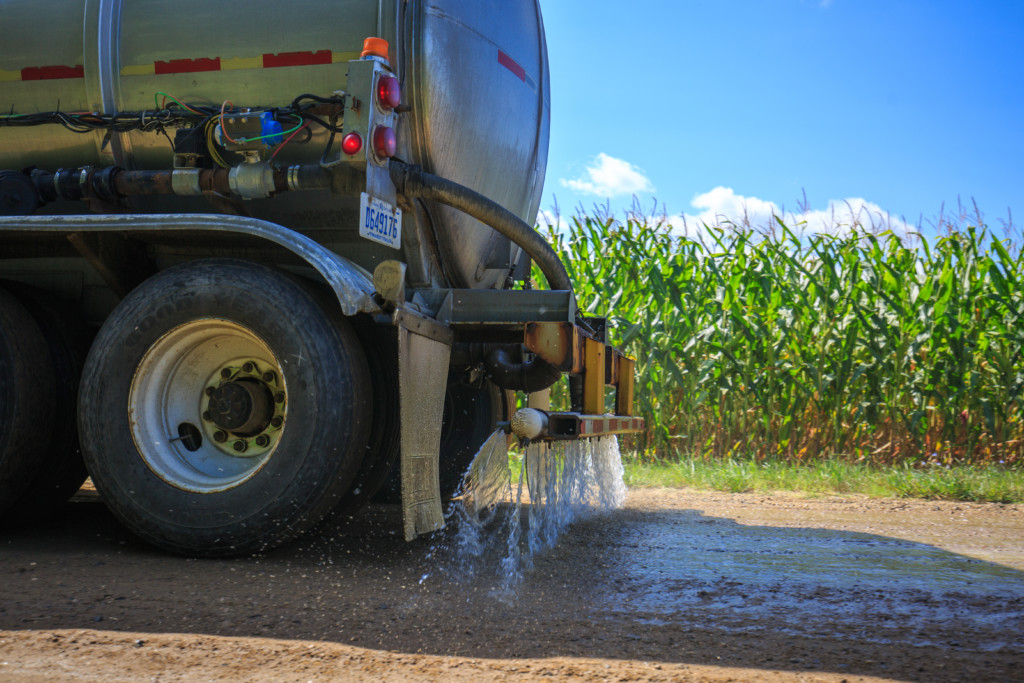
Liquid calcium chloride is most commonly applied using a tank truck equipped with a rear-mounted spray bar that distributes the product evenly across the road width. The spray bar should be calibrated so that the application is uniform — no streaking, no gaps, and no excessive pooling along the edges. Operators who apply the product too quickly or without consistent speed will see uneven results that show up within weeks as patchy dust control performance.
Timing Relative to Weather and Traffic
Applications should be timed to avoid periods of heavy rain immediately following treatment. While calcium chloride resists being washed away more effectively than some other chemical treatments, heavy rainfall shortly after application can displace product from the surface before it has had time to bind with the road material. A window of dry weather following application — even a relatively short one — allows the chemical to integrate with the surface layer and begin drawing ambient moisture before the first significant rain event arrives.
Traffic management during and immediately after application also matters. Keeping vehicles off the treated surface for a short period allows the product to begin settling into the road matrix rather than being disturbed by tire action before it has had a chance to work. On active haul roads or high-traffic access routes where stopping traffic entirely is not practical, applying in sections and managing flow in one direction at a time can minimize the disruption effect while still allowing treatment to proceed.
Environmental and Safety Considerations
Calcium chloride is a salt compound, and like any road treatment material, it should be applied with attention to its potential effects on adjacent land and water. According to the United States Environmental Protection Agency, road runoff from treated surfaces can carry dissolved salts into drainage channels, roadside vegetation areas, and nearby water bodies. The risk is generally proportional to the concentration applied and the proximity to sensitive areas. Roads adjacent to wetlands, streams, or areas with shallow groundwater warrant particular attention during planning and application.
Protecting Vegetation and Drainage Zones
Calibrating application rates carefully and avoiding excessive product near the road edges reduces the likelihood of salt stress affecting roadside vegetation. Many road programs that have used calcium chloride responsibly over multiple seasons report minimal vegetation impact when the product is applied within appropriate rates and roadway limits. The goal is to treat the road surface, not the surrounding soil, and consistent operator training reinforces this distinction in practice.
Drainage infrastructure should also be inspected periodically on roads that receive regular chemical treatment. Salt accumulation in drainage channels over time can affect the chemistry of downstream water if allowed to concentrate. Routine maintenance that keeps drainage open and flowing reduces this risk significantly.
Building a Repeatable Dust Control Program
One-time applications of calcium chloride provide temporary improvement, but the real operational benefit comes from treating roads on a structured seasonal schedule. Most effective programs begin with a primary application at the start of the dry season, followed by one or more maintenance applications based on observed surface conditions and traffic levels. Roads carrying heavier or faster-moving traffic will require more frequent attention than lightly used access lanes, and the schedule should reflect that difference.
Keeping records of application dates, rates, and surface conditions before and after treatment gives road managers the information they need to refine the program over time. A program that is evaluated and adjusted based on actual field observations will consistently outperform one that runs on a fixed schedule without feedback. The investment in documentation pays back in reduced product waste, fewer unexpected surface failures, and more reliable road conditions across the treatment season.
Conclusion
Managing dust on unpaved roads is a practical, ongoing responsibility — not a one-time fix. Liquid calcium chloride remains one of the most effective and widely used chemical treatments available for this purpose because its mechanism of action addresses the root cause of dust generation rather than simply masking it temporarily. When applied to a properly prepared surface, at the right time, and followed by appropriate compaction and maintenance, it delivers road conditions that are safer, more stable, and easier to manage over a full season.
The key for any facility, county road department, or site manager is to approach the process methodically: understand the road’s composition, prepare the surface correctly, time the application with weather and traffic in mind, and build in a maintenance schedule that reflects real-world conditions. Dust control is not a product decision alone — it is a program decision. When the full process is followed with care and consistency, liquid calcium chloride performs reliably across a wide range of road types, climates, and operational settings throughout the United States.