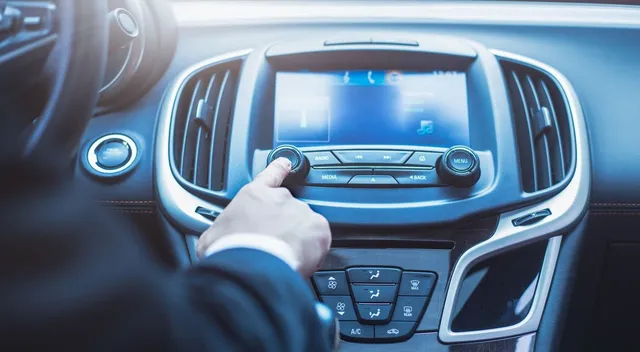

The head unit is the part of a car audio system people notice first and think about least. It controls the sound, the navigation, the phone connection, and in many modern vehicles, the reversing camera and climate control settings as well. Choosing one is not simply a matter of picking the largest screen in the shop. A unit that suits one vehicle may not physically fit another, and features that matter to one driver are irrelevant to the next.
Start With What Physically Fits
Before considering features, establish what the vehicle can actually accept.
Head unit sizes are not arbitrary. They follow standardised dimensions, with single-DIN and double-DIN being the two common aftermarket sizes.
A single-DIN unit measures approximately 180mm wide and 50mm tall. A double-DIN unit is the same width but twice the height, at approximately 100mm, which is common for larger touchscreen models.
Many vehicles also need a fascia kit to fill the surrounding dashboard opening, and some newer cars with fully integrated dash displays cannot take an aftermarket unit at all without specialised adapters.
Checking this first prevents the most common and most frustrating outcome: buying a unit that will not go in.
Consider a Floating Screen if Space Is Limited
Vehicles with only a single-DIN opening are not restricted to small screens.
Floating or tablet-style units mount a large display in front of the dashboard while the body of the unit sits in the smaller opening behind it. This gives drivers of older or smaller vehicles access to full touchscreen functionality.
The main consideration is how the larger screen will look and integrate with the dashboard, which can vary between vehicles.
Decide Between Wired and Wireless CarPlay
Many modern touchscreen head units support Apple CarPlay and Android Auto, but the exact smartphone features vary between models. Not all of them support wireless connectivity.
With wireless, the phone stays in your pocket, connects on its own, and comes in handy for the drive to the shops. Wired requires the phone to be connected by cable, but it charges the phone while you drive, and it doesn’t drop out on longer trips.
Many units offer both. If wireless matters to you, confirm it before purchase. It is one of the most commonly assumed features and one that not all units include.
Check Which Factory Features You Want to Keep
This is the question most buyers overlook.
Steering wheel controls, reversing cameras, parking sensor alerts, factory amplifiers, and in some vehicles the climate display all run through the original head unit.
Retaining them generally requires an interface module matched to the vehicle, and sometimes more than one. The head unit alone will not do it.
Discussing this with a car audio specialist before buying is worthwhile, because the interface required may influence which head units are suitable in the first place.
Look Past the Power Figures
Car head units advertise impressive numbers, most commonly something like 50 watts by four channels. That is peak power, not continuous power.
Actual continuous (RMS) output is typically much lower than the advertised peak figure, often around 14-22 watts per channel depending on the head unit. It is enough to drive factory speakers comfortably and not much more.
If better sound and future upgrades are the goal, pay attention to the number and configuration of the pre-outs. RCA pre-outs allow you to connect external amplifiers, while additional outputs can make it easier to build a more advanced system with separate front, rear and subwoofer channels.
Think About Cameras and Future Additions
A head unit is easier to choose when you know what else might be connected to it.
Many aftermarket head units include a reversing-camera input, but camera compatibility and integration can vary between models and vehicles. Front camera inputs, dash camera integration, and additional video inputs are not always included. Neither are digital signal processing features such as time alignment and multi-band equalisation, which matter if a full system upgrade is planned.
Buying a unit with slightly more capability than you currently need is usually cheaper than replacing it in two years.
Set a Budget That Includes Installation
The price on the box is part of the cost, not all of it.
A complete installation may also require a wiring harness, a fascia kit, a steering wheel control interface, an aerial adapter, and labour. On some vehicles, these components cost more than the unit itself.
Asking for an installed price rather than a product price gives you a figure you can actually compare between suppliers.
Conclusion
A car head unit is a long-term investment, so it is worth taking the time to choose one that suits your vehicle and your needs. Remember, the right head unit is the one that fits your vehicle, not the one with the biggest screen. The one that keeps the features you actually use, not the ones that just fill the brochure. The one that supports the way you actually use your phone, and leaves room for whatever you add next.
So while you’re at it, put these questions to someone who knows the specific vehicle. It’s the difference between a unit that happened to be on the shelf and one you’ll still be happy with in five years.