
Planning an event involves hundreds of decisions. The venue matters. The lighting matters. The sound system matters. The visual experience matters just as much. One of the first questions event planners often encounter is what is uhd vs hd, especially when comparing displays, projectors, LED walls, and presentation screens. Understanding the difference helps event teams choose equipment that fits the venue, audience, content, and production goals.
A screen is not simply a screen. Display technology affects how attendees experience presentations, videos, product demonstrations, speakers, graphics, and live feeds. The right setup makes content easy to see and understand. The wrong setup can make even excellent content look flat, blurry, or difficult to read.
Why Display Quality Matters at Events
Visual content is now a central part of event production.
Corporate conferences use presentation decks and branded graphics. Product launches rely on high-resolution product imagery. Trade shows use video walls to attract attention. Concerts use large displays to keep audiences connected to the stage.
The audience may be sitting several hundred feet away from the main screen. They still need to see the content clearly.
Good visual production keeps the audience focused on the message.
Poor visual production creates distractions.
A presentation with tiny text becomes difficult to follow. A low-resolution video becomes noticeably soft when displayed on a large screen. A camera feed can lose detail when the signal or display system cannot support the required resolution.
That is why event planners should consider display specifications during the planning stage rather than treating them as an equipment detail.
Start With the Venue
The venue should influence your display strategy.
A small meeting room has different requirements than a convention center ballroom. A theater has different viewing conditions than an outdoor festival. A large exhibition hall may require multiple displays instead of one central screen.
Start by looking at the size, layout, seating arrangement, and viewing distance.
Ask a few basic questions:
- How large is the room?
- How many people will attend?
- How far will the audience sit from the screen?
- Will attendees sit directly in front of the display or at wide angles?
- Is the room bright or dark?
- Will there be natural light?
- Does the audience need to read small text?
- Will the display show live video?
- Will multiple screens be used?
These questions help determine the type of display and resolution needed.
HD vs. UHD: Why Resolution Matters
HD typically refers to high-definition video formats such as 1280 × 720 or 1920 × 1080 pixels.
UHD, or Ultra High Definition, commonly refers to a resolution of 3840 × 2160 pixels.
That difference is significant.
A 1080p HD image contains about 2.1 million pixels. A 3840 × 2160 UHD image contains about 8.3 million pixels.
More pixels can provide more visible detail.
This becomes particularly important when the image is displayed on a large screen. A small HD monitor may look perfectly sharp at a normal viewing distance. The same resolution can look less detailed when stretched across a massive display.
Screen size and viewing distance should always be considered alongside resolution.
Resolution alone does not determine whether an event display will look good.
Think About the Content
The type of content being displayed should influence your equipment choices.
A speaker presentation with large text and simple graphics may not require the same specifications as a high-resolution product video.
Consider these common event applications.
Presentations
Corporate presentations often contain:
- Text
- Charts
- Graphs
- Logos
- Photographs
- Videos
- Animated transitions
Text readability is especially important.
A presentation can contain excellent information and still fail visually if attendees cannot read the slides.
Use large fonts and strong contrast. Keep important information away from the edges of the screen. Test the actual presentation from the back of the room before the event begins.
Product Demonstrations
Product launches benefit from detailed imagery.
A cosmetics company may want attendees to see packaging details. A technology company may display close-up product footage. An automotive brand may use large visuals to highlight design features.
Higher-resolution displays can make detailed product imagery more effective, particularly on large screens.
Live Camera Feeds
Live camera feeds create another consideration.
The production team needs to capture the image, process the signal, transmit it, and display it. Every part of that chain matters.
A UHD display cannot automatically turn an HD camera feed into true UHD content.
The camera, switcher, processor, cables, converters, transmission system, and display all need to work together.
This is why event production should be treated as an integrated system rather than a collection of individual pieces of equipment.
Consider Brightness and Ambient Light
Resolution gets plenty of attention, but brightness is also important.
A high-resolution screen can still be difficult to see in a bright room.
Large windows, overhead lighting, stage lighting, and outdoor sunlight can affect visibility. Event teams should evaluate the lighting conditions before selecting a display.
The goal is not simply to choose the highest resolution available. The goal is to create a clear image under the actual conditions of the event.
An indoor ballroom with controlled lighting may have very different requirements from an outdoor event held during the afternoon.
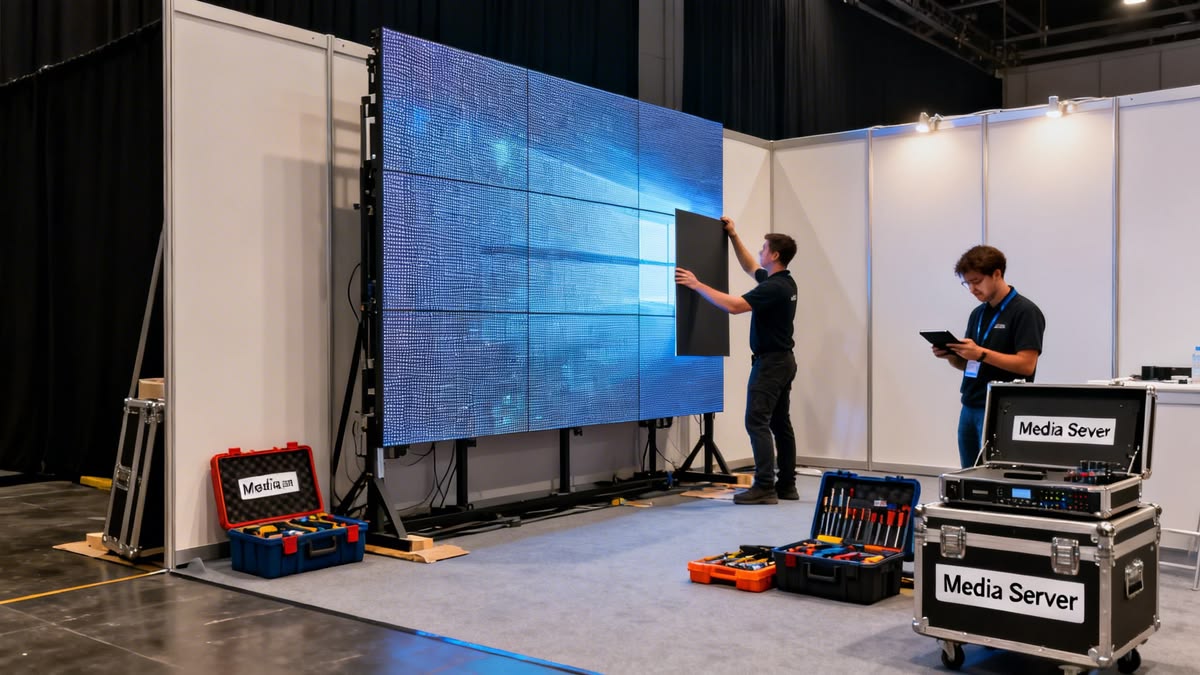
LED Walls vs. Projectors
Event planners often choose between LED walls and projection systems.
Both can work well. The right option depends on the event.
LED Walls
LED walls use individual light-emitting diodes to create the displayed image.
They can produce bright, vibrant visuals and work well for large stages, concerts, conferences, and branded environments.
LED walls are particularly useful when brightness is a major concern.
They can also create large, seamless visual surfaces without the same projection limitations associated with ambient light.
Projectors
Projectors remain useful for many event environments.
They can support large images and flexible screen sizes. They are common in conference rooms, meeting spaces, theaters, and presentation environments.
Projection does require more attention to screen placement, projector brightness, throw distance, ambient light, and image alignment.
The room itself can determine whether projection is practical.
Do Not Ignore Viewing Distance
Viewing distance is one of the most important parts of display planning.
Imagine a conference with 500 attendees. The people sitting near the front may see every detail. The people at the back have a different experience.
A screen should be large enough for the entire audience.
This is especially important when presentations contain text.
A useful test is simple: sit in the last audience row and look at the actual presentation content.
Can you read the headline?
Can you distinguish the chart?
Can you see the speaker’s face on the camera feed?
Can you recognize important product details?
If the answer is no, the production team needs to adjust the display, content, seating, or all three.
Think About Aspect Ratio
Most modern HD and UHD content uses a 16:9 aspect ratio.
This format is common for presentations, video, streaming, and modern displays.
However, events sometimes use unusual screen configurations.
A stage might include:
- One central screen
- Two side screens
- A wide LED wall
- Multiple vertical displays
- A panoramic background
- Creative projection surfaces
Content must be designed for the actual screen configuration.
Stretching a standard presentation across an unusual display can distort images. Leaving large unused areas can also reduce the visual impact.
Content and display design should be planned together.
Bandwidth Matters for Live Streaming
Resolution affects more than the screen.
It also affects your media files and network requirements.
Higher-resolution video generally requires more data than lower-resolution video. Live streaming therefore requires careful planning around available bandwidth, encoding, transmission, and platform requirements.
HD can be practical when bandwidth is limited.
UHD can be useful when the production environment supports the additional data requirements and the visual improvement justifies the added complexity.
For a live event, stability matters.
A flawless HD stream is more useful than an unreliable high-resolution stream that constantly buffers or drops frames.
Consider the Entire Signal Chain
One common event production mistake is focusing on the display while ignoring everything connected to it.
A typical video signal may travel through several components:
Camera → switcher → processor → distribution system → display
Every component needs to support the required format.
Suppose a production team uses a UHD display but captures content with an HD camera. The display can show the signal, but the original content remains HD.
The same principle applies to presentation computers and playback systems.
Your weakest major component can limit the final visual result.
This is why technical planning should happen before equipment is ordered or rented.
Test Everything Before the Event
A technical rehearsal is one of the easiest ways to prevent visual problems.
Do not wait until attendees enter the room.
Test the actual equipment.
Check:
- Resolution
- Aspect ratio
- Brightness
- Color
- Camera feeds
- Presentation playback
- Video playback
- Audio-video synchronization
- Screen alignment
- Signal switching
- Backup sources
- Cable connections
- Content from different computers
Run the same type of content that will appear during the event.
A static logo may look perfect during testing. A fast-moving video can reveal completely different problems.
Build a Backup Plan
Professional event production always benefits from redundancy.
Technology can fail.
A presentation computer can freeze. A cable can stop working. A signal processor can malfunction. A camera can lose connection.
The production team should know what happens next.
Keep backup content available. Have spare cables and adapters. Maintain backup playback sources when practical. Make sure operators know how to switch to a secondary source.
A backup plan protects the attendee experience when something goes wrong.
The audience does not need to know about every technical problem happening backstage.
Budget for the Entire Production
Display costs are only one part of the budget.
You may also need:
- Video processors
- Signal converters
- Switchers
- Cameras
- Lenses
- Playback computers
- Distribution equipment
- Rigging
- Technicians
- Cabling
- Power distribution
- On-site support
A higher-resolution display can also require supporting hardware capable of handling the signal.
This is why comparing two screens based only on rental price can be misleading.
Compare the complete production system, not just the display.
Match the Technology to the Audience
Every event has a different audience.
A small internal meeting may prioritize efficiency and simplicity. A national conference may require a more elaborate production system. A product launch may depend heavily on visual impact. A trade show may need displays that remain bright under challenging lighting.
The audience determines what details matter.
A technical conference may rely on charts and data. A fashion event may focus on color and imagery. A shareholder meeting may prioritize presentations and speaker visibility.
There is no single display setup that works for every event.
The Goal Is Better Communication
Technology should support the event message.
That is the most important consideration.
A giant screen is not automatically better. UHD is not automatically necessary. HD is not automatically outdated.
The right technology is the technology that allows the audience to see and understand the content clearly within the venue and production environment.
Start with the event objective.
Then consider the venue.
Next, evaluate the audience and viewing distance.
After that, choose the appropriate display type, resolution, brightness, signal infrastructure, and supporting equipment.
This approach creates a more reliable production plan.
Final Thoughts
Choosing event display technology requires more than comparing HD and UHD specifications. Resolution is only one part of the visual experience. Screen size, viewing distance, brightness, content quality, signal processing, bandwidth, and venue conditions all affect the final result.
HD remains useful for many applications. It can provide clear visuals while keeping equipment and bandwidth requirements manageable. UHD provides significantly more pixels and can deliver greater detail, particularly on larger displays and with high-resolution content.
The best event production strategy begins with the audience.
What do they need to see?
Where will they be sitting?
What content will they watch?
What conditions will the production team face?
Answer those questions first. Then build the technology around them.
When the display, content, production equipment, and venue work together, technology becomes more than a backdrop. It becomes part of the event experience.