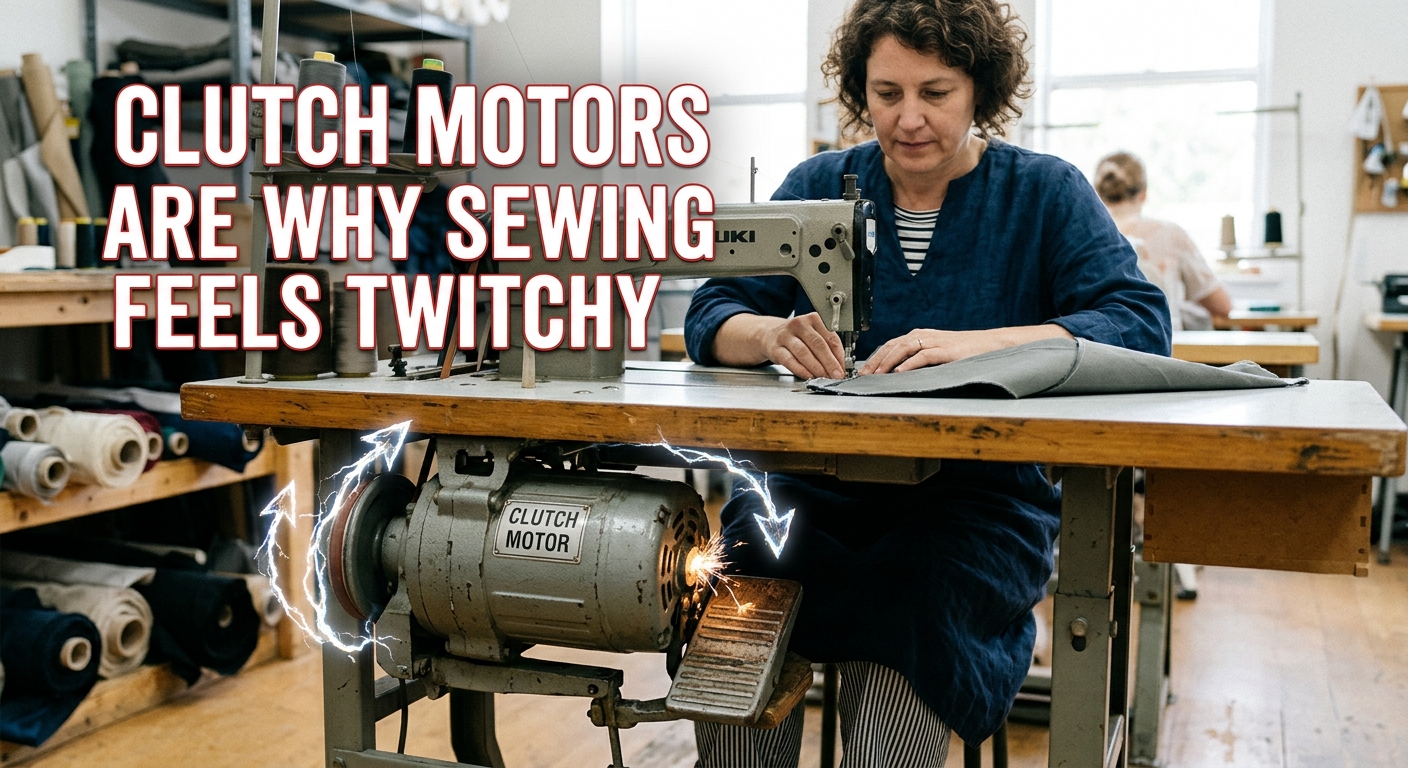

Someone learning on an industrial machine gets told to feather the pedal. They feather it, nothing happens, they push slightly harder, and the machine takes off at a speed nobody wanted. The needle goes where it likes, the stitch line wanders, and the lesson is that industrial machines are hard to control.
They are not. The motor is.
A traditional clutch motor runs continuously whenever the machine is switched on, and the pedal engages a friction plate to transfer that spinning to the machine. There is no proportional relationship between pedal travel and machine speed. There is a dead zone, then engagement, then speed.
What Changes With A Servo
A servo motor only turns when the pedal asks it to, and it turns at the speed the pedal specifies.
The pedal becomes proportional. A small movement produces slow rotation, a larger one produces more, and the relationship holds throughout the range. That is the entire difference in control terms, and it is substantial.
At the low end it means genuine stitch-by-stitch work. Turning a corner, negotiating a thick seam junction, or placing the last few stitches before a stop become controlled operations rather than bursts of speed interrupted by stopping.
For leather that matters more than for cloth. Every needle hole in leather is permanent. A stitch placed wrong cannot be unpicked and redone without a visible line of holes remaining, so the ability to place each one deliberately is not a refinement, it is the difference between a repairable mistake and a ruined panel.
The Brushless Distinction
Servo motors come in brushed and brushless forms, and the difference shows up in maintenance and in longevity.
Brushed motors use carbon brushes to transfer current to the rotating armature. Those brushes wear, they generate dust, and they eventually need replacing.
A brushless servo motor switches electronically instead, with no physical contact to wear. That removes a consumable, removes the dust, and removes a periodic maintenance task. It also generally runs cooler and quieter, since there is no friction at the commutator.
For a workshop running long hours the maintenance difference accumulates. For a small operation it mostly means the motor is something that gets installed and then ignored.
Noise And The Room
The clutch motor runs constantly. In a room with several machines that is a continuous mechanical drone from the moment the shop opens until it closes, regardless of whether anyone is sewing.
A servo is silent at rest. The only noise is the machine itself when it runs.
In a small workshop, a studio attached to a home, or a shared space, that is a genuine quality-of-life change and occasionally a permission-to-operate one. In a production room with a dozen machines the cumulative reduction is noticeable to everyone in it.
The power consumption follows the same logic. A motor that only runs when sewing uses considerably less energy than one that spins all day.
Speed Limiting Is The Underrated Feature
Most servo controllers allow a maximum speed to be set, capping how fast the machine can go regardless of how hard the pedal is pushed.
This is the feature that transforms training. A new operator on a capped machine cannot accelerate into a mistake, which means they can concentrate on feeding the work and watching the seam rather than on restraining the pedal.
It also suits particular operations. Heavy leather, thick seam junctions, and detailed work all benefit from a ceiling well below the machine’s capability, and setting that once is more reliable than asking the operator to maintain restraint.
For a shop where one machine is used for several different jobs, adjusting the cap by task is quicker than adapting technique.
Needle Positioning And Programmable Functions
Many servo controllers offer needle positioning, stopping the needle consistently up or down when the pedal is released.
Needle-down stops are the useful setting for pivoting. The needle stays in the work, the presser foot lifts, the piece rotates around the needle, and the seam continues without a break in the stitch line. Doing that with a clutch motor means hand-wheeling to position, every time.
Needle-up stops suit removing work cleanly.
Some controllers add automatic backtacking, thread trimming, and foot lift depending on the machine and the control head fitted. Those are useful in production and largely irrelevant in a one-person shop, and paying for them when they will not be used is a common overspend.
Fitting One To An Existing Machine
Servo motors are usually a direct replacement for a clutch motor on a standard industrial table, using the same mounting holes.
The practical points are pulley size and belt length. Motor pulley diameter determines the speed range at the machine, and changing motors often means changing the belt. Getting this wrong produces a machine that either cannot reach useful speed or cannot run slowly enough to be controlled.
The pedal linkage transfers to the new motor, though the geometry may need adjustment since servo pedals have different travel characteristics.
Power requirements should be checked against the supply, particularly for larger motors.
None of this is complicated, and most of it is easier than the clutch motor being removed.
Sizing Against The Machine
Motor power needs matching to the work, and bigger is not automatically better.
A lightweight machine sewing garment leather does not need a large motor, and an oversized one is harder to control at low speed because the low end of its range is less finely divided.
A heavy walking-foot machine punching through multiple layers of firm leather needs torque at low speed, which is where an underpowered servo struggles. The failure mode is stalling or hesitation at the point of highest resistance, which is exactly the seam junction where control matters most.
Low-speed torque is the specification to look at rather than headline speed, because most leather work happens well below any machine’s maximum.
Four Things To Check Before Buying
The machine’s power requirement, sized for the heaviest work it actually does.
Pulley and belt compatibility, since these are frequently overlooked and always needed.
Whether needle positioning is included, as it is the feature most likely to be missed if absent.
Which programmable functions are genuinely useful for the work, rather than which are available.
The motor is the cheapest component in an industrial sewing setup and the one that most determines how the machine feels to use.