


Sports betting usually involves predicting which team or player will win. However, arbitrage betting offers an alternative approach based on mathematical calculations rather than sporting forecasts.
The strategy involves identifying differences between bookmakers’ odds and using them to cover all possible outcomes of a particular event.
When suitable prices are available, bettors can construct combinations that produce a positive theoretical return regardless of the final result.
Let’s examine this method using a practical example.
Understanding the basics of arbitrage
Bookmakers independently calculate odds, which means their prices for identical events do not always match.
Occasionally, the differences become large enough to create an arbitrage opportunity, commonly known as a surebet.
Sports featuring two possible match winners, such as tennis and volleyball, are particularly convenient for illustrating the principle.
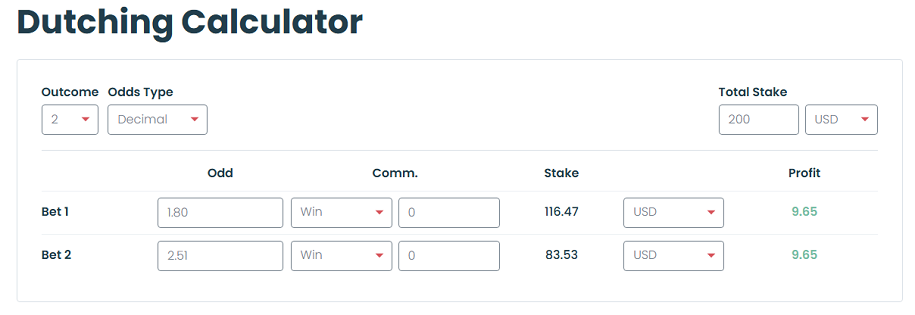
In sports such as football, where a match can have three possible outcomes, stake allocation becomes slightly more complex. A 3 way dutching calculator can help bettors distribute their stakes across a home win, draw and away win to achieve a balanced payout.
Consider a hypothetical volleyball match between China and the USA.
Two bookmakers offer the following prices:
1.43 – for China at Bookmaker B
3.90 – for the USA at Bookmaker A.
Combining these prices may reate an opportunity to cover both outcomes profitably.
Checking whether a surebet existsc
To identify an arbitrage opportunity, divide 1 by the odds for each outcome and add the results together.
Formula:
(1 / Odds 1) + (1 / Odds 2) = S
If S is less than 1, the combination represents a theoretical surebet.
Calculation for our example:
(1 / 1.43) + (1 / 3.90) = 0.9557
Since 0.9557 is below 1, an arbitrage opportunity exists.
Distributing the betting budget
Suppose we have $1,000 available for this opportunity.
To calculate the appropriate stake for each outcome, use the following formula:
Stake = Total Budget / (Odds × S)
China to win:
$1,000 / (1.43 × 0.9557) ≈ $731.70
USA to win:
$1,000 / (3.90 × 0.9557) ≈ $268.30
Let’s examine the possible returns.
If China wins:
$731.70 × 1.43 = $1,046.33
Net profit: $1,046.33 − $1,000 = $46.33
If the USA wins:
$268.30 × 3.90 = $1,046.37
Net profit: $1,046.37 − $1,000 = $46.37
In either scenario, the theoretical profit is approximately 4.6% of the total investment.
Finding opportunities more efficiently
The greatest practical challenge is discovering profitable combinations before the odds change.
Manually comparing prices across numerous sportsbooks can be extremely time-consuming, particularly when several competitions are taking place simultaneously.
For this reason, many arbitrage bettors use specialised scanning platforms.
These tools automatically monitor bookmaker markets, compare prices and identify potential surebets.
BetBurger is an established service offering this functionality for both Prematch and Live sports betting.
Its features include:
- Automated scanning of bookmaker odds.
- Filtering options for selecting relevant opportunities.
- Convenient navigation to corresponding bookmaker markets.
- Tools for simplifying your work (eg. expected value calculator and odds comparison service).
- Educational resources covering arbitrage and other betting strategies.
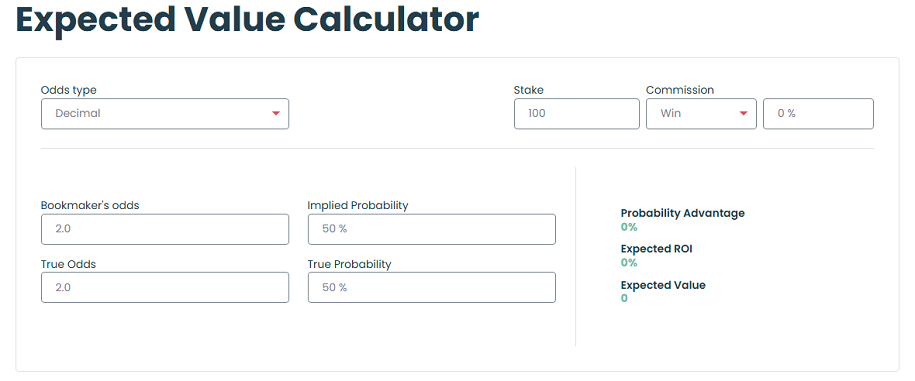
Using such software reduces the effort required to search for opportunities and calculate potential returns.
Nevertheless, bettors should always confirm the current odds before submitting their wagers.
Conclusion
Sports arbitrage demonstrates how price discrepancies between bookmakers can create profitable mathematical combinations.
Although the underlying calculations are relatively straightforward, successful execution requires attention to betting limits, changing odds and settlement rules.
Automated scanners such as BetBurger can simplify the process, helping users discover opportunities while leaving the final evaluation and execution in their hands.


