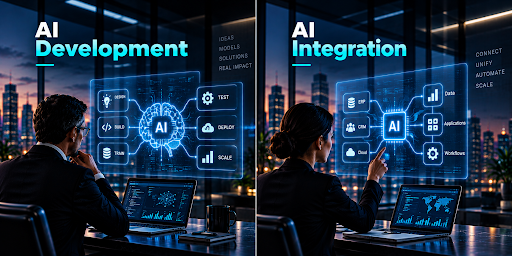

Organizations are investing in artificial intelligence to improve productivity, accelerate decision-making and modernize business processes. However, developing an AI solution is only one part of creating business value. Organizations must also connect intelligent capabilities with enterprise applications, reliable data and operational workflows. AI development provides the technical foundation for building these solutions, while AI integration enables them to function within existing business systems.
Together, these capabilities help organizations move beyond isolated experiments toward scalable enterprise applications. Successful implementation requires clear business objectives, appropriate architecture, strong governance and measurable performance outcomes.
This article explores how AI development and AI integration work together, their enterprise applications, business benefits and implementation priorities.
What is AI development?
AI development is the process of designing, building, testing and maintaining artificial intelligence solutions that address specific business requirements.
It can involve machine learning, generative AI, predictive analytics, intelligent automation and AI agents. Development activities include defining requirements, preparing data, selecting models, building applications, testing outputs and monitoring performance.
Enterprise AI development should begin with a clearly defined business problem rather than a particular technology.
The objective is to create reliable intelligent capabilities that improve productivity, service delivery or decision-making.
What is AI integration?
AI integration is the process of connecting artificial intelligence capabilities with existing enterprise applications, databases, platforms and workflows.
An AI application operating independently may generate useful information, but its business impact can remain limited if employees must manually transfer that information into other systems.
Integration enables AI to access authorized enterprise information and support activities within established workflows.
For example, an AI assistant connected to an IT service management platform could retrieve relevant documentation and help specialists investigate incidents.
AI integration therefore connects intelligent technology with operational execution.
Why AI development and integration must work together
Organizations sometimes develop AI applications without fully considering how employees will use them within existing processes.
This can result in disconnected tools, duplicated information and additional manual work.
AI development determines what an intelligent application can do. Integration determines how that capability interacts with enterprise data, applications and business processes.
Both are essential for scalable implementation.
Organizations should therefore consider architecture, data access, workflow requirements and governance during solution design rather than addressing integration only after development is complete.
Core technologies supporting enterprise AI
Several technologies contribute to intelligent enterprise applications.
Machine learning
Machine learning analyzes historical and operational information to identify patterns, detect anomalies and improve predictions.
Generative AI
Generative AI can summarize information, generate content, support knowledge retrieval and enable natural-language interactions.
Predictive analytics
Predictive models help organizations anticipate demand, financial outcomes and operational risks.
Intelligent automation
Automation executes repetitive activities and connects AI-generated insights with approved workflows.
AI agents
AI agents can coordinate multistep activities, interact with enterprise tools and initiate authorized actions within defined controls.
AI development combines these technologies according to business requirements, while AI integration connects them with enterprise operations.
Key applications across business functions
Organizations can use intelligent technologies across several enterprise areas.
Finance
AI can support financial analysis, reporting, transaction processing and exception management through connections with finance platforms.
Human resources
Integrated AI can improve employee self-service, onboarding, HR case management and workforce administration.
Procurement
AI can support sourcing, contract analysis, supplier management and purchasing workflows.
Supply chain
Intelligent applications can assist with demand planning, inventory analysis, logistics and operational exception management.
Information technology
AI can improve software development, incident management, technical documentation and infrastructure monitoring.
Customer operations
AI-powered applications can summarize interactions, retrieve customer information and support service representatives.
These applications demonstrate how AI integration can extend intelligent capabilities across business functions.
Business benefits of AI development
Well-designed AI applications can improve several dimensions of enterprise performance.
Greater productivity
AI can reduce repetitive and knowledge-intensive work, allowing employees to focus on more complex activities.
Faster decision-making
Intelligent analysis can help employees interpret information and evaluate business conditions more efficiently.
Improved service delivery
AI-powered assistants can accelerate information retrieval and support faster responses to routine requests.
Greater operational efficiency
Automation can reduce manual handoffs and improve process consistency.
Better scalability
AI-enabled workflows can help organizations manage growing workloads without proportional increases in administrative effort.
These benefits become more achievable when AI development is supported by effective integration.
How AI integration strengthens enterprise applications
AI integration enables intelligent capabilities to operate within the systems employees already use.
For example, a generative AI assistant may summarize financial information. When connected with approved finance platforms, it can retrieve relevant data and provide more contextual responses.
Similarly, AI connected to procurement systems can support contract retrieval and purchasing workflows.
Integration also supports consistent security controls, data governance and monitoring.
Rather than creating separate AI experiences for every function, organizations can establish reusable capabilities that support multiple business applications.
Building an enterprise AI implementation roadmap
A practical roadmap should connect development and integration requirements from the beginning.
Organizations can follow several steps:
- Identify business problems suitable for AI.
- Establish expected performance improvements.
- Assess existing applications and data readiness.
- Select appropriate AI models and technologies.
- Define architecture and integration requirements.
- Develop and test applications using realistic scenarios.
- Establish security, privacy and governance controls.
- Integrate AI with approved enterprise workflows.
- Train employees and monitor performance.
- Measure realized business outcomes.
This approach helps organizations move from experimentation toward scalable implementation.
Best practices for AI development and integration
Successful implementation requires organizations to balance technical capabilities with business requirements.
- Start with clearly defined objectives and measurable outcomes.
- Improve enterprise data quality before implementation.
- Select models according to performance, cost and security requirements.
- Use scalable architecture and integration approaches.
- Establish appropriate identity and access controls.
- Maintain human oversight for sensitive decisions.
- Test AI outputs and system interactions before deployment.
- Monitor performance, reliability and operating costs.
- Prepare employees to work effectively with intelligent applications.
- Continuously refine solutions based on business results.
These practices help ensure AI development creates capabilities that can be maintained and scaled.
Common implementation challenges
Legacy enterprise systems can make AI integration difficult because older platforms may lack modern interfaces or accessible data.
Fragmented information can also reduce AI effectiveness when different applications contain inconsistent records.
Security is another important consideration. AI applications connected to enterprise systems may access sensitive employee, customer or financial information.
Organizations must establish clear permissions and monitor interactions to prevent unauthorized access or actions.
Reliability also matters because AI-generated outputs can be incorrect. Appropriate testing, validation and human oversight remain essential.
Measuring the value of AI integration
The success of enterprise AI should be evaluated through business performance rather than the number of applications developed or systems connected.
Relevant measures can include employee productivity, process cycle time, service resolution, operating costs and decision speed.
For example, integrating an AI assistant with a service management platform should demonstrate improvements in issue resolution or employee efficiency.
Organizations should establish performance baselines before implementation and compare actual outcomes with expected benefits.
This enables leaders to identify which AI investments should be expanded and which require further improvement.
The future of AI development
Enterprise AI is evolving toward more connected and increasingly autonomous applications.
AI agents may coordinate activities across multiple systems, retrieve relevant information and initiate approved workflows.
This will increase the importance of AI integration because intelligent systems will need reliable access to enterprise applications and data.
Future AI development will also involve selecting and coordinating different models according to business requirements rather than relying on a single model for every application.
Organizations will need stronger governance, architecture and monitoring as intelligent capabilities become more deeply embedded in operations.
Conclusion
AI development provides the capabilities required to build intelligent enterprise applications, while AI integration connects those capabilities with business systems, data and workflows.
Organizations that coordinate both disciplines can move beyond isolated AI tools toward scalable solutions that improve productivity, decision-making and service delivery.
By focusing on clear business priorities, reliable data, secure integration and measurable outcomes, enterprises can build intelligent operations that support sustainable performance improvement.