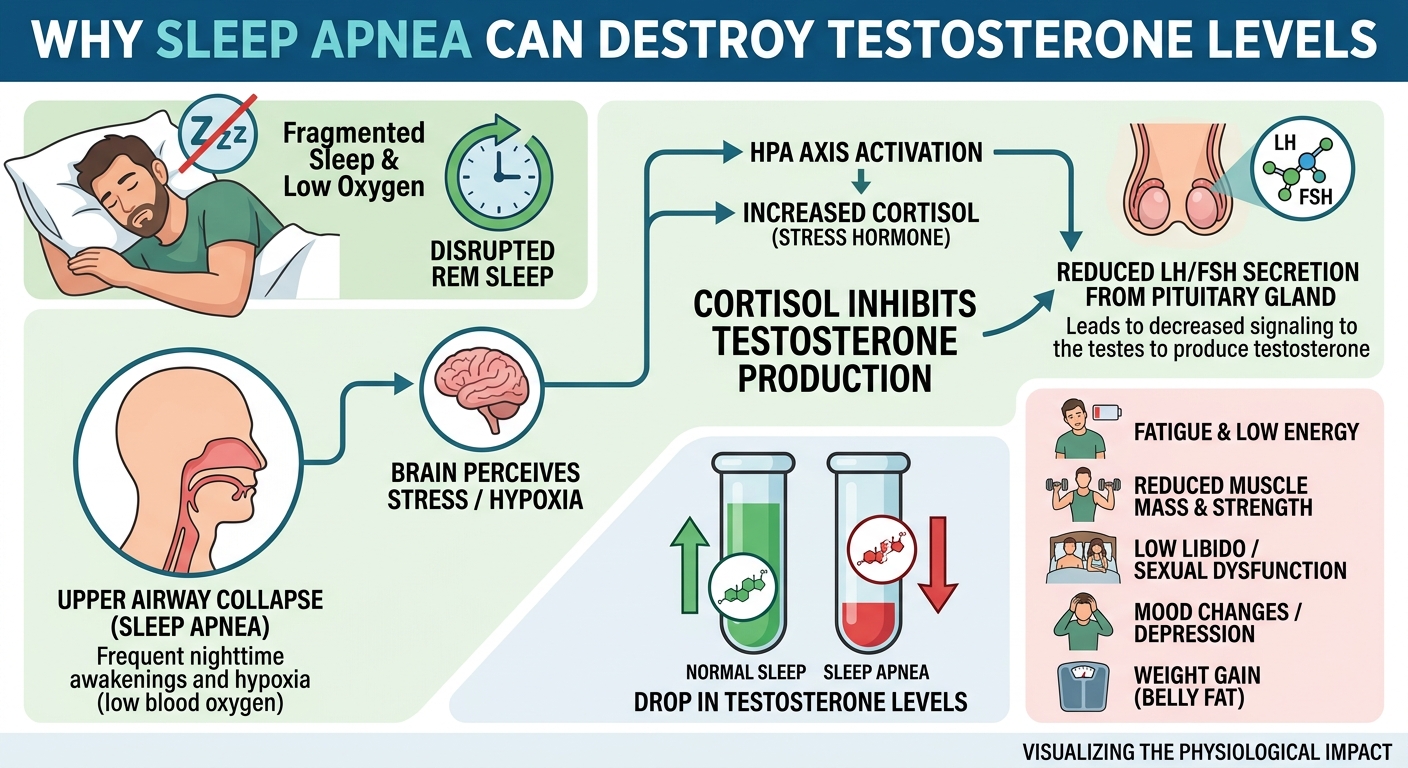

Why Sleep Apnea Can Destroy Testosterone Levels is a question that deserves more attention because sleep affects far more than daytime energy. In men, healthy sleep supports the hormonal signals involved in testosterone production, while obstructive sleep apnea (OSA) repeatedly interrupts normal breathing throughout the night. As a result, severe or poorly controlled sleep apnea may be associated with lower testosterone, reduced libido, fatigue, and other symptoms that can resemble hormonal deficiency. Research also suggests that treating sleep apnea may improve aspects of hormonal and metabolic health in some men.
For men experiencing persistent symptoms, understanding the underlying cause matters. Testosterone Replacement Therapy can be an appropriate medical treatment for men who have confirmed hypogonadism, but it should not automatically be considered the first answer to every low-testosterone result. Current endocrine guidance emphasizes accurate testing, identifying reversible causes, and appropriate monitoring before and during treatment.
How Sleep and Testosterone Are Connected
Testosterone production follows a daily rhythm that is closely connected with sleep. During healthy sleep, the brain and reproductive system communicate through hormonal signals that support testosterone production. However, when sleep becomes repeatedly fragmented, that process can become disrupted. Sleep apnea causes a person to experience repeated episodes of partial or complete upper-airway obstruction, which can lead to brief awakenings and changes in blood oxygen levels.
The problem becomes more significant when these interruptions happen repeatedly throughout the night. Instead of moving smoothly through restorative sleep stages, the body repeatedly responds to breathing disturbances. This can increase physiological stress and interfere with the hormonal environment needed for normal testosterone production. Studies have found associations between obstructive sleep apnea severity and testosterone-related changes, although the relationship is complex and can also involve obesity, age, metabolic health, and other factors.
Why Sleep Apnea Can Lower Testosterone
There is no single mechanism that explains every case. Instead, several processes can work together to affect testosterone levels.
| Sleep apnea effect | Possible hormonal impact |
| Repeated sleep interruptions | Disrupts restorative sleep |
| Reduced oxygen levels | Creates physiological stress |
| Increased sympathetic activity | Keeps the body in a heightened stress state |
| Hormonal disruption | May interfere with normal reproductive hormone signaling |
| Obesity and metabolic problems | Can independently contribute to lower testosterone |
| Chronic poor-quality sleep | May negatively affect normal testosterone rhythms |
One important factor is sleep fragmentation. Testosterone production is linked to normal sleep architecture, so repeatedly waking or moving out of deeper sleep can interfere with the body’s normal hormonal rhythm. In addition, sleep apnea can contribute to changes in stress-related pathways. Research has associated severe OSA with altered cortisol activity, which may further complicate the hormonal environment.
At the same time, it is important not to oversimplify the relationship. Not every man with sleep apnea will have low testosterone, and low testosterone does not automatically prove that sleep apnea is the cause. Instead, clinicians generally consider the entire picture, including symptoms, repeated morning testosterone measurements, sleep quality, weight, medications, and other medical conditions.
The Role of Oxygen and Repeated Nighttime Stress
When breathing becomes obstructed during sleep, oxygen levels can fall. The brain responds by activating mechanisms that help restore normal breathing. These repeated responses may increase sympathetic nervous system activity and prevent the body from remaining in a consistently restful state.
Over time, this pattern can affect multiple systems rather than only testosterone. A 2026 review in EBioMedicine described sleep disorders, cardiovascular health, and testosterone as interconnected areas, noting that sleep disorders may impair testosterone levels and that some studies have found hormonal improvement following positive-airway-pressure treatment for OSA.
This is why treating sleep quality can be an important part of addressing hormonal concerns. Rather than focusing exclusively on the number shown on a laboratory report, healthcare professionals can investigate whether an underlying sleep disorder is contributing to the symptoms.
Symptoms That Can Make the Problem Easy to Miss
Low testosterone and sleep apnea can produce surprisingly similar symptoms. Consequently, someone may assume that a hormonal problem is responsible when untreated sleep apnea is also present.
Common symptoms can include:
- Persistent daytime fatigue
- Reduced sexual desire
- Difficulty maintaining normal energy levels
- Erectile difficulties
- Poor concentration
- Irritability or mood changes
- Reduced physical performance
- Non-restorative sleep
- Loud snoring or witnessed breathing pauses
The overlap makes proper evaluation particularly valuable. For example, feeling exhausted after apparently spending eight hours in bed does not necessarily mean the body received eight hours of restorative sleep. Sleep apnea can repeatedly interrupt normal sleep without the person remembering every awakening.
Can Treating Sleep Apnea Improve Testosterone?
This is where the outlook becomes more encouraging. Treating the underlying sleep disorder can improve sleep quality and may support broader hormonal and metabolic health. Positive airway pressure, particularly CPAP, is a standard treatment for many people with obstructive sleep apnea.
Research on whether CPAP consistently raises testosterone has produced mixed findings. Some studies have reported hormonal improvements after treatment, while others have found little or no short-term change. For example, one randomized study found no meaningful sex-hormone change after only a single night of CPAP, illustrating why long-term treatment outcomes should not be judged from immediate results.
More recent research has continued to investigate this relationship. A 2025 study involving men with severe obesity and obstructive sleep apnea reported that CPAP treatment was associated with improved total testosterone independently of changes in BMI.
Therefore, treating sleep apnea remains valuable even when testosterone does not immediately increase. Better breathing during sleep, improved sleep quality, and management of related metabolic risks can provide important health benefits.
Where Testosterone Replacement Therapy Fits In
Testosterone Replacement Therapy can play an important role when a man has properly diagnosed testosterone deficiency. However, it should be approached as a medical treatment rather than a general energy or performance booster.
The Endocrine Society recommends diagnosing hypogonadism when compatible symptoms and consistently low testosterone levels are present, with testosterone testing generally repeated using morning measurements. Clinicians should also investigate the underlying cause rather than assuming that every low result requires testosterone medication.
For appropriately diagnosed hypogonadism, Testosterone Replacement Therapy may help address symptoms and maintain normal testosterone-dependent functions. Nevertheless, untreated severe obstructive sleep apnea is specifically listed among the conditions in which testosterone therapy should not be started until the sleep disorder is addressed.
That distinction is important. Testosterone treatment may be beneficial for the right patient, but treating the underlying sleep problem first can be an essential part of responsible care.
Lifestyle Changes Can Support Better Hormonal Health
Medical treatment is only one part of the picture. Healthy lifestyle habits can support both sleep and hormonal health, particularly when excess weight or metabolic problems contribute to the situation.
Useful habits may include:
- Maintaining a consistent sleep and wake schedule
- Getting regular physical activity
- Managing body weight when medically appropriate
- Avoiding smoking
- Limiting alcohol, particularly close to bedtime
- Discussing persistent snoring or breathing pauses with a healthcare professional
- Following prescribed CPAP or other sleep-apnea treatment consistently
Weight management deserves special attention because obesity can contribute to both obstructive sleep apnea and low testosterone. The Endocrine Society’s 2026 statement notes that, for appropriately diagnosed hypogonadism associated with overweight or obesity when no other cause has been identified, weight loss is typically considered a first-line approach.
A Better Approach Starts With the Cause
The connection between sleep apnea and testosterone demonstrates why looking for the root cause can be more useful than simply treating a laboratory number. If a man has symptoms of testosterone deficiency, testing can help establish whether testosterone is actually low. If he also snores heavily, wakes frequently, experiences witnessed breathing pauses, or remains exhausted despite adequate time in bed, evaluating for sleep apnea may be equally important.
In some cases, addressing sleep apnea, improving lifestyle factors, and managing related medical conditions may improve hormonal health without requiring testosterone medication. In other cases, genuine hypogonadism may remain after reversible contributors have been addressed, and Testosterone Replacement Therapy may then be considered under appropriate medical supervision.
The Bigger Picture
Why Sleep Apnea Can Destroy Testosterone Levels is ultimately less about one hormone and more about the importance of healthy sleep. Repeated nighttime breathing interruptions can affect sleep quality, oxygenation, stress pathways, and metabolic health, all of which can interact with testosterone regulation. Evidence suggests that treating sleep apnea can improve several aspects of health, while research continues to clarify exactly how much testosterone levels change after treatment.
For men with confirmed hormonal deficiency, Testosterone Replacement Therapy can be an effective option when appropriately prescribed and monitored. However, addressing untreated sleep apnea should remain part of the medical evaluation. With proper diagnosis, sleep-focused treatment, lifestyle improvements, and individualized hormone care when necessary, there is a positive path toward improving both sleep and overall well-being.
Frequently Asked Questions
Can sleep apnea really lower testosterone?
Yes, obstructive sleep apnea is associated with lower testosterone in some men, particularly when the condition is severe. However, the relationship is influenced by several factors, including age, obesity, metabolic health, and sleep quality. Therefore, sleep apnea should be considered a potential contributor rather than assumed to be the sole cause.
Will CPAP automatically increase testosterone?
Not necessarily. Research has produced mixed results. Some studies report improvements in testosterone after effective OSA treatment, while others have found limited changes. Nevertheless, CPAP can address the underlying breathing disorder and improve sleep quality, making treatment worthwhile even when testosterone changes are not guaranteed.
Is Testosterone Replacement Therapy safe with sleep apnea?
Testosterone Replacement Therapy requires careful medical evaluation when sleep apnea is present. Current Endocrine Society guidance recommends against starting testosterone therapy in men with untreated severe obstructive sleep apnea. A healthcare professional should evaluate and manage the sleep disorder before considering hormone treatment.
How is low testosterone diagnosed?
Symptoms alone are not enough. Current guidance recommends compatible symptoms together with consistently low, accurately measured testosterone levels. Morning testosterone testing is generally used, and a low result should typically be confirmed with another morning measurement before diagnosing hypogonadism.
Can treating sleep apnea eliminate the need for testosterone?
Sometimes addressing reversible contributors may improve testosterone levels, but this cannot be guaranteed. If a man has persistent, confirmed hypogonadism after appropriate evaluation and treatment of contributing conditions, Testosterone Replacement Therapy may still be considered. The decision should be individualized and medically supervised.
Medical note: This article is for educational purposes and does not replace an evaluation by a qualified healthcare professional. Persistent snoring, witnessed breathing pauses, excessive daytime sleepiness, or symptoms of testosterone deficiency warrant professional assessment.