
When was the last time you checked your email? Today? Maybe a few minutes ago?
But when was the last time you checked if your email has ever been leaked online? Not your inbox or spam folder. Your actual email account.
That is the kind of safety check most of us ignore when 50+ unread messages are breathing down our necks every day.
But email leak checks should be part of your digital hygiene too. Thankfully, professional services make it quick.
They do not magically stop every threat. But they can help you answer one important question faster:
Is my email address safe, and how do I make sure it doesn’t get leaked?
Below is a review of five email-focused data leak checkers that can help anyone spot risks connected to their email accounts.
The key things reviewed for each service are:
- Does it check risks linked to an email address?
- Does it offer alerts for future breaches?
- Does it give clear next steps?
- Is it simple enough for regular people, not only security experts?
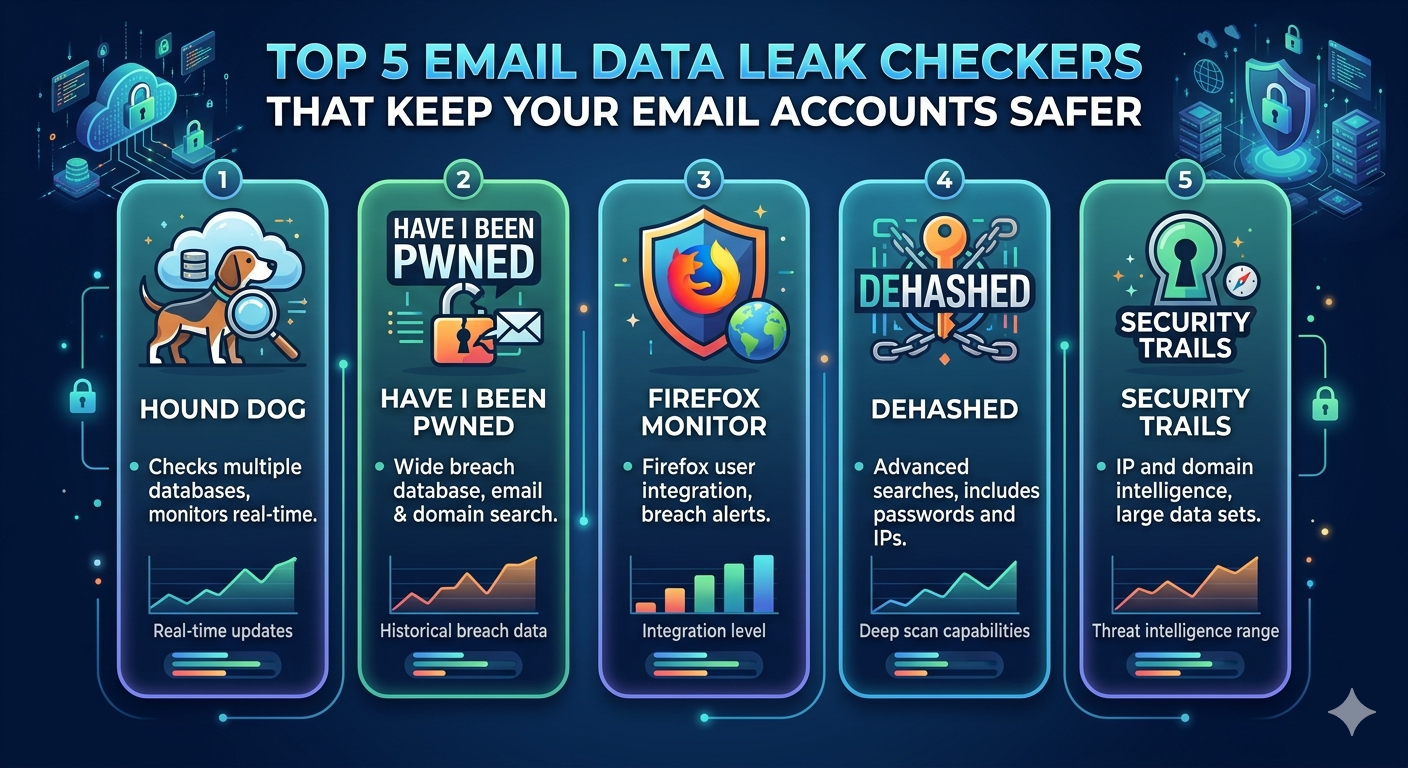
Quick Comparison: Top 5 Email Data Leak Checkers
|
Service |
Best for |
Alerts |
Main strength |
Main limitation |
|
Boundly |
People who want email leak alerts plus simple account-protection steps |
Yes |
Combines monitoring with plain-language guidance |
Newer/less established than older public checkers |
|
Have I Been Pwned |
Fast email breach checks |
Yes |
Huge public breach database and free notifications |
Less hand-holding for non-technical users |
|
Mozilla Monitor |
People who want a guided breach report |
Yes |
Easy explanations and guided steps |
Uses Have I Been Pwned database to track compromised accounts |
|
Avast Hack Check |
Simple email/password leak check |
Limited alerts. Broader monitoring via paid Avast products |
Very beginner-friendly and easy to use |
Limited protection pushes users toward broader paid tools |
|
XposedOrNot |
Free email breach search with real-time alerts |
Yes |
Free, open-source email breach alerts |
Interface may feel more technical than consumer security brands |
Boundly: Best for Simple Email Leak Checks and Clear Next Steps
Boundly is built around a practical problem: most people do not know what to do when they learn their email account may be at risk.
A lot of checkers can tell you that your email appeared in a data leak. That is useful, but it often leaves you with the harder question: what should you do next?
Should you change your email password, the password for the leaked website, or every password you have? Should you turn on two-factor authentication? Is the leak serious, or is it something you can fix in a few simple steps?
Boundly understands this problem. That’s why they have a dedicated support team ready to answer your questions 24/7. You can reach out to their security specialist, and they’ll explain what happened and what to do next in simple, human English.
So instead of being left alone with a scary alert, you get clear guidance from professionals.
What Boundly Does
Boundly checks email accounts for data leaks 24/7 and sends alerts when an email account may be exposed online. Their main value is not only detection, but also response.
Users get guidance from security specialists on what to do after a leak, including how to create stronger but still memorable passwords and how to set up 2FA (two-factor authentication).
That makes Boundly especially useful for people who do not want a technical dashboard full of security terms. It is closer to a guided safety tool than a raw data leak database.
Pros
1) It focuses on what regular people actually need
Most users do not want to decode data leak terminology. They want to know: Is my email at risk? Which account should I fix? What step should I take now?
Boundly’s biggest advantage is that it connects alerts to practical action.
2) It offers ongoing monitoring, not just a one-time check
A one-time scan is helpful, but leaks can appear later. If you check today and your email looks fine, that does not guarantee it will stay that way.
Ongoing monitoring is more useful for people who want to know when their safety changes.
3) It explains password and 2FA steps in simple language
This matters because “turn on 2FA” sounds easy until you open account settings and see security keys, authenticator apps, backup codes, recovery emails, and login prompts.
Boundly’s value is in making those steps feel doable with the help of their support team.
Cons
1) It is less publicly established than older data leak checkers
Have I Been Pwned, Mozilla Monitor, Avast, and similar tools have years of public visibility. Boundly is a young service that has potential for growth, but it does its job well. So if you’re asking: “Is Boundly legit?”, the answer is yes.
2) Users may still need outside instructions for specific platforms
Changing a Gmail password, setting up 2FA on Facebook, and securing an Outlook account all involve different steps. These account-specific instructions can also change over time.
But if you need help with these steps, you can contact Boundly’s support team and get help from a real human anytime.
3) It does not remove leaked data from the internet
This is true for most leak checkers. Their value is detection and response, not deletion. Users should understand that an alert means “act now,” not “the leak has been fixed for you.”
Boundly: The Takeaway
Boundly is best for people who want email leak monitoring with clear, human guidance. It is a strong fit for regular users who do not want to read security forums or guess what to do after a data leak alert.
Have I Been Pwned: Best for Fast, Trusted Email Breach Checks
Have I Been Pwned is one of the best-known email breach checkers online. It lets users check whether their email address appears in known data breaches. As of the current official page, their database lists 991 pwned websites and more than 17.5 billion pwned accounts.
Its strength is simple: enter an email address, see if it appears in known breaches, and sign up for alerts if that email appears in future breaches.
What Have I Been Pwned Does
Have I Been Pwned checks if an email address has appeared in data breaches loaded into its database. It also shows paste records, which are cases where data was found in text-sharing sites or public dumps. Users can sign up for breach notifications, verify their email, and receive alerts when that email appears in new breaches.
Pros
1) It is one of the most trusted public breach checkers
HIBP is widely used by individuals, companies, and security teams. It is often the first place people go when they want to check if an email address appeared in a breach.
2) It is fast and direct
You enter an email address and get a clear result. That makes it useful for people who want a quick answer.
3) It offers free breach notifications
Users can sign up to get notified when their email address appears in new data breaches. The setup requires email verification, which also prevents people from secretly monitoring someone else’s inbox.
Cons
1) It may feel too bare-bones for non-technical users
HIBP gives useful breach details, but it does not always feel like a step-by-step recovery guide. Some people may still wonder which password to change first, whether to close an account, or how serious each breach is.
2) It cannot show every breach in the world
No leak checker really can. Some breaches are private, undiscovered, not verified, or never added to public databases.
3) Sensitive breach results may require verification
For privacy reasons, HIBP does not publicly show certain sensitive breach results unless the user verifies ownership of the email address. That is good for privacy, but it can add a step.
Have I Been Pwned: The Takeaway
Have I Been Pwned is best for people who want a trusted, fast, free email breach check. It is especially useful for users who are comfortable reading breach details and taking action themselves.
Mozilla Monitor: Best for Guided Breach Reports From a Familiar Brand
Mozilla Monitor is Mozilla’s data breach notification service. It lets users enter an email address, scan for breach exposures, and get guidance on how to fix them. Mozilla says breach monitoring protection is free and that it continuously monitors and sends alerts for new breaches.
Mozilla Monitor uses the Have I Been Pwned database to track known breaches and notify users if online accounts are compromised.
What Mozilla Monitor Does
Mozilla Monitor shows what kinds of information may have been exposed and provides steps to resolve exposures. It can also send alerts for future breaches.
Mozilla’s own support page describes it as a breach notification service that warns users if their online accounts have been involved in a data leak.
Pros
1) It is easier to understand than many raw breach checkers
Just like Boundly, Mozilla Monitor is built for ordinary users. The language is more explanatory, and the product is designed to guide people through what happened and what to do next.
2) It offers ongoing breach alerts
Users can sign up for monitoring and receive alerts when new breaches affect their email. Mozilla says users need a Mozilla account to get alerts and a detailed report, but public email searches can be done without signing up.
3) It explains why old breaches still matter
This is important because many people ignore old leaks. Mozilla explains that credentials exposed years ago can still appear later and that reused passwords can put other accounts at risk.
Cons
1) It relies on Have I Been Pwned as its breach source
That is not necessarily bad, but it means Mozilla Monitor is not completely independent as a breach checker. If you already use Have I Been Pwned, some results may overlap.
2) It is not email-only
Mozilla Monitor may show other exposed information connected to a breach, such as passwords, contact details, or financial information. For users who want an email-account-only tool, this may feel broader than needed.
3) Detailed reports and alerts require an account
A basic scan is simple, but ongoing alerts and detailed reports require sign-up. Some users may prefer tools that do not ask for an account.
Mozilla Monitor: The Takeaway
Mozilla Monitor is best for people who want a more guided experience than Have I Been Pwned but still want a free, recognizable service.
Avast Hack Check: Best for a Simple Email Password Leak Check
Avast Hack Check is a free tool that checks if online accounts linked to an email may have been leaked. The tool is built for users who want a simple answer without learning security terms.
What Avast Hack Check Does
Avast Hack Check checks if data linked to your email has been involved in a leak and sends a private report to the user’s inbox. Avast says the tool can show if accounts such as LinkedIn, Facebook, X, email, or others have been compromised.
Pros
1) It is very beginner-friendly
The tool is easy to understand: enter your email, get a report, and change passwords if needed. It does not require the user to understand tech terms.
2) It focuses on leaked login details
Avast frames the risk around leaked login details and compromised online accounts, which is directly relevant to email account safety.
3) It connects the result to password action
Avast explains that users should change passwords if compromised accounts are found and avoid reusing passwords.
Cons
1) It is a pathway into Avast’s broader paid products
The free check is useful, but Avast’s stronger monitoring is part of BreachGuard, which includes broader personal data monitoring, data broker removal, privacy advice, and identity support..
2) The report-by-email format may not suit everyone
Some users may prefer instant results on the page. Others may not want another security-related email in their inbox.
3) It may feel less transparent than open public breach databases
Compared with Have I Been Pwned, Avast does not give the same public database-style experience. Users get a simpler report, but less independent detail.
Avast Hack Check: The Takeaway
Avast Hack Check is best for people who want a simple, familiar, non-technical email leak check and do not mind receiving the report by email.
XposedOrNot: Best Free Email Breach Alerts for Users Who Want More Transparency
XposedOrNot is a free data breach search engine that lets you check if your email address was exposed in a breach. It also offers free real-time breach alerts and says the project is open source.
It is less of a household name than Mozilla or Avast, but it has useful features for people who want email breach monitoring without paying for a full identity protection product.
What XposedOrNot Does
XposedOrNot lets users enter an email address and instantly check it against known breaches and leaks. It also offers 24/7 monitoring and says it notifies users immediately if their email appears in a new breach.
The service also says it does not log search queries or store results.
Pros
1) It offers free breach alerts
Some tools give a free one-time scan and reserve ongoing monitoring for paid plans. XposedOrNot says users can set up free alerts for new breaches.
2) It gives practical next steps
The site advises users to change the breached account password, change reused passwords elsewhere, and turn on two-factor authentication where possible.
3) It is transparent about being open source
For users who care about transparency, open-source positioning can be a plus. It may also appeal to more security-conscious readers.
Cons
1) It may feel more technical than other tools
Regular users may find Mozilla Monitor or Avast Hack Check easier to trust at first glance because those brands are more familiar.
2) It may show more data than expected
Risk scores, breach details, password tools, domain tools, and other features can be useful, but they can also make the experience feel less simple.
3) It’s not as widely known as other big brands
XposedOrNot has useful email breach checking and alert features, but it is not as widely known as Mozilla, Avast, or Have I Been Pwned. Some readers may need some time before they feel comfortable using it.
XposedOrNot: The Takeaway
XposedOrNot is best for users who want a free email breach checker with alerts and do not mind a slightly more technical experience.
Which Email Data Leak Checker Should You Choose?
There is no single perfect tool for everyone when it comes to email account protection.
If you want a well-known public breach checker, Have I Been Pwned is your choice.
Looking for a more guided experience from a privacy brand? Mozilla Monitor is a good option.
If a simple email/password leak check is what you need, consider Avast Hack Check.
If you want a free email breach checker with real-time alerts and transparency, XposedOrNot is worth using.
If you want 24/7 email leak monitoring, simple steps for protecting your account and access to real people when you need help, Boundly is the most practical option — especially if you do not want to figure everything out alone.