
Purchasing decisions can affect more than the immediate need they address. They can involve budgets, vendors, procurement teams, finance, and multiple levels of approval.
A well-structured procure to pay process connects purchasing requests, approvals, purchase orders, invoices, and payments, creating a clear path from request to settlement.
Capital expenditure decisions require greater scrutiny because they can influence an organization’s finances for years. An effective capex approval process helps organizations evaluate investments based on budget, business value, expected returns, and authorization requirements.
Why Purchasing and Capital Decisions Need Better Coordination
Procurement and capital expenditure are often managed separately. Routine purchases may move through procurement and accounts payable, while larger investments follow a different approval path involving finance, department heads, and senior management.
When these processes operate in silos, organizations may face:
- Limited visibility into budgets and commitments
- Delays caused by manual approvals
- Difficulty connecting invoices with original requests
- Repeated data entry across teams
- Poor visibility into who approved a purchase and why
Connecting these activities through structured workflows creates a clearer link between the original decision and the resulting financial transaction.
From Purchase Request to Payment
A connected procure-to-pay process can follow a simple journey:
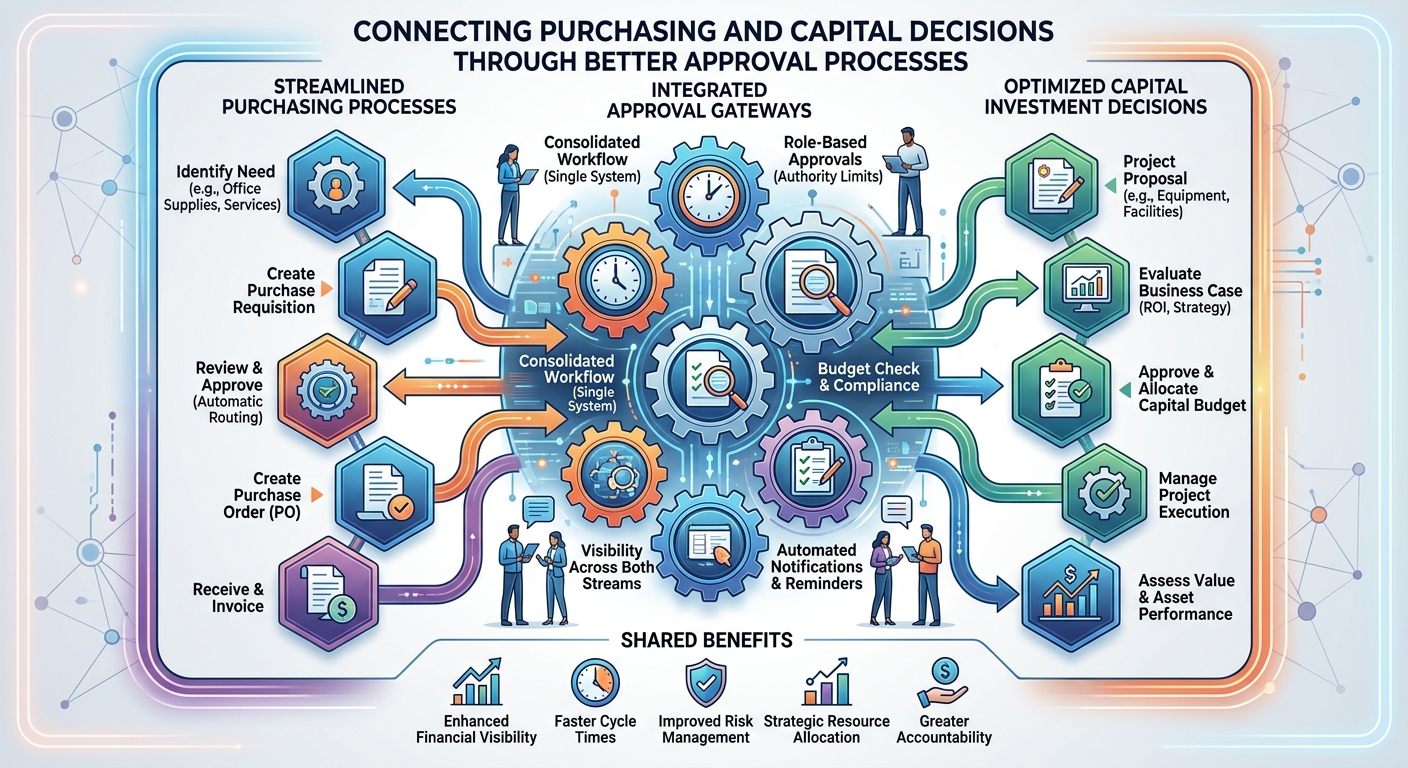
Request → Review → Approval → Purchase Order → Receipt → Invoice → Payment
Each stage builds on the previous one:
- Request: An employee or department submits a purchase requirement.
- Approval: The request is reviewed against policies, budgets, and authorization levels.
- Procurement: The purchasing team selects the vendor and creates the purchase order.
- Receipt: The organization confirms that the goods or services were received.
- Invoice: The invoice is verified against the relevant purchasing information.
- Payment: Once approved, the invoice moves to payment.
Approval routing can be based on factors such as department, purchase value, or authorization level, helping the right stakeholders review requests without unnecessary delays.
Capital Spending Requires a Different Approval Journey
Capital purchases require more than confirming that something needs to be purchased. Organizations may need to evaluate:
- Investment amount
- Available budget
- Expected business value
- Return on investment
- Strategic importance
For example, new production equipment may require input from operations, finance, procurement, and senior management.
A structured capex workflow can connect these stages:
Investment Proposal → Financial Review → Approval → Procurement → Asset Acquisition
This creates a documented decision path and reduces dependence on email conversations and manually maintained spreadsheets.
Where the Two Processes Meet
The two workflows come together when an approved capital investment becomes an actual purchasing transaction.
For example, once new equipment receives capex approval, procurement still needs to manage the vendor, purchase order, delivery, invoice, and payment.
Capex Approval → Procurement → Purchase Order → Invoice → Payment
Connecting these stages provides useful context. Finance can check whether actual spending aligns with the approved investment, while procurement can see the authorization behind the purchase.
This creates a stronger connection between what the organization approves and what it ultimately spends.
How Workflow Automation Helps
An Agentic Workflow Platform can help organizations coordinate purchasing and capital approval activities through configurable workflows.
Organizations can use workflow automation to:
- Route requests to the appropriate approvers
- Apply approval rules based on spending limits
- Track request and approval status
- Maintain supporting documents
- Create an audit trail
- Reduce repetitive manual data entry
- Connect approved investments with purchasing activities
Cflow supports configurable workflows that can route requests to the appropriate stakeholders, manage documents, and provide visibility into workflow status.
Turning Approval Data Into Better Decisions
Approval workflows can also provide information about how well purchasing and capital processes are performing.
Workflow dashboards and Reports & Analytics can help teams identify:
- Approval bottlenecks
- Recurring delays
- Transaction volumes
- Workload distribution
- Opportunities to improve approval hierarchies
Document Management can keep relevant records organized, while Cflow Sign can support electronic signing when formal authorization is required. OCR can also reduce manual effort when extracting information from invoices and other documents.
Building a More Connected Financial Workflow
The goal is not to make every approval more complicated. It is to create the right level of control while keeping routine transactions moving.
For operational purchases, this means a smooth path from request to payment.
For capital investments, it means ensuring that significant spending receives the appropriate review before procurement begins.
When these workflows are connected, employees know where requests should go, approvers know what requires their attention, procurement can see the authorization behind purchases, and finance can trace spending back to its original decision.
Conclusion
Purchasing and capital expenditure decisions may follow different approval paths, but they ultimately contribute to the same financial picture.
Connecting procure-to-pay activities with capex approval creates a clearer relationship between business decisions and actual spending.
Cflow, as an Agentic Workflow Automation Platform, can help organizations structure these approval journeys, connect related activities, and improve visibility across departments supporting stronger control, clearer accountability, and fewer process gaps.