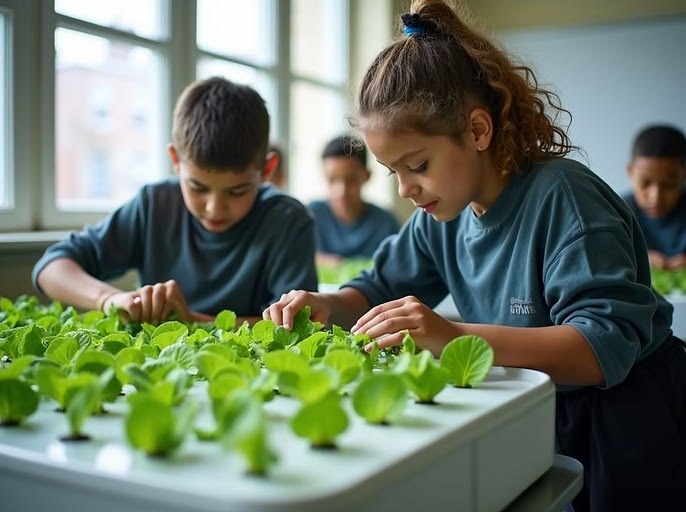

Ask a group of pupils where a tomato comes from and the answers can be surprising. Some will say a supermarket. Others will picture a farm somewhere far away, without knowing how the fruit actually forms on the plant. For a generation that spends much of its day looking at screens, the link between soil, sunlight and the food on a dinner plate can feel abstract.
More schools, colleges and universities are closing that gap in a very practical way. They are building greenhouses on site and turning them into working classrooms where students plant, measure, harvest and, in many cases, eat what they grow. The idea isn’t new, but interest has grown alongside concern about climate, food security and how well young people are prepared for the jobs of the future.
Why Hands-On Learning Sticks
Most teachers know the difference between a lesson that is heard and a lesson that is experienced. Reading about photosynthesis in a textbook is one thing. Watching seedlings lean toward the light, recording how fast they grow, and comparing plants kept in different conditions is something else entirely.
A greenhouse gives students a living subject to study over weeks and months. Mistakes become part of the lesson. If a crop wilts, the class has to work out why. Was it too much water, too little, or a sudden change in temperature? That kind of problem-solving builds curiosity and patience in a way worksheets rarely can.
It also suits learners who struggle to sit still at a desk. Moving around, getting their hands dirty and seeing a clear result can help some students engage with science for the first time.
One Space, Many Subjects
A school greenhouse is often seen as a biology resource, but it can support a surprisingly wide timetable.
Science. Biology, chemistry and environmental science all find natural experiments here, from plant growth and soil nutrients to how temperature and humidity affect living things.
Engineering and maths. Students can study how a structure collects and holds heat, track energy use, and collect data on temperature and yields. Graphs and calculations become far more interesting when the numbers come from something they built and tended.
Climate and renewable energy. A greenhouse is a working example of how buildings manage sunlight and heat, which makes it an ideal setting for lessons on energy efficiency and climate-responsive design.
Food and nutrition. Produce can feed into cookery lessons, school meals and wider farm-to-school efforts that connect pupils with fresh, local food.
Business. Older students can plan crops, track costs and even sell surplus produce, picking up practical lessons in budgeting and enterprise.
Learning About Sustainability By Doing It
Schools are under growing pressure to teach sustainability, and a greenhouse makes the topic concrete. Students can see how much water a crop really needs and test ways to use less. They can explore renewable energy, resource efficiency and regenerative growing methods that protect soil over time.
These lessons tend to travel home. A child who has grown lettuce at school may start asking questions about food waste, packaging and where the family’s groceries come from.
A Window Into Future Careers
Growing food indoors has become a serious industry. Controlled environment agriculture, where crops are raised in carefully managed conditions, now draws on horticulture, engineering, data analysis and technology. Agritech companies, sustainable farms and food systems organizations all need people with these skills.
Well-planned greenhouse projects for students give young people an early taste of that world. Some schools involve students in designing and even helping build the structure itself, which turns the project into a lesson in planning, teamwork and construction before a single seed is sown.
Planning Matters More Than Glass
A greenhouse that sits unused after the first enthusiastic term is a common story. The schools that get lasting value from one usually plan carefully before building.
Safety and access. The space needs safe circulation, room for groups to gather for instruction, observation areas, and access for students with mobility needs.
Curriculum fit. Deciding early which subjects will use the space helps shape its size and layout.
Who looks after it. Someone has to oversee the greenhouse, handle maintenance and keep crops on schedule.
Holidays. Plants don’t take summer breaks. Schools need a plan for watering and care when classrooms are empty.
Water and irrigation. Reliable watering systems save time and protect crops.
Local rules. Building and education regulations vary, so they should be checked early.
Size depends on several factors too, including the age of the students, whether the space needs to double as a classroom, budget and the site available. Some schools choose a freestanding structure, while others look at options that attach to an existing building.
Funding The Idea
Cost is often the biggest hurdle. Many schools look to grants aimed at education, sustainability and food projects to help cover building costs. Grant applications can be time-consuming, so working with an experienced grant writer, or a parent or governor with that background, can make a real difference.
Partnerships help as well. Local businesses, gardening groups and community organizations sometimes contribute funding, materials or volunteer time, especially when the greenhouse supports community food access.
Year-Round Potential
A well-designed greenhouse doesn’t have to close for winter. With energy-efficient design and suitable climate control, growing can continue through the colder months, which means lessons can run across the whole school year rather than only in spring and summer.
Questions For Schools To Consider
What do you most want students to learn from the space?
Which subjects and year groups will use it regularly?
Who will take responsibility for daily care and holiday cover?
How much space is available, and where does it get the most light?
What funding sources could support the project?
Could students be involved in the design or build?
A greenhouse won’t transform a school on its own. With clear goals and steady care, though, it can become one of the most memorable places on campus, a space where science, food and sustainability stop being topics on a page and start growing in front of students’ eyes.