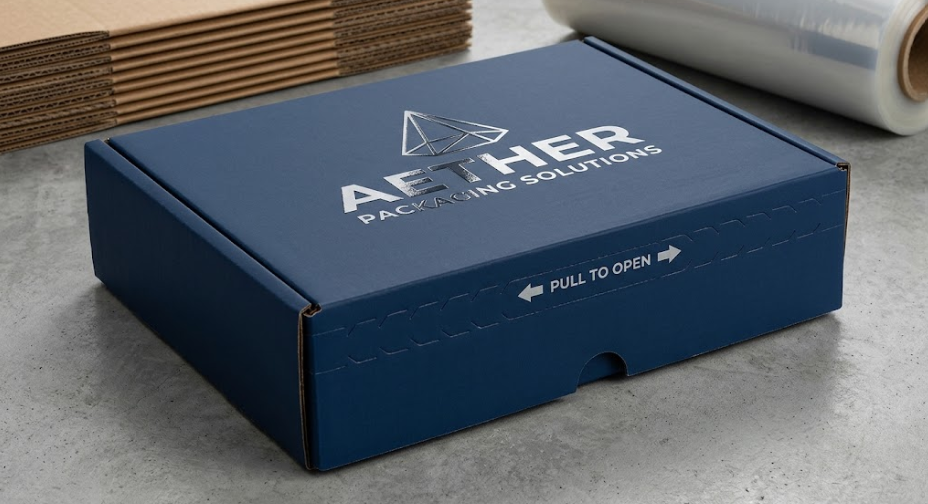

Every manufacturer wants a box that protects the product. Fewer people think about the possible negative effect of creating a box that protects something to look bulky, boring, or industrial. It does not have to be this way at all.
Here’s how to have both the necessary protection with die cut boxes.
Material Thickness Isn’t Just a Spec Sheet Number
This is where most packaging decisions go wrong. People pick a thickness based on cost, not on what’s actually inside the box.
Single-wall corrugated works for light, sturdy items. Soap, small accessories, anything that isn’t fragile. Double-wall handles more weight and rougher handling. Triple-wall is for heavy or genuinely fragile products — electronics, glass, anything that can’t afford to shift.
Die cutting cardboard that is the correct thickness is important. If it is too thin the box can get crushed when shipped or delivered. If it is too thick it will make the box stronger than needed and a bulky size for the receiver.
Structural Design Does More Work Than Padding
A well-designed structure holds its shape without extra material stuffed inside. Reinforced corners. Interlocking flaps. Creases placed exactly where stress concentrates during handling.
Die cut boxes can be engineered this way because the cutting process allows precise control over where folds happen. A flat template can’t always do this. A custom die can.
This matters because bulk padding — foam peanuts, excess bubble wrap — looks cheap. It also adds weight, which adds shipping cost. A box that’s structurally sound needs less filler to do the same job.
Inserts Protect Without Adding Bulk
An insert holds the product in a fixed spot inside the box. No sliding, no rattling around during a bumpy truck ride.
For fragile or oddly shaped products, custom die cut boxes with a matching insert do more for protection than extra cardboard ever could. The insert also keeps the unboxing experience clean — the product sits exactly where it should, not buried under packing material.
Skip the insert on delicate items and you’re relying on luck. Bad idea for anything that ships regularly.
Locking Mechanisms Beat Tape
Tape looks fine on day one. By the time a box has gone through a sorting facility, a delivery truck, and someone’s front porch, tape edges lift and boxes come apart at the seams.
Die cut packaging boxes can include locking tabs cut directly into the structure. No adhesive needed. The box stays shut because the design holds it shut, and it opens cleanly without ripping cardboard or leaving sticky residue behind. A box that has a clean mechanism seems a lot more premium than a box that needs tape for sealing.
This also makes unboxing feel more intentional.
Resistance Comes From Geometry and Not Just Materials
Thicker cardboard helps, but shape matters just as much. Boxes with flat, unsupported panels flex under weight. Boxes with structural creases and reinforced edges distribute that weight instead of buckling under it.
Die-cut cardboard boxes can be designed with internal fold patterns that act almost like a skeleton. Stack pressure in a warehouse, rough handling during transit — good geometry absorbs a lot of that stress before it ever reaches the product.
Test this before committing to a full production run. A basic stack test or drop test on a prototype tells you more than any spec sheet.
Dimensional Optimization Saves Money You’re Probably Losing Right Now
A box with too much empty space costs more to ship and gives the product room to shift around inside. Both are bad.
Die cut cardboard packaging designed to fit the product closely, with just enough clearance for an insert or light padding, solves both problems at once. Shipping carriers increasingly charge based on dimensional weight, not just actual weight. An oversized box costs more even if it’s mostly empty air.
It is simply not possible to feel premium while opening a box that is three times the size of what is inside of it. This is why it is absolutely imperative to get the dimensions of your box strictly according to the product in hand.
Bringing It Together
None of these elements work well alone. The right material thickness without good structural design still crushes under pressure. A locking mechanism without proper dimensional fit still lets the product move around.
Die-cut boxes built well combine all of it — thickness matched to the product, structure that holds its shape, an insert that keeps things still, a closure that doesn’t rely on tape, and dimensions that don’t waste space or money.
If you’re ordering wholesale die cut boxes, ask your supplier about testing a prototype before committing to a full run. A stack test and a drop test cost far less than a batch of damaged returns.
Custom Boxes built around real shipping conditions protect the product and still look like something worth unboxing. That’s not a tradeoff. It’s just a good design.