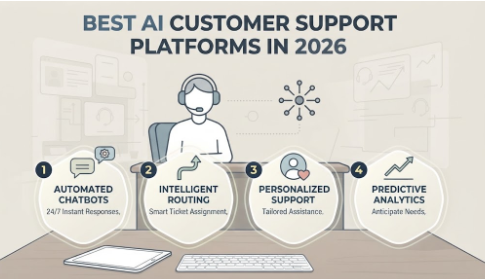

Customer expectations are changing quickly in 2026. People want fast answers, helpful conversations, and support that is available around the clock. At the same time, businesses need to manage growing numbers of customer questions without constantly increasing support costs. This is where AI-powered customer service tools can make a major difference.
Modern AI Customer Support Platforms can answer common questions, assist human agents, organise support requests, summarise conversations, and help businesses provide faster service. However, every platform has different strengths, so choosing the right one depends on your business size, support channels, budget, and automation needs.
What Are AI Customer Support Platforms?
AI customer support platforms are software solutions that use artificial intelligence to help businesses communicate with and support their customers. They can work through websites, email, live chat, social media, and other communication channels.
Unlike traditional chatbots that mainly follow fixed rules, newer AI systems can understand natural language and use information from a company’s knowledge base to provide more relevant answers. They can also recognize when a customer needs human assistance and route the conversation to the appropriate team member.
Why Businesses Are Using AI for Customer Support
The biggest reason businesses are adopting AI support tools is efficiency. A well-configured AI assistant can handle repetitive questions without requiring a support agent to respond manually to every request.
AI can also help businesses provide support outside normal working hours. Customers can receive immediate responses to basic questions even when the human support team is unavailable.
Other potential benefits include:
- Faster response times
- 24/7 customer assistance
- Reduced repetitive work for agents
- Automated ticket classification
- Conversation summaries
- Multilingual customer support
- More consistent responses
- Better organization of customer requests
- Improved agent productivity
Best AI Customer Support Platforms in 2026
There is no single platform that is perfect for every company. The following tools stand out for different customer-support requirements.
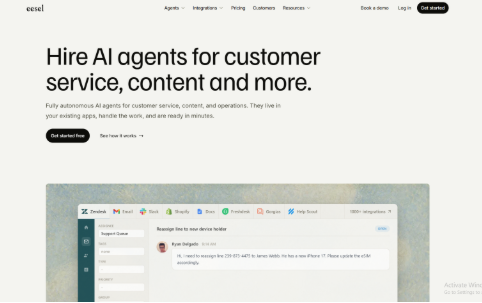
Eesel AI is an AI-powered customer support solution designed to help businesses provide instant answers using their existing company knowledge. It can connect information from sources such as help centres, documentation, and internal resources, allowing customers to get answers without requiring an agent to handle every basic question.
One of its key advantages is its focus on making company knowledge accessible through AI. Instead of relying only on generic AI responses, businesses can provide relevant information for the AI to use when responding to customer questions. This can make it useful for teams that want to automate repetitive support requests while keeping answers connected to their own documentation.
Eesel AI can also help reduce the workload on support teams by handling common questions and directing customers toward useful information. Human agents can then spend more time dealing with complex issues that require personal attention.
Best for: Businesses, SaaS companies, and support teams that want AI-powered customer assistance based on their existing knowledge and documentation.
2. Intercom
Intercom is a popular customer communication platform with AI-powered support capabilities. Its AI features can help businesses answer customer questions, automate conversations, and assist support teams.
One of its strongest advantages is combining AI assistance with human customer service. Businesses can automate straightforward conversations while allowing agents to take over when a situation requires personal attention.
Best for: SaaS companies, startups, and businesses that want conversational customer support.
3. Zendesk

Zendesk is a well-established customer service platform that has expanded significantly into AI-powered support. It provides tools for ticket management, customer conversations, knowledge bases, reporting, and agent assistance.
Its AI capabilities can help organizations automate common requests and provide agents with useful information during support interactions.
Best for: Medium-sized and large organizations that need a comprehensive customer service system.
4. Salesforce Service Cloud
Salesforce Service Cloud combines customer service functionality with Salesforce’s broader CRM ecosystem. Its AI capabilities can assist service teams with tasks such as generating responses, summarizing conversations, and helping agents access customer information.
For companies already using Salesforce, its integration with customer data can be particularly useful.
Best for: Businesses that already rely heavily on Salesforce.
5. HubSpot Service Hub
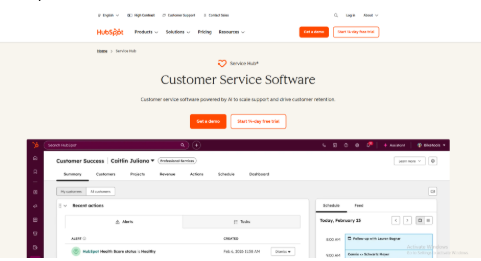
HubSpot Service Hub is designed for businesses that want customer service tools connected with marketing and sales data. Its AI features can support customer interactions, content creation, ticket management, and service workflows.
The platform can be especially convenient for companies that already use HubSpot CRM because customer information can be managed within the same ecosystem.
Best for: Small and growing businesses using HubSpot’s CRM.
6. Freshdesk
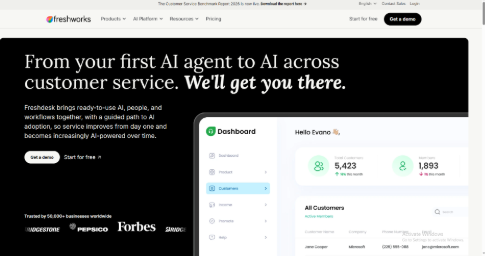
Freshdesk provides help desk and customer support functionality with AI-powered features designed to reduce repetitive support work. Businesses can use it to organize tickets, manage customer conversations, and automate certain support processes.
Its relatively approachable interface makes it an option worth considering for teams that want to introduce AI without building a complicated support infrastructure.
Best for: Small and medium-sized businesses.
How to Choose the Right AI Customer Support Platform
Choosing a platform should not be based only on how advanced its AI sounds. Businesses should evaluate how well the tool fits their existing support operation.
1. Check AI Accuracy
The AI should provide useful answers based on reliable company information. Incorrect answers can create frustration and damage customer trust.
2. Look at Integrations
Check whether the platform works with the tools your business already uses, such as CRM systems, ecommerce platforms, email, messaging applications, and knowledge bases.
3. Consider Human Handoff
AI should not necessarily replace your entire support team. Look for a system that can smoothly transfer complicated conversations to human agents.
4. Review Automation Features
Consider what the platform can automate. Useful capabilities may include answering FAQs, categorizing tickets, summarizing conversations, creating responses, and routing requests.
5. Compare Pricing
AI support platforms can have very different pricing models. Some charge according to seats, conversations, tickets, AI usage, or a combination of factors. Calculate the expected cost based on your actual support volume rather than comparing headline prices alone.
6. Consider Scalability
A platform should continue to work effectively as your customer base and support volume grow. Choosing a system that can scale can prevent another migration later.
AI Support Does Not Mean Removing Human Agents
One of the biggest misconceptions about AI customer service is that businesses must completely replace human support agents. In reality, the most useful approach is often a combination of AI and human support.
AI can deal with repetitive questions and basic requests, while human agents can focus on situations involving complaints, unusual problems, sensitive issues, or customers who need personalized assistance.
This approach can make support teams more productive without removing the human element from customer service.
The Future of AI Customer Support
AI customer service is likely to become more capable as businesses collect better customer data and build stronger knowledge bases. Future systems will increasingly focus on understanding customer intent, predicting potential problems, and helping agents resolve issues more efficiently.
However, businesses will still need to monitor AI-generated responses carefully. Good customer support depends not only on automation but also on accurate information, clear communication, privacy, and appropriate human oversight.
Final Thoughts
The best AI customer support platform in 2026 depends on what your business actually needs. Intercom may appeal to companies focused on conversational support, Zendesk offers a broad customer service ecosystem, Salesforce works well for businesses deeply invested in its CRM, while Gorgias is particularly useful for e-commerce.
Before choosing a platform, compare its AI capabilities, integrations, automation options, pricing, scalability, and human-agent handoff. The right solution should not simply automate customer conversations; it should help your entire support team deliver faster, more consistent, and more useful customer experiences.