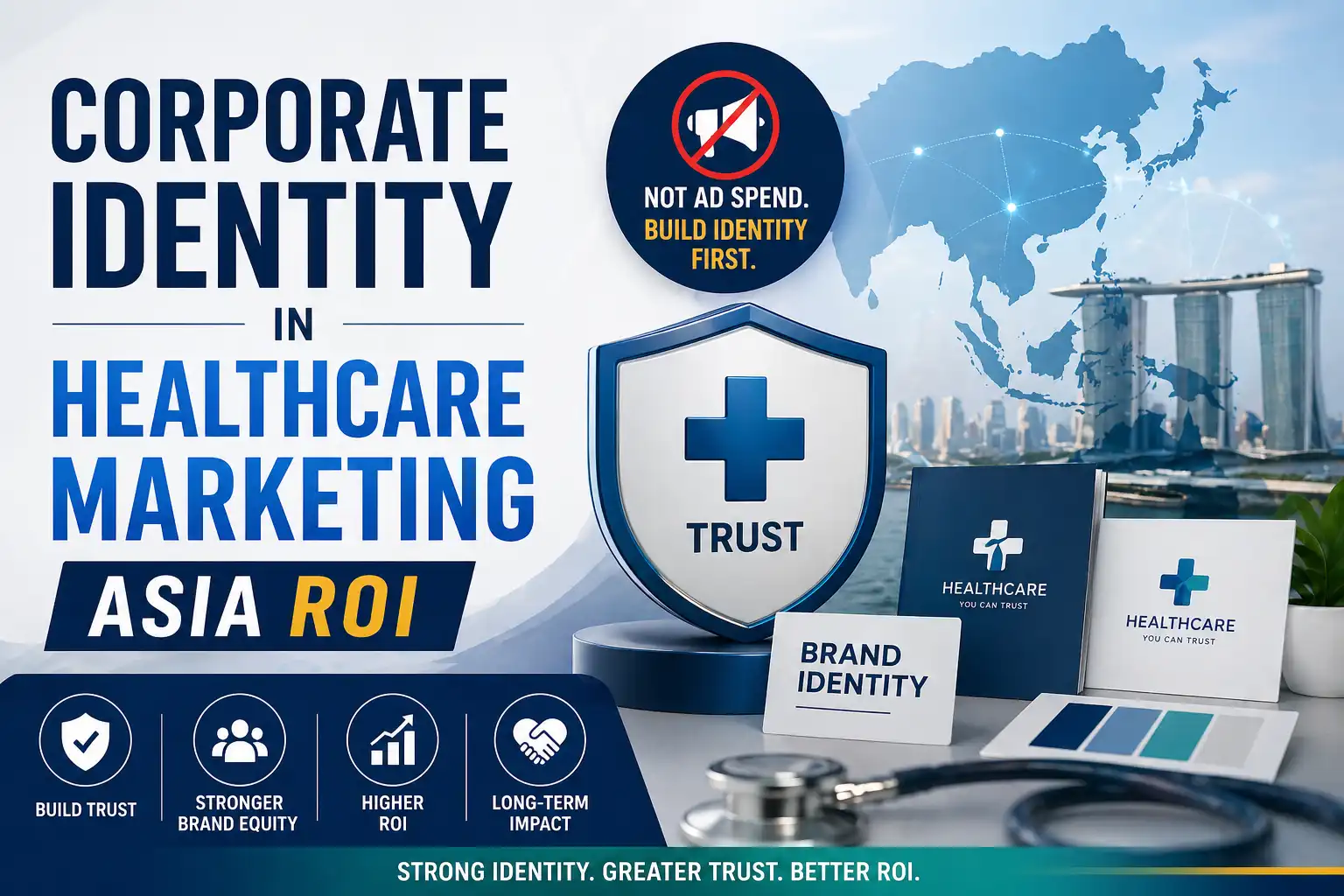

There is a persistent assumption in healthcare marketing that visibility is a function of budget. Spend more on media, run more digital campaigns, push harder across channels, and the market will respond. For some industries, this logic holds reasonably well. For healthcare, it tends to produce the opposite of what organisations need most: trust.
Across Asia, healthcare providers, insurers, pharmaceutical companies, and allied health brands are operating in environments where patient expectations are rising, regulatory scrutiny is tightening, and the competition for credibility — not just attention — is intensifying. In that environment, the organisations that are gaining ground are not necessarily the ones with the largest advertising budgets. They are the ones that have spent time building a coherent, recognisable corporate identity before they begin spending on outreach.
This article examines why corporate identity is the foundation of effective healthcare marketing, not a parallel workstream or an aesthetic consideration to be addressed after strategy is set.
The Relationship Between Identity and Trust in Healthcare
Corporate identity in healthcare is not a logo or a colour palette. It is the structured expression of what an organisation stands for, how it communicates, how it presents itself across every touchpoint, and how consistently it does all of this over time. Identity encompasses visual language, verbal tone, institutional values, and the internal culture that supports all of the above. When these elements are coherent and aligned, they create something that advertising alone cannot manufacture: institutional credibility.
Working with a corporate branding agency singapore that understands the specific demands of regulated, trust-sensitive industries is often where this work begins for healthcare organisations looking to build that foundation properly. The distinction matters because healthcare identity is not built the same way as a consumer product brand. The stakes are different. The audience is different. The decision-making process of a patient, a referring physician, or a hospital procurement officer is nothing like that of someone choosing a subscription service.
Trust in healthcare is built through consistency. When a patient encounters a hospital’s website, speaks to a receptionist, reads a discharge summary, or sees an outdoor advertisement, they are forming an impression based on how coherent the experience feels. If these touchpoints feel disjointed — different tones, inconsistent visual standards, conflicting messages — the organisation communicates, however unintentionally, that it lacks internal discipline. In a healthcare context, that impression carries real consequences for patient confidence and referral behaviour.
Why Consistency Is More Than a Design Preference
Consistency in corporate identity is an operational matter, not a stylistic one. Healthcare organisations typically operate across multiple departments, locations, and sometimes jurisdictions. Each of these units communicates with different audiences: patients, regulators, insurers, clinical staff, and the broader public. Without a defined identity system, each unit defaults to its own interpretation of how the organisation should present itself. The result is fragmentation that accumulates over time.
This fragmentation has a measurable effect on how external audiences perceive the organisation. Referring physicians and institutional partners in particular tend to form lasting impressions based on the professionalism and clarity of how an organisation represents itself. A fragmented identity signals organisational complexity that may translate into process risk. A coherent identity signals that the organisation is well-governed and reliable — qualities that matter enormously in a sector where relationships are long-term and decisions are high-stakes.
How Asian Healthcare Markets Specifically Reward Identity Clarity
Markets across Southeast Asia and Northeast Asia have specific characteristics that make corporate identity work more consequential than in markets with longer-established healthcare brand conventions. In Singapore, Malaysia, Thailand, South Korea, and parts of China, healthcare markets are maturing rapidly. Private providers are expanding. Medical tourism is growing. And patients — particularly those making elective or high-value decisions — are increasingly capable of comparing providers across borders, not just within their home market.
In this context, a healthcare marketing agency singapore-based or regionally focused will tell you that campaigns which perform well are almost always backed by a clear, well-developed institutional identity. The campaign is the surface. The identity is the infrastructure. Without the infrastructure, campaigns produce awareness that does not convert into trust, and trust is what drives appointment bookings, second opinions, referrals, and long-term patient relationships.
There is also a cultural dimension worth acknowledging. In many Asian markets, institutional reputation carries significant weight in healthcare decisions. Patients and families are not simply responding to messages; they are assessing the credibility of the institution behind those messages. An organisation that has invested in a coherent, credible identity is better positioned to meet that scrutiny than one that relies primarily on campaign-level communications to carry its reputation.
The Role of Regulatory Environment in Shaping Identity Requirements
Healthcare advertising in Asia is subject to varying but generally significant levels of regulatory oversight. In Singapore, the Ministry of Health maintains clear guidelines on what healthcare providers can and cannot claim in public communications. Similar frameworks exist in other regional markets. These constraints mean that healthcare organisations cannot rely on the kinds of bold, emotive, or comparative advertising that consumer brands use freely.
This regulatory environment actually reinforces the case for identity-led marketing. When direct product or service claims are restricted, the organisation’s character — its values, its history, its clinical philosophy, its community presence — becomes the primary vehicle for differentiation. Organisations that have invested in articulating and consistently expressing these qualities have more to work with when campaign space is constrained. Those that have not are left competing primarily on price or proximity, neither of which builds durable brand equity.
What Identity Work Actually Involves for Healthcare Organisations
Building a corporate identity for a healthcare organisation is a deliberate process that touches strategy, communication, and internal culture. It begins with a clear understanding of who the organisation is — not as an aspiration, but as a current operational reality. What does it actually do well? What values guide clinical and administrative decisions? How do staff and leadership describe the organisation to people outside it? These questions, when answered honestly, produce the raw material for identity development.
From there, identity work involves translating those answers into consistent, communicable expressions: visual systems that can be applied across all touchpoints, verbal guidelines that govern tone and terminology, and internal frameworks that help staff understand how the organisation presents itself and why. A healthcare marketing agency singapore with experience in this category will typically approach identity development as a research and alignment process before it becomes a design or messaging process.
Internal Alignment as a Precondition for External Communication
One of the most common failures in healthcare branding is the gap between how an organisation presents itself externally and how it actually operates internally. This gap emerges when identity work is treated as a communications exercise rather than an organisational one. The visual standards are set, the messaging guidelines are written, and then the work is handed to a marketing team while clinical and administrative operations continue as before.
What patients and partners experience is an organisation whose communications promise something the operational reality does not consistently deliver. Over time, this erodes exactly the trust that the identity work was meant to build. Sustainable identity in healthcare requires that the values and positioning expressed externally are recognisable in the internal experience of staff, patients, and partners. This is not an abstract ideal — it is a practical requirement for identity to function as a long-term asset rather than a short-term impression.
Campaign Performance as an Outcome of Identity Strength
The argument here is not that advertising is unimportant. It is that advertising performs better when it is anchored in a strong corporate identity. A well-run digital campaign, a content programme, a media partnership, or a thought leadership series will all produce more durable results when the organisation behind them is clearly and consistently recognisable. The World Health Organization’s work on health communication consistently emphasises that institutional credibility is a precondition for effective health messaging — a principle that applies with equal force to commercial healthcare communications.
When a healthcare marketing agency singapore builds a campaign for an organisation with strong identity foundations, the campaign has something to refer back to and reinforce. Every piece of content, every advertisement, every event or publication becomes an opportunity to deepen the audience’s understanding of who the organisation is. Without that foundation, campaigns exist in isolation. They generate impressions but not accumulation. Attention but not recognition.
Measuring Identity ROI in Healthcare Contexts
Healthcare organisations are often cautious about investing in identity work because the return is not as immediately measurable as a pay-per-click campaign or a lead generation programme. This caution is understandable but can be counterproductive. Identity investment compounds over time in ways that direct advertising does not. Brand recognition among referring physicians builds over years, not months. Patient loyalty is shaped by cumulative experience, not a single campaign.
The organisations across Asia that have built the most recognisable and respected healthcare brands — both private hospital groups and specialist providers — share a common characteristic: they treated identity as infrastructure, not decoration. They invested early, maintained consistency, and allowed that consistency to do the work that advertising cannot do alone. The result is that their campaigns, when they do run, operate at a significantly lower cost of trust. The audience is already predisposed to listen.
Closing Observations
The healthcare sector in Asia is competitive in ways that will only intensify over the coming years. More providers, more informed patients, more cross-border comparison, and tighter regulatory frameworks will all increase the pressure on organisations to differentiate in ways that are credible and sustainable.
The organisations that will hold ground in this environment are not those with the largest media budgets. They are those that have done the more disciplined work of building clear, consistent, and credible corporate identities — and have then used those identities as the platform on which all marketing activity rests. A healthcare marketing agency singapore that understands this sequence is not simply a vendor for campaigns. It is a strategic partner in building something that advertising spend alone cannot create.
Corporate identity in healthcare is not a brand exercise. It is an institutional investment. And in markets where trust is the primary currency, it is the investment that determines whether everything else performs.