
Text-to-3D for Content Creators: Speed & Competitive Advantage
The Content Creation Timeline Problem
The content creator economy runs on speed. The faster you produce content, the faster you can publish, the faster you can test what resonates with your audience. This creates a constant pressure: more content, more often, higher quality.
A digital creator wants to make content about a new product. The content concept is simple: showcase a 3D model of the product with different visual treatments. The traditional timeline: Day 1—Commission a 3D artist or use a stock model ($300–$2,000), Days 2–3—Customize the model to match the product’s actual appearance, Day 4—Create variations (different colors, materials, lighting), Day 5—Render final images or video, Day 6—Edit and publish.
By the time the content is published, a week has passed. The product launch moment is gone. The trend window has closed. The content doesn’t perform as well as it could have if published day-one.
For creators, this timeline is painful because their competitive advantage is speed.
What Text-to-3D Enables
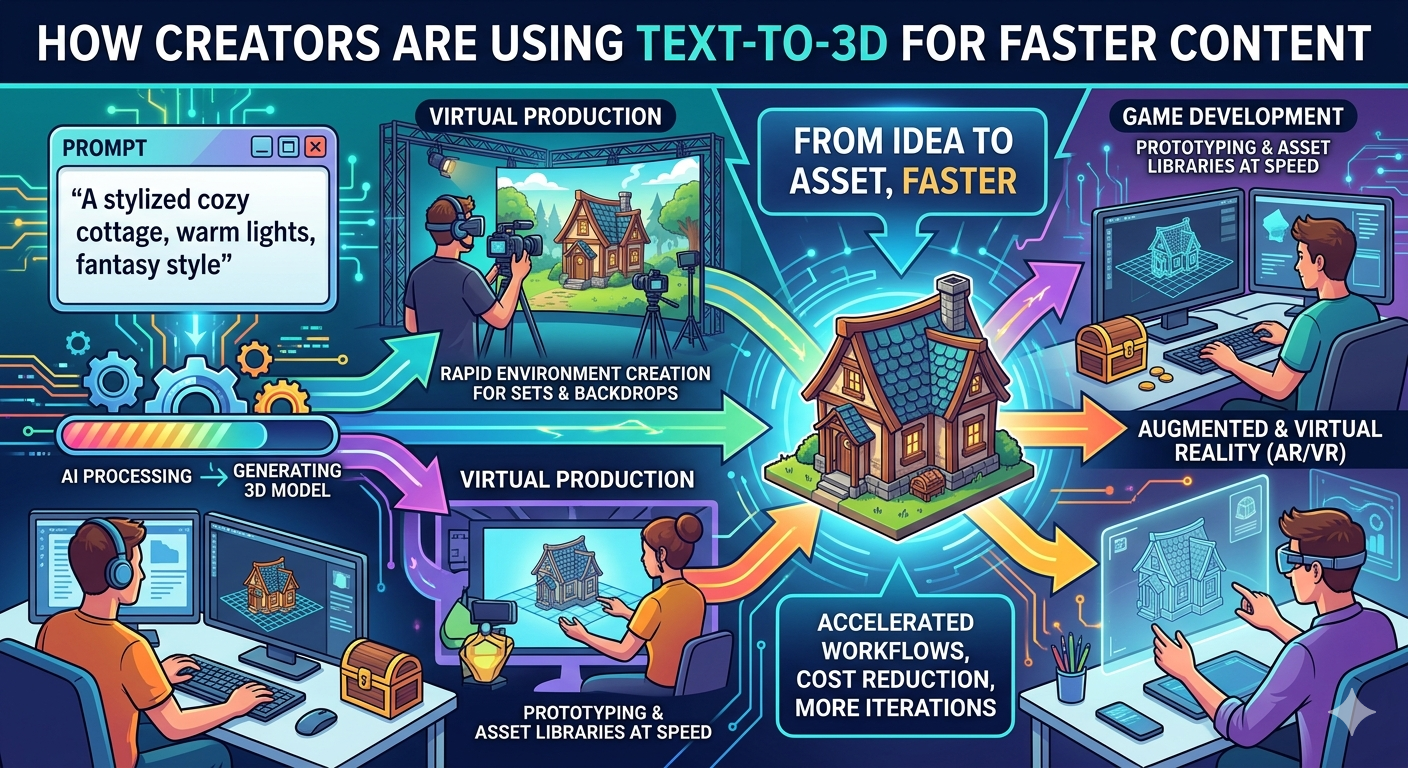
A creator can now: Describe the product: “A sleek, minimalist water bottle, aluminum finish, with a matte black band.” Generate a 3D model: 2 minutes. Create variations: “Now in white. Now in rose gold.” 3 minutes per variation. Render and publish: 10 minutes. Total timeline: 20 minutes from concept to publish.
The difference between a week and 20 minutes is transformative. It means creators can capture trends in real-time. They can publish on the same day as the product announcement. They can iterate based on audience feedback in hours, not days.
Where This Lands for Different Creator Types
Product creators and unboxers. Creators who make videos about products can now generate 3D mockups of products before they arrive. They can create teaser content. They can visualize products they’ve only seen in photos.
Game content creators. YouTubers and streamers who make game content can generate custom 3D assets (weapons, characters, environments) that match their personal brand.
Digital artists and designers. Creators building digital art or design portfolios can generate 3D concepts that would have taken days or weeks to model.
Tech reviewers. Tech reviewers can create 3D visualizations of products to show how they work, disassembled, or integrated into scenarios.
Educational content creators. Educators can generate 3D models of complex objects to explain concepts visually.
Fashion and lifestyle creators. Creators can visualize products on models or in environments before photographing or filming them.
In each case, the creator gains the ability to produce content faster and more frequently.
The Quality Question for Creators
Does the 3D need to be perfect? No. It needs to be good enough to tell a story. A text-to-3D generated 3D model might not be production-ready for a AAA game, but it’s perfectly fine for a YouTube thumbnail, a product comparison video, or a design mockup.
The quality floor for “acceptable” content is much lower than the quality floor for “professional asset.” Creators are optimizing for engagement and speed, not for technical perfection.
The Workflow Shift for Creator Studios
Individual creators using text to 3D model generator tools will see immediate productivity gains. Creator studios (with multiple people) will see organizational shifts: Instead of having a dedicated 3D artist spending days on individual assets, studios can have a 3D generalist who directs AI generation and does light refinement, more diverse content because assets can be produced faster, ability to respond to trends in real-time.
A creator studio’s output can increase by 3–5x if they adopt text-to-3D and optimize their workflow around it.
The Monetization Angle
For some creators, this opens a new revenue stream: creating 3D content services. A creator can offer: Custom 3D product visualization for e-commerce sellers, 3D mockups for game content creators, 3D concept art for studios.
The barrier to entry is now lower (you don’t need years of 3D training), so more creators will enter this market. But the expertise in “describing what clients actually need” remains valuable.
The Trend Arbitrage Opportunity
In trend-driven content, first-movers win. The first creator to make content about a new product or trend captures the most views. Text-to-3D gives creators a speed advantage. They can generate 3D visualizations of trends faster than competitors who rely on manual creation or commissions.
This is a classic first-mover advantage in content. The creators who adopt this tool first will be producing more content, capturing more trends, and building larger audiences.
What Creators Should Do Now
If you create content that involves 3D—or could involve 3D—you should experiment with text-to-3D tools now. The advantage goes to creators who figure out how to integrate these tools into their workflow effectively. Early adopters will have a speed advantage and higher output. That translates to more content, more audience reach, and potentially higher income.
The learning curve is short. A creator who understands visual concepts can learn to use text-to-3D tools in hours. The question isn’t “can I learn this?” It’s “how do I integrate this into my content strategy?”