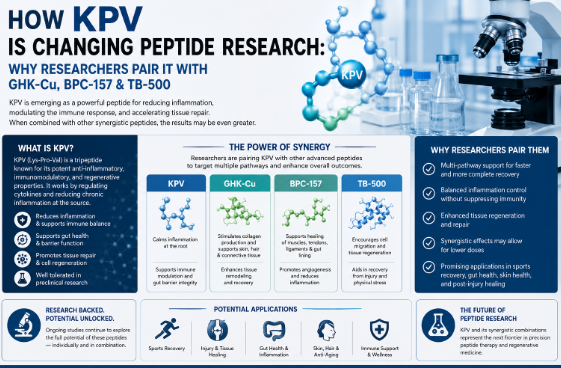

Peptide research continues to evolve as scientists explore new combinations that may offer broader insights into tissue regeneration, recovery pathways, and skin-related biological processes. One peptide that has gained increasing attention in recent years is KPV.
While GHK-Cu, BPC-157, and TB-500 have already established themselves as popular subjects in peptide research, the addition of KPV has created a new area of interest. Researchers are now investigating how KPV may complement these peptides and contribute to more comprehensive studies involving tissue health, recovery mechanisms, and cellular signaling.
This growing interest has led to the development of combination products such as the Klow Blend, which brings together GHK-Cu, BPC-157, TB-500, and KPV into a single research formulation from pure peptides uk.
In this guide, we’ll explore what KPV is, why researchers are interested in it, and why it is increasingly being paired with GHK-Cu, BPC-157, and TB-500.
What Is KPV?
KPV is a short peptide consisting of three amino acids: Lysine (K), Proline (P), and Valine (V).
It is derived from alpha-melanocyte-stimulating hormone (α-MSH), a naturally occurring peptide involved in several biological functions.
Researchers have become interested in KPV because of its potential role in:
- Cellular signaling pathways
- Inflammatory response research
- Tissue recovery studies
- Skin-related biological processes
- Gastrointestinal research
Unlike many larger peptides, KPV’s small size allows researchers to investigate unique mechanisms that may differ from traditional recovery-focused peptides.
Although research is still developing, KPV has become one of the most talked-about emerging peptides in the scientific community.
Why Is KPV Gaining Attention in Peptide Research?
Many peptides are studied primarily for recovery or regeneration. KPV has attracted attention because researchers believe it may influence biological pathways associated with inflammation and cellular communication.
This has opened the door to studies involving:
- Skin health
- Recovery support mechanisms
- Tissue repair pathways
- Cellular balance
- Gut-related biological processes
As peptide science advances, researchers increasingly seek combinations that target multiple pathways simultaneously rather than relying on a single peptide.
KPV appears to fit naturally into this approach.
Understanding the GHK-Cu, BPC-157 & TB-500 Foundation
Before understanding why KPV is added, it’s important to examine the peptides already included in the blend.
GHK-Cu
GHK-Cu is one of the most extensively researched copper peptides.
Researchers commonly study GHK-Cu for:
- Collagen-related processes
- Skin regeneration
- Tissue remodeling
- Cellular repair pathways
- Hair and skin research
Because of its strong association with skin quality research, GHK-Cu often serves as the foundation of many regenerative peptide stacks.
BPC-157
BPC-157 is widely studied for its potential involvement in:
- Tendon research
- Ligament studies
- Muscle recovery pathways
- Blood vessel formation
- Soft tissue regeneration
Its broad range of research applications has made it one of the most recognized peptides in recovery-focused studies.
TB-500
TB-500 is a synthetic version of a naturally occurring peptide fragment called thymosin beta-4.
Researchers investigate TB-500 for:
- Cellular migration
- Tissue remodeling
- Recovery mechanisms
- Connective tissue research
- Flexibility and mobility studies
TB-500 is particularly interesting because researchers believe it may support recovery processes throughout the body rather than remaining localized.
Why Researchers Add KPV to This Stack
The addition of KPV creates a more comprehensive research model.
Rather than duplicating the functions of GHK-Cu, BPC-157, or TB-500, KPV introduces a different area of scientific interest.
Researchers often investigate whether KPV may complement the existing peptides by supporting pathways associated with:
- Cellular communication
- Tissue balance
- Recovery-related biological signaling
- Skin research
- Inflammatory response mechanisms
This complementary relationship is one reason why KPV has become increasingly popular in advanced peptide research.
Potential Research Benefits of Combining KPV with GHK-Cu, BPC-157 & TB-500
Although no therapeutic claims can be made, several research areas continue to attract attention.
1. Skin Health Research
GHK-Cu is already widely known for studies involving:
- Collagen production
- Skin elasticity
- Tissue remodeling
- Appearance-related skin research
Researchers are exploring whether KPV may contribute additional support through its involvement in cellular signaling pathways relevant to skin biology.
This has made the combination especially attractive in skin-focused peptide studies.
2. Recovery Pathway Research
BPC-157 and TB-500 are frequently studied for tissue recovery mechanisms.
Researchers continue investigating how KPV may interact with these peptides within broader regenerative models.
The goal is not necessarily to replace existing peptides but to expand the number of biological pathways being examined.
3. Connective Tissue Studies
Research involving:
- Tendons
- Ligaments
- Muscles
- Fascia
- Connective tissues
often includes BPC-157 and TB-500.
Adding KPV allows scientists to study additional cellular processes that may be relevant to tissue maintenance and recovery.
4. Comprehensive Regenerative Research
Many peptide researchers are moving toward multi-peptide formulations because biological systems rarely rely on a single pathway.
The combination of:
- GHK-Cu
- BPC-157
- TB-500
- KPV
creates a research model that investigates several interconnected biological processes simultaneously.
What Is the Klow Blend?
The Klow Blend is a research formulation that combines:
- GHK-Cu
- BPC-157
- TB-500
- KPV
into a single product.
Rather than sourcing four separate peptides, researchers can use one blended formulation designed for convenience and consistency.
Those interested in a professionally prepared formulation can explore Klow Blend for sale, which combines these four popular research peptides into a single product.
Why Researchers Prefer Peptide Blends
Combination formulations continue to grow in popularity because they offer several advantages.
These may include:
Simplified Research Preparation
Managing multiple peptides individually can increase complexity.
Blended formulations simplify preparation and handling.
Consistent Ratios
Pre-formulated blends help maintain consistent peptide ratios across research applications.
Greater Convenience
Researchers can work with a single formulation rather than tracking multiple products separately.
Broader Research Scope
Multi-peptide combinations allow scientists to investigate multiple biological pathways simultaneously.
Choosing High-Quality Research Peptides
As peptide research grows, quality remains one of the most important considerations.
Researchers should look for suppliers that provide:
- Research-grade products
- Transparent labeling
- Reliable manufacturing standards
- Proper storage recommendations
- Consistent batch quality
Product purity and consistency are essential factors when conducting meaningful peptide research.
Frequently Asked Questions
What is KPV?
KPV is a three-amino-acid peptide derived from alpha-melanocyte-stimulating hormone (α-MSH). Researchers study it for its potential involvement in cellular signaling, inflammatory response pathways, and tissue-related biological processes.
Why combine KPV with GHK-Cu, BPC-157, and TB-500?
Researchers often combine these peptides because they focus on different biological pathways. The goal is to create a broader research model that examines multiple aspects of tissue and cellular function.
What makes KPV different from other peptides?
KPV is significantly smaller than many commonly researched peptides and is often studied for its unique relationship with cellular communication and biological signaling pathways.
What is the Klow Blend?
The Klow Blend is a peptide formulation that combines GHK-Cu, BPC-157, TB-500, and KPV into a single research product.
Where can researchers learn more about peptide products in the UK?
Researchers interested in research-grade compounds can explore UK Peptides for additional information on peptide research products and resources.
Final Thoughts
KPV is quickly becoming one of the most interesting peptides in modern research. While GHK-Cu, BPC-157, and TB-500 remain popular for studies involving skin quality, tissue regeneration, and recovery pathways, KPV introduces another dimension focused on cellular signaling and biological balance.
This complementary relationship has helped drive interest in advanced formulations like the Klow Blend, where researchers can study four well-known peptides together within a single research model.
As peptide science continues to expand, combinations that investigate multiple biological pathways simultaneously are likely to remain a major focus. Researchers seeking high-quality formulations should always prioritize reputable suppliers and ensure all products are used strictly for research purposes only.