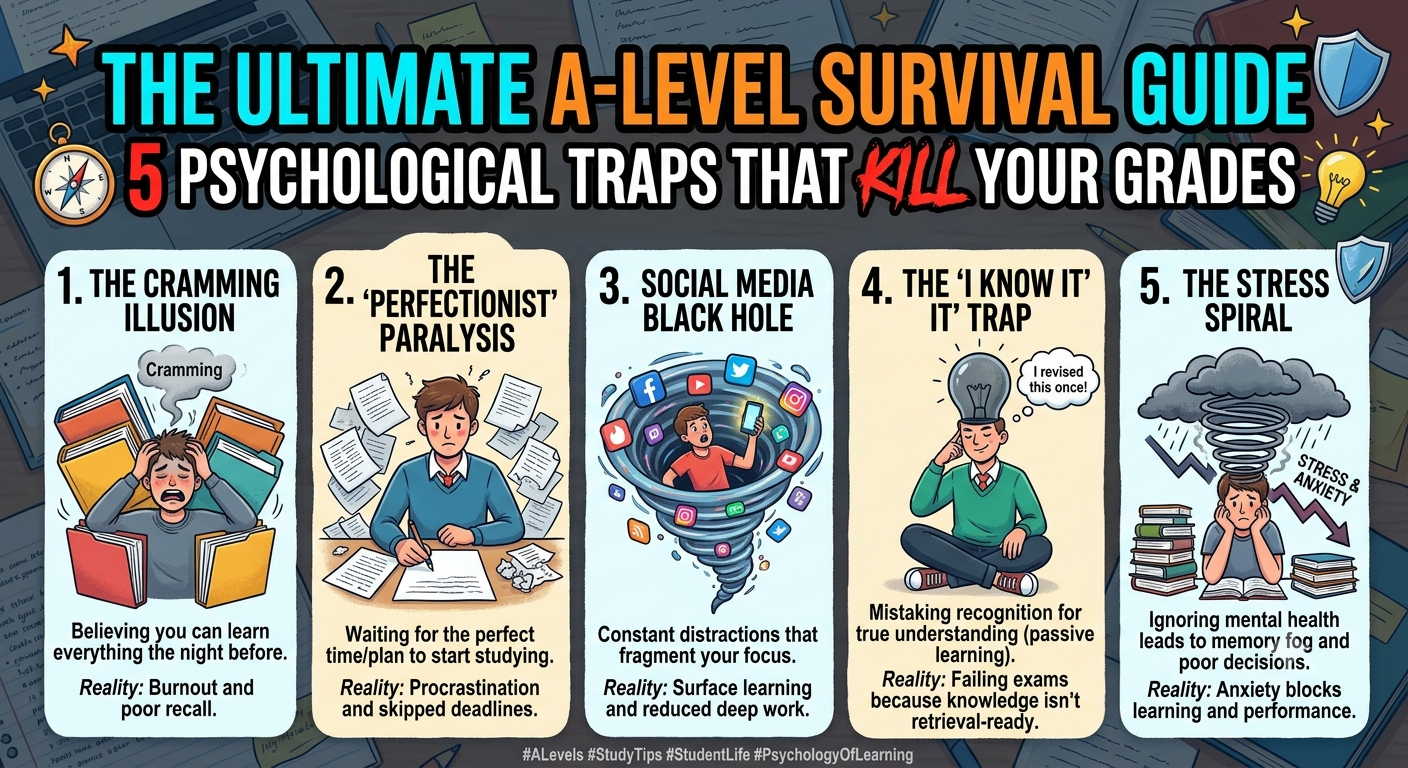

You can have the best notes, the most expensive textbooks, and a flawless revision timetable, but if your mindset is working against you, your A-Level grades will suffer.
A-Levels are as much a psychological marathon as they are an academic one. The sheer volume of content and the looming pressure of university offers can cause even the highest-achieving GCSE students to stumble.
If you want to secure those elusive A* and A grades, you need to recognize and defeat these five common psychological traps.
1. The “Productive Procrastination” Trap
This is the most dangerous trap because it feels like work. Productive procrastination is when you spend three hours color-coding a revision timetable, organizing your desk, or turning 50 pages of biology notes into beautifully illustrated mind maps—without actually memorizing a single fact.
- The Reality: Your brain loves this because it releases dopamine and makes you feel accomplished, but it’s an illusion.
- The Fix: Prioritize “ugly” studying. Real, effective revision is mentally exhausting. It looks like messy scrap paper covered in active recall brain-dumps, blurred flashcard sessions, and timed past papers that you aggressively red-pen using exam board mark schemes. If it feels easy and relaxing, you probably aren’t learning.
2. The Illusion of Competence (The “Recognizing vs. Knowing” Dilemma)
Have you ever read through a chapter in a textbook, nodded along, and thought, “Yep, that makes perfect sense, I know this,” only to completely freeze when faced with an exam question on that exact topic?
This is the Illusion of Competence. There is a massive psychological difference between recognizing information when it is right in front of you and recalling it from scratch under exam conditions.
- The Fix: Never review a topic by just reading it. Instead, close the book and force yourself to explain the concept out loud to an empty room or write down the key mechanisms from memory.
For students looking to break out of passive learning habits, switching to modern digital systems can make a massive difference. Transitioning to an online learning structure like https://www.atmoschool.com/ forces you out of this passive trap by integrating interactive checkpoints, continuous micro-quizzes, and active digital modules directly into the learning process, ensuring you truly understand the material before moving forward.
3. The “I’ll Start When I’m Motivated” Myth
Waiting for inspiration or motivation to strike before you open your books is a recipe for failure. A-Levels require hundreds of hours of independent study; motivation will naturally dip, especially during the cold winter months of Year 13.
- The Fix: Rely on systems, not motivation. Amateurs wait for motivation; professionals build routines. Give yourself an incredibly low barrier to entry to break the friction of starting. Use the 5-Minute Rule: tell yourself you only have to do five minutes of chemistry revision. Once the books are open and the pen is moving, your brain crosses the friction threshold, and momentum takes over.
4. Grade Dysmorphia (Panic After the First Mock Exam)
In Year 12, a huge psychological shock hits many students. You might have coasted to straight 8s and 9s at GCSE, but on your first A-Level mock or essay, you get a D or an E.
Many students spiral into anxiety, assuming they “just aren’t smart enough” for A-Levels, and give up.
- The Fix: Understand that A-Level grading is a completely different calibration. Early low grades do not mean you are failing; they mean you are adjusting to the assessment style. Treat every early test not as a reflection of your intelligence, but as a diagnostic report showing you exactly where the gaps in your knowledge are.
5. The Solitary Confinement Mindset
Because A-Levels require so much independent study, many students lock themselves in their rooms, cut off social interactions, and study for 10 hours straight. This rapidly triggers burnout, which destroys cognitive function, memory retention, and mental health.
- The Fix: Protect your sleep and your breaks. High-intensity study for 4 hours with proper breaks and 8 hours of sleep will always beat a sluggish, exhausted 10-hour scrolling-and-studying marathon. Treat your brain like an athlete treats their body: recovery is just as important as the training itself.
Summary: Shift Your Mindset
| The Psychological Trap | The Mindset Shift |
| Productive Procrastination | Focus on messy active recall, not pretty organization. |
| Illusion of Competence | If you can’t explain it with the book closed, you don’t know it. |
| Waiting for Motivation | Build a strict routine and use the 5-minute rule to start. |
| Early Grade Panic | Early Ds and Cs are normal calibration, not final results. |
| Study Burnout | Prioritize high-quality sleep and structured breaks over long, exhausting hours. |