
If you are looking for AI stocks to buy this month, the real skill is not picking names off a headline. It is reading what large investors are doing underneath the price. Over the past month the semiconductor group had its sharpest broad selloff of the year, and most of the coverage called it the start of an AI unwind. The order flow said something else. Sorting the names that held from the ones that broke is exactly the kind of read a research platform like Bargo is built for.
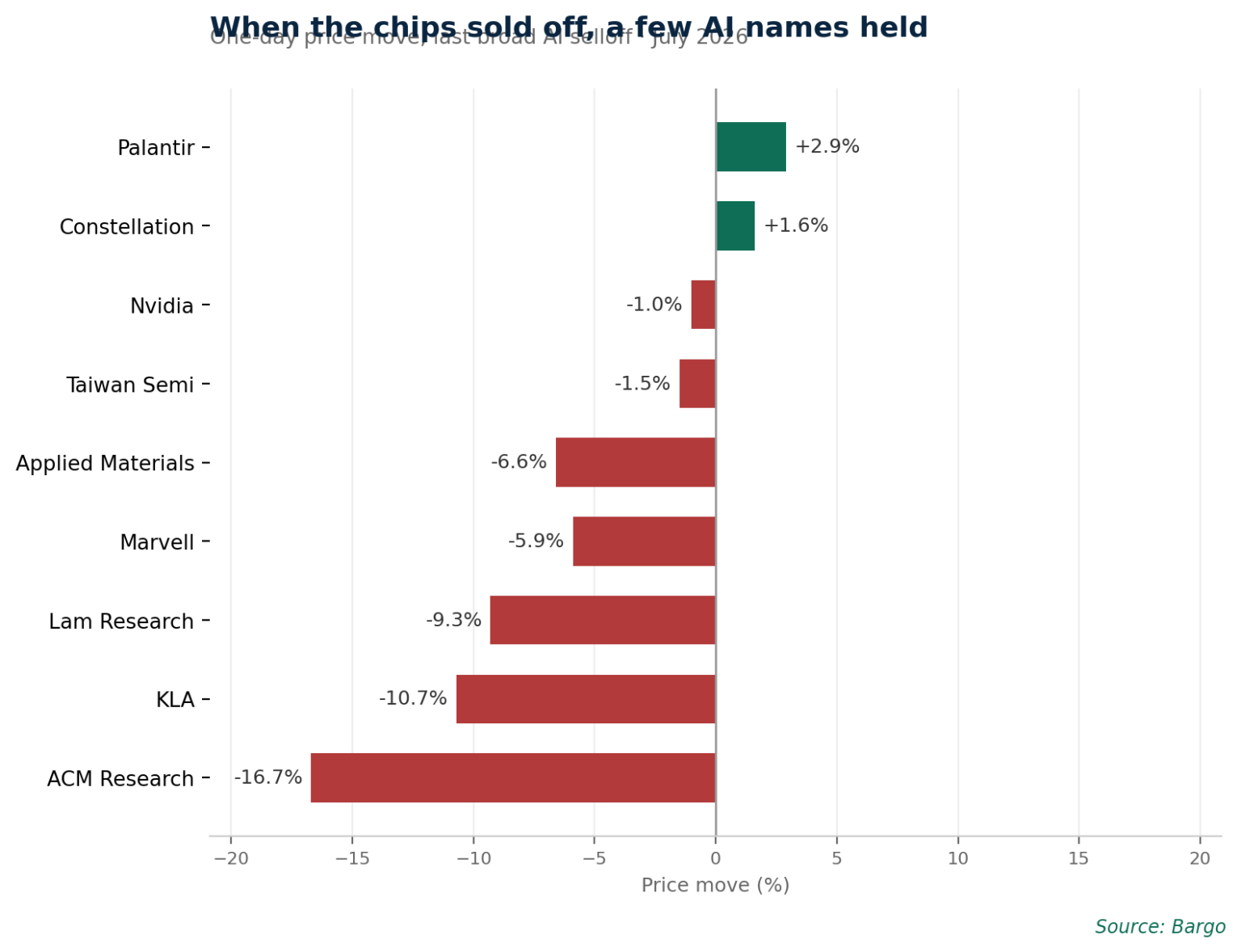
Here is the picture in one line, as of July 2026. On the market’s last broad AI selloff the whole chip complex went red on screen, yet institutional buying kept flowing into the anchors. Nvidia (NVDA) fell about 1 percent while the broad semiconductor ETF dropped 2.5 percent and equipment names like KLA (KLAC) and Lam Research (LRCX) fell 9 to 11 percent. Underneath, five of the seven largest tech names were being bought, not sold. The chart below shows the split.
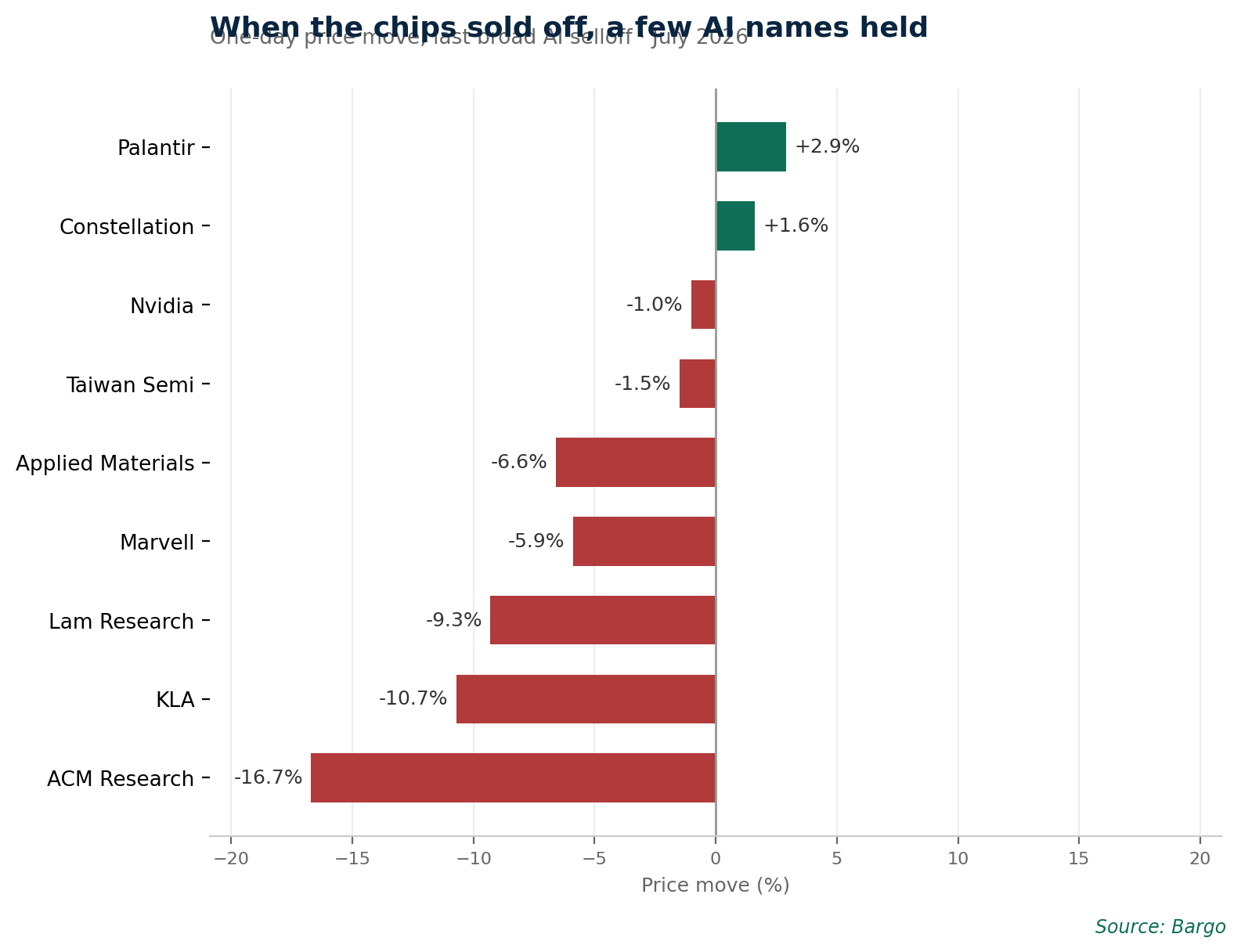
One-day price move on the last broad AI selloff, July 2026. Source: Bargo.
What separates the AI stocks to buy from the rest?
The AI stocks worth buying are the ones institutions accumulate while the tape looks ugly. Price tells you what already happened. Flow, insider activity, and valuation tell you what is being set up next. Large funds fade the panic that retail buys into, and they leave fingerprints in three places most people never check: accumulation flow shows whether big orders are buying or selling, insider filings show when executives buy their own stock, and valuation shows whether you are overpaying for the growth.
Which AI names held when the group sold off?
The anchors held and the equipment makers broke, which told you the selling was rotation, not a collapse. As of the latest data in July 2026 the split looked like this.
| Group | Example names | One-day move | Read |
| Held, green | Palantir (PLTR), Constellation (CEG) | +2.9%, +1.6% | Enterprise AI and AI-power, off the memory cycle |
| Held near flat | Nvidia (NVDA), Taiwan Semi (TSM) | -1.0%, -1.5% | The anchors, quietly bought |
| Bled | KLA (KLAC), Lam (LRCX), ACM Research (ACMR) | -10.7%, -9.3%, -16.7% | Equipment repricing on memory-cycle fear |
The tell sat inside the worst-hit name. ACM Research fell almost 17 percent that session, yet signed order flow, meaning shares weighted by whether they were bought or sold, came in net positive at 42,008 buys against 38,194 sells. The price screamed exit. The flow showed accumulation into the drop.
Are AI stocks still cheap enough to buy?
Several of the biggest AI names are still cheap for how fast they are growing. The cleanest gauge is the PEG ratio, which divides the price-to-earnings multiple by the growth rate, so anything under 1.0 means you are paying little for a lot of growth. As of July 2026 Micron (MU) sat at 0.14, Broadcom (AVGO) at 0.41, Qualcomm (QCOM) at 0.59, and Nvidia at 0.60. Cheap alone is not a buy signal, though. Micron screens cheapest here, yet over the past month its own CEO sold $38.4 million of stock into a wall of bullish news, the classic crowd-loud, insider-quiet tension.
Which signals matter most before you buy?
Insider buying and accumulation flow carry the most weight, because they show conviction with real money, but they only mean something read together. One name passed every filter at once this month: Taiwan Semi logged 33 insider buys and zero sells in 30 days, the only mega-cap tech name with a clean insider-buy signal, while its price held through the selloff and its foundry business sat outside the memory-cycle fear. When flow, insiders, and valuation all point the same way, that is the setup worth acting on.
What to actually do with this
Start with the flow, not the headline. Before buying any AI name, check whether it was accumulated or dumped on its worst recent day, whether insiders have been buying, and whether the price is sane for the growth. When all three line up you are early. When the headline is loud and the flow is calm, you are late. The AI build-out is still the defining trade of this market, across compute, memory, and the power that runs the data centers, and the winners keep separating from the pretenders on exactly the kind of ugly session the market saw this month.
This is research and education, not investment advice. Do your own diligence before buying any stock.