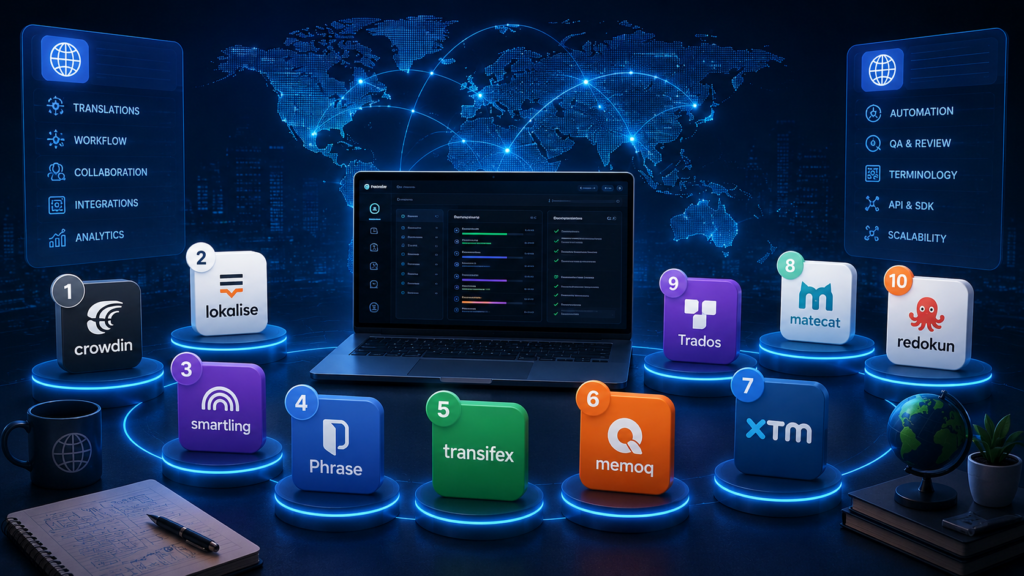

Key Takeaway: The right localization platform matches your team’s content types, release cadence, and integration stack — not the vendor with the most impressive sales pitch. Ten platforms consistently deliver enterprise-grade capability in 2026, each with different strengths worth evaluating in a structured pilot.
TL;DR: The top localization platforms in 2026 combine neural machine translation, translation memory, glossary management, and continuous integration workflows. Crowdin, Lokalise, Phrase, Smartling, Smartcat, POEditor, Transifex, Localize, Applanga, and Bureau Works each occupy different positions in the market. The best choice depends on team size, content volume, target languages, and technical stack. Structured pilots beat proposal comparisons every time.
Localization has moved from a launch-week afterthought to core infrastructure for global software, mobile apps, games, marketing content, and support operations. The platforms that make continuous localization possible have matured dramatically since 2022 — offering integrations with Git repositories, design tools, helpdesks, and CMS systems that turn translation from a bottleneck into a parallel workflow.
Choosing among these platforms is more consequential than most teams initially estimate. The vendor selected today shapes localization capability for the next three to seven years, and switching costs grow substantially as translation memory and integrations accumulate. This guide profiles ten of the most capable localization platforms available today, describes what they do as a service, and provides a framework for choosing the right one for your team.
What Localization Platforms Actually Do as a Service
Modern translation platforms deliver an integrated stack of capabilities that would take engineering teams a year to reproduce internally. Delivered as managed services, they typically include:
- Neural machine translation — multiple engine options with automatic routing
- Translation memory — a database of past translations that compounds in value over time
- Glossary and terminology management — enforcement of brand-consistent terms across releases
- In-context editing — translators see strings in the actual UI they are translating
- Continuous integration — source strings flow automatically from code repositories to translators
- Human review workflows — routing for flagged or high-stakes content
- Quality assurance automation — checks for placeholders, tags, and length constraints
These capabilities apply across use cases: software localization for product strings, mobile app localization for iOS and Android builds, game localization for narrative and UI content, website localization for marketing pages, and support content localization for help centers. Game localization as a service is a particularly demanding subset — it requires cultural consultation, voice-over coordination, and linguistic QA on playable builds alongside the core translation workflow. The best platforms handle all of these use cases without forcing teams to switch products per content type.
Top 10 Localization Platforms in 2026
1. Crowdin
Crowdin localization tools are delivered as a managed service that combines multiple neural engines, translation memory, glossary management, in-context editing, and continuous integration workflows into a single platform. The service supports over fifty file formats and integrates natively with GitHub, GitLab, Bitbucket, Figma, Zendesk, and dozens of other systems — making it a common choice for product-led teams that need one platform covering strings, marketing content, help center articles, and design assets.
Best fit: teams shipping in multiple languages on a continuous release cadence, from indie developers to large enterprises. Free tier available; enterprise plans include SSO, audit logs, and dedicated support.
2. Lokalise
Lokalise is a developer-friendly translation management system focused on SaaS and mobile-first teams. It offers branching workflows that mirror Git branches, in-context editing, and Lokalise OTA for pushing translations to live mobile apps without store resubmission.
Best fit: mid-market SaaS and mobile teams that prioritize workflow polish and mobile SDK integration.
3. Phrase
Phrase, formed through the merger of Phrase Strings and Memsource, combines developer-facing string management with a full translation management system inherited from Memsource. Its NextMT engine can be fine-tuned on customer-specific data.
Best fit: enterprises with diverse content types beyond product strings — marketing, support, legal.
4. Smartling
Smartling sits at the enterprise end of the market. Its NeuralTranslate engine learns from customer-specific translation memory, and the platform pairs with a vetted translator network for managed language services.
Best fit: global brands with strict consistency requirements across high-volume marketing, e-commerce, and customer experience content.
5. Smartcat
Smartcat has positioned itself as an AI-first translation platform that bundles editor, translator marketplace, payment processing, and multi-engine machine translation into a single environment. Consumption-based pricing suits variable translation volume.
Best fit: enterprises consolidating multiple vendors into a single platform.
6. POEditor
POEditor occupies the accessible end of the market. It supports all major mobile and web file formats, offers a clean web editor, integrates with GitHub, GitLab, Bitbucket, and Slack, and provides a genuine free tier for small projects.
Best fit: indie developers and small studios needing professional-grade tooling without enterprise complexity.
7. Transifex
Transifex has been a fixture in the localization space for years, with particular strength in community-driven and open-source translation projects. It supports the standard mobile and web file formats and offers competitive pricing for commercial teams.
Best fit: teams mixing commercial and open-source content, or projects with active community translator bases.
8. Localize
Localize takes a no-code approach — it intercepts and translates website content client-side, eliminating the need to extract strings into resource files. Teams launch new languages within days rather than weeks.
Best fit: marketing sites and web apps prioritizing speed over long-term localization architecture.
9. Applanga
Applanga is a mobile-first platform built around over-the-air translation updates. Deep iOS and Android SDK integration lets developers push translation changes to live apps in real time and A/B test alternative translations directly in production.
Best fit: mobile teams that iterate rapidly and want live translation experimentation.
10. Bureau Works
Bureau Works differentiates through deep AI integration — automatic engine selection per segment, AI-assisted post-editing, and translator ranking based on measured performance data. Consumption-based pricing suits variable volume.
Best fit: enterprises that want maximum AI leverage while maintaining human review on critical content.
Best Practices for Choosing a Localization Platform
Structured evaluation consistently outperforms proposal comparison. Effective selection follows a predictable pattern:
- Define your specific use cases first. Content types, languages, volume, quality tiers, and integration requirements. Vague requirements produce vague evaluations.
- Shortlist three platforms maximum. More candidates dilute pilot quality without improving decision confidence.
- Run paid pilots on real production content. Vendors that resist paid pilots are almost always the wrong choice.
- Score against actual criteria, not vendor claims. Engine quality, integration depth, review workflow, pricing transparency, data privacy, and vendor stability.
- Negotiate translation memory ownership explicitly. Your language assets must remain portable in standard formats (TMX, TBX).
- Start with a limited deployment. Confirm operational fit on one use case before expanding across the organization.
The platform that survives 30-60 days on real production content is the right long-term choice — not the one that dominates the sales pitch.
Frequently Asked Questions
What is the difference between a localization platform and a translation management system?
A translation management system provides the workspace, workflow, and integration layer for localization projects. Modern localization platforms typically include a TMS plus additional components: neural translation engines, translator marketplaces, in-context editing, and human review workflows. In practice, the terms are used interchangeably in 2026.
How much do enterprise localization platforms cost?
Free tiers exist on several platforms for small projects. Paid plans start around $40-$200 per month for small teams. Mid-market plans range from a few hundred to a few thousand dollars monthly depending on volume and seats. Enterprise contracts vary widely — from $50,000 to $500,000+ per year based on translation volume, languages, and managed services.
Can these platforms handle game localization?
Yes. Most platforms profiled support game engine file formats (Unity .po, Unreal .csv, JSON, ARB) and workflows for narrative content, UI strings, and cultural adaptation. Crowdin, Lokalise, and Phrase have particularly strong game industry adoption. Studios with heavy voice-over needs often supplement platform tooling with specialized VO agencies.
How do I know if my team needs a professional localization platform?
Signals include: shipping in four or more languages on a regular cadence, translation volume exceeding 30,000 words per release, glossary consistency issues appearing in user feedback, or engineering time on translation coordination beginning to compete with feature work. Two or more signals typically indicate professional tooling is needed.
How do I choose between a platform, a TMS, and a full-service agency?
Platforms suit teams with internal localization capacity that want control. TMS-focused tools fit teams that already have translation engines in place. Full-service agencies fit teams without internal localization expertise that prefer managed services. The right choice depends on internal maturity, not vendor marketing.
Conclusion
The market for enterprise translation platforms in 2026 offers legitimate differentiation across ten strong vendors. Crowdin, Lokalise, Phrase, Smartling, Smartcat, POEditor, Transifex, Localize, Applanga, and Bureau Works each fit different operational profiles. The right choice depends on your specific content, integration, and workflow requirements — not on vendor rankings that assume every team has identical needs.
Enterprises that treat platform selection as infrastructure planning rather than procurement build partnerships that support them across multiple releases. Those that treat it as a checkbox regret the choice within a year. Structured pilots, honest criteria, and portable data are the three factors that separate successful vendor decisions from expensive mistakes.