

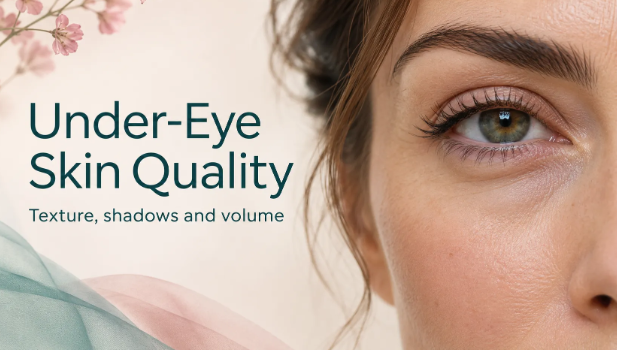

Under-eye skin quality concerns the condition of the skin itself, including fine surface lines, texture, and how underlying color shows through it. Volume loss concerns the support and shape beneath that surface. A hollow can cast a shadow beneath relatively smooth skin, while finely creased skin can appear over a contour that has not lost much projection.
That distinction is central to understanding Elravie Re2O Fine. Humedix identifies Fine as a human acellular dermal matrix product and presents it separately within the Re2O range. [1] Its material identity belongs to a discussion about the skin’s extracellular matrix. It should not be interpreted simply as another name for a conventional hyaluronic acid volumizing gel.
The first useful question is therefore whether a concern comes mainly from the surface, color, or underlying contour. The familiar phrase “tired-looking eyes” can describe all three.
Fine Lines Belong to a Moving Surface
The lower eyelid is a mobile area. Its skin changes shape with blinking, squinting, and expression, and its surface can show folds that become more or less apparent as the area moves. A fine line is therefore a feature of the surface and its behavior; it does not automatically mark an empty space underneath.
Texture describes the small-scale arrangement of that surface. Several shallow creases across an area are different from one broader depression at the transition to the cheek. The first can remain visible across a relatively continuous contour. The second changes the larger shape of the region, even when the surface inside it looks smooth.
The dermis contains a network of extracellular material, including collagen fibers that contribute mechanical strength. Fisher and colleagues showed that collagen fragmentation changes the physical environment of fibroblasts in aged human skin. [8] This gives a biological reason to distinguish the condition of the skin’s matrix from the amount of deeper volume.
The practical difference is straightforward: a smoother surface would be a skin-quality change. A shallower hollow would be a contour change. They may influence the same overall impression, but they are not interchangeable descriptions of a result.
A Hollow Is Part of Three-Dimensional Anatomy
The tear trough is a depression near the transition between the lower eyelid and cheek. Its appearance involves anatomical relationships, rather than a single missing layer of skin. Wong, Hsieh, and Mendelson identified a tear trough ligament in cadaveric dissections, demonstrating a structural basis for this familiar contour. [3]
That finding helps explain why a trough can be visible in someone whose surrounding skin appears relatively smooth. The contour reflects how tissues relate to their attachments and underlying framework. Surface roughness and structural depth should therefore be described separately.
A recessed area also changes the way light reaches the face. The shadow along a depression can make the region look darker without a matching increase in brown pigment. Altering the direction of illumination may change the apparent darkness because it changes the shadow, not because the skin’s pigment has suddenly changed.
Light and facial geometry can alter the darkness seen in a photograph without changing the amount of pigment. This is why a shadow-related concern belongs to a contour discussion, whereas surface roughness belongs to a skin-quality discussion.
Darkness Can Come From Pigment and Visible Vessels
“Dark circles” is a visual description with several possible contributors. Melanin affects brown coloration. Blood within superficial vessels contributes other visible tones. Skin thickness and optical properties influence how those underlying structures are seen. Shadow from the contour can add another component.
Ohshima and Takiwaki compared lower eyelid measurements in participants with and without dark circles and found an association with dermal thickness. [4] Mac-Mary and colleagues later used clinical and instrumental assessments to identify pigmentation, vascular features, and thinner skin as contributors to the appearance of infraorbital dark circles. [5] These observations explain why darkness cannot be assigned to one universal cause.
A separate clinical study by Ranu and colleagues classified periorbital hyperpigmentation into different patterns, including vascular, constitutional, postinflammatory, and shadow-related presentations. [6] The categories are useful because they describe different processes beneath a similar everyday complaint.
For example, a persistent brown tone across a relatively flat area and a dark arc beneath a pronounced contour may look similar at a glance. Their visual origins can differ. Improving surface smoothness would not, by itself, demonstrate that either pigment production or structural shadowing had been corrected.
What the Matrix Concept Adds to Re2O Fine
Human acellular dermal matrix, abbreviated hADM, is processed dermal tissue from which cells have been removed. It is an extracellular matrix material, rather than a preparation of living donor cells. The purpose of decellularization is to reduce cellular components while retaining a useful tissue-derived matrix; the processing method influences what remains and how it is organized. [7]
This material concept differs from supplying an isolated moisturizing ingredient. A matrix contains structural relationships between its components. Describing it as “collagen” alone would leave out the tissue-derived nature of the material and the importance of its processing.
Humedix’s Fine launch information describes a smaller-particle presentation within the Re2O family and discusses its positioning for delicate skin areas. [2] That gives Fine a distinct product identity. It does not provide a basis for assigning every clinical result from the original Re2O presentation to Fine, or for assuming that smaller particles guarantee a particular cosmetic outcome.
The scientifically useful connection is narrower and more concrete: an ECM-based material belongs in a discussion of dermal structure and skin quality. A claim about eliminating pigmentation, correcting a hollow, or changing the entire lid-to-cheek contour would require evidence for that specific result with the exact product.
Comparing Concerns Without Combining Their Endpoints
The most informative comparison separates what is seen from what would count as a change. This avoids treating “brighter,” “smoother,” and “less hollow” as three interchangeable ways of describing one improvement.
| Visible concern | Main feature being considered | A relevant change to distinguish |
| Fine surface creasing | Texture and behavior of the skin | A change in the pattern or prominence of shallow lines |
| Brown discoloration | Pigment-related color | A change in color contrast rather than contour depth |
| Blue or purple appearance | Vascular visibility and skin optics | A change in visible tone rather than added volume |
| A recessed transition | Three-dimensional contour | A change in hollowing rather than surface smoothness |
| A mixed presentation | Several contributors together | Separate changes in each relevant feature |
A person can experience a worthwhile change in one feature while another remains. If the surface looks smoother but a structural shadow persists, that is not a contradiction. The two observations concern different aspects of the area. Equally, a change in the appearance of a hollow would not establish that the skin’s matrix or pigment content had changed to the same degree.
This separation is useful when interpreting research. A study that measures skin texture answers a texture question. A color measurement and a contour assessment answer different questions, even if all are included under the broad label of rejuvenation.
Why Mixed Concerns Need a Precise Description
Consider an under-eye area with fine creases and a visible trough. The creases remain a surface feature, while the trough creates a broader transition. Calling both “wrinkles” hides the difference in scale and anatomy. The same problem occurs when all dark appearance is described as pigmentation.
Another example is relatively smooth skin that allows a blue-toned appearance to show through. Adding the word “dry” to that description would introduce a different concern, one that has not yet been established. Product language becomes more helpful when it follows the observed feature instead of supplying the explanation in advance.
Re2O Fine can be understood within this more precise vocabulary. Its hADM identity directs attention toward the dermal environment. The individual question remains which part of under-eye appearance is actually being discussed. That keeps a focused material concept from turning into an unsupported promise to erase every sign of tiredness.
Frequently Asked Questions
Are dark circles always a sign of volume loss?
No. Pigmentation, vascular visibility, skin thickness, and structural shadows can all contribute. A hollow is one possible source of a dark appearance, but it is not the only one. The same everyday term can therefore describe quite different features. Understanding the contributor is more useful than treating darkness as a single anatomical diagnosis.
Are fine lines and a tear trough the same type of crease?
They occur at different scales. Fine lines describe the skin surface, whereas a tear trough is part of the broader lid-to-cheek contour. Both may be visible together, but a smoother surface and a less pronounced depression are different outcomes. Calling both wrinkles can obscure the distinction between skin condition and underlying shape.
Is Re2O Fine a conventional HA filler?
Humedix identifies it as a human tissue product based on acellular dermal matrix. [1] That is a different material identity from a formulated hyaluronic acid gel. The two categories should be compared through their composition and intended role, rather than assumed to be interchangeable because both appear in aesthetic product catalogs.
Does acellular mean that the product contains living stem cells?
No. Acellular means that cells have been removed during tissue processing. The relevant material is the remaining extracellular matrix. This is different from a preparation containing living cells, and it should be explained using that tissue-material identity. Claims about cell-based therapies cannot simply be carried across to an acellular matrix product.
Does Fine mean that the result will be subtler or safer?
The manufacturer discusses a finer particle presentation, but a product name is not a complete clinical outcome measure. Subtlety, tolerability, and effectiveness are separate questions that depend on the exact product and context. The descriptor helps distinguish the presentation; it does not provide a universal prediction for every under-eye concern.
Can an improvement in skin quality remove every type of darkness?
Different causes require different evidence. A change in surface texture may improve the overall appearance while pigment, vascular visibility, or a contour shadow remains. Skin-quality improvement should therefore be described through the feature that changed. It should not be expanded into a claim that every contributor to dark circles has been corrected.
Explore the Distinct Fine Presentation
For professionals comparing professional skin boosters from MJS, Re2O Fine offers a specific ECM-based product identity to examine. Keep the comparison centered on dermal quality and the exact feature under discussion. Distinguishing texture, color, and hollowing makes the product’s positioning clearer and helps explain what a meaningful result would need to address.
References
[1] Humedix. Elravie Re2O Fine: Official Product Information. Undated; accessed 2026.
[2] Humedix. Humedix Holds a Re2O Fine Launch Symposium for Medical Professionals. Official corporate news, translated title. 2026.
[3] Wong CH, Hsieh MKH, Mendelson B. The Tear Trough Ligament: Anatomical Basis for the Tear Trough Deformity. Plastic and Reconstructive Surgery. 2012.
[4] Ohshima H, Takiwaki H. Evaluation of Dark Circles of the Lower Eyelid: Comparison between Reflectance Meters and Image Processing and Involvement of Dermal Thickness in Appearance. Skin Research and Technology. 2008.
[5] Mac-Mary S, Zornoza Solinis I, Predine O, et al. Identification of Three Key Factors Contributing to the Aetiology of Dark Circles by Clinical and Instrumental Assessments of the Infraorbital Region. Clinical, Cosmetic and Investigational Dermatology. 2019.
[6] Ranu H, Thng S, Goh BK, Burger A, Goh CL. Periorbital Hyperpigmentation in Asians: An Epidemiologic Study and a Proposed Classification. Dermatologic Surgery. 2011.
[7] Crapo PM, Gilbert TW, Badylak SF. An Overview of Tissue and Whole Organ Decellularization Processes. Biomaterials. 2011.
[8] Fisher GJ, Quan T, Purohit T, et al. Collagen Fragmentation Promotes Oxidative Stress and Elevates Matrix Metalloproteinase-1 in Fibroblasts in Aged Human Skin. American Journal of Pathology. 2009.


