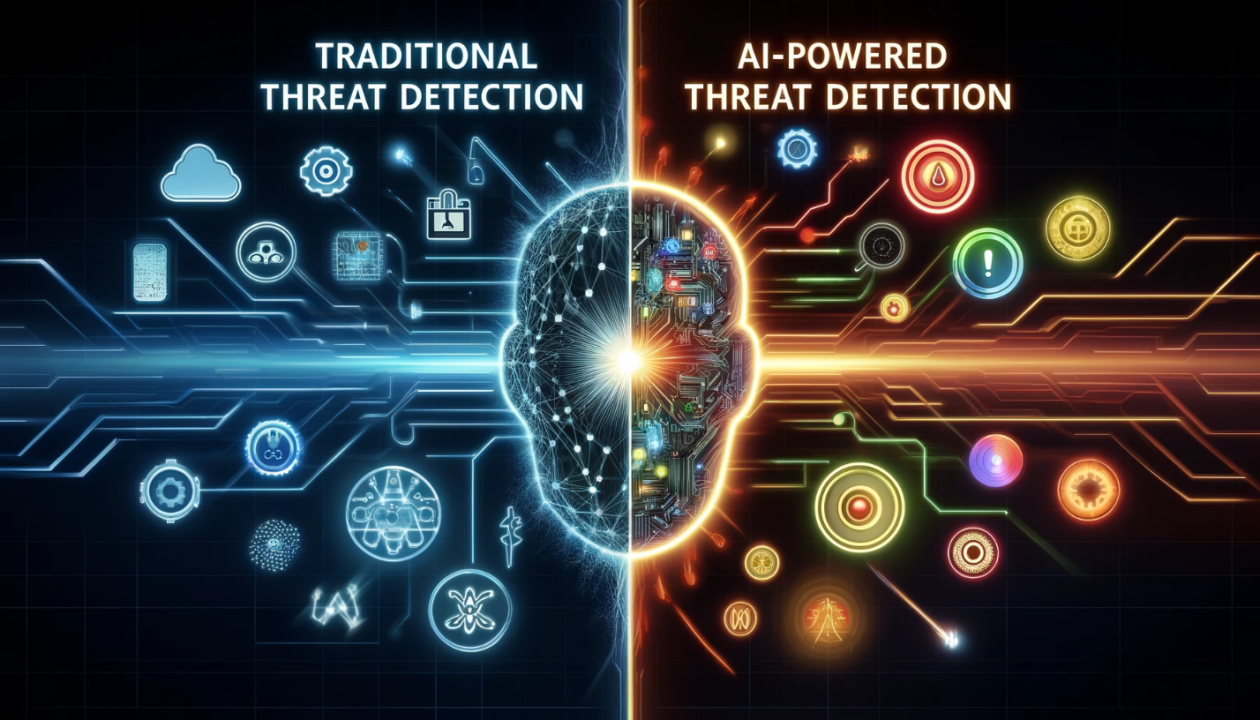

Do not treat AI security as a silver bullet for one problem. This is a detection paradigm that has already been implemented across several disparate layers of enterprise infrastructure with unique threat profiles, collection sources and operational requirements. The trick to understanding AI security is recognizing that it can appear at multiple points in the stack and that each presents a different detection problem.
The answer really depends on whether we are talking about network traffic, endpoints, user accounts, email, cloud workloads or identity systems. The only theme is behavioral modeling over telemetry, but the telemetry, baseline and threat patterns are unique in each instance.
Network Traffic Analysis
Articulating network traffic flows at scale, AI-powered network detection and response tools constantly monitor patterns that signature-based monitoring would miss. NetFlow records, DNS query logs, packet metadata and east-west traffic inside the network. And the model learns what normal behavior is for every slice of your environment: which systems talk to which, at which volumes, when, and by using what protocols.
Anomalous activity can be surfaced by deviations from this learned baseline, potentially indicating command-and-control communication, staging for data exfiltration, lateral movement after initial compromise, or reconnaissance. An attacker communicates to her command-and-control server using encrypted channels (no malware signature will be left), but the communication pattern, type of traffic, timing, volume and destination characteristics may deviate from what is normal for this source system as determined by the model.
Endpoint Detection and Response
On the other hand, AI endpoint detection and response tools focus on monitoring process behavior per device rather than network traffic between devices. The model learns what processes are normal for an endpoint, which parent-child process relationships should exist, the file paths that applications access and the registry keys modified in a typical operation scenario.
A full breakdown of what is AI security for detection covers how these behavioral models function across endpoint, network, and application layers, and how they differ from signature-based endpoint protection.
For example, detection at the endpoint is especially useful for living-off-the-land attacks, in which an attacker uses legitimate system utilities such as PowerShell, WMI, or remote administration tools to perform malicious actions. While the tools themselves do not leave a malware signature, the unique combination of tools, execution context, and action sequence can behave differently than expected in ways that trained models reliably recognize.
User and Entity Behavior Analytics
UEBA stands for user and entity behavior analytics, which uses AI modeling against all authentication events, access logs and activity across productivity systems to flag users or accounts that in some way behave differently from their own historical average or whom they are compared with.
The ENISA Threat Landscape 2025 identifies insider threats and account compromise as persistent categories of incident that traditional perimeter-focused detection consistently misses, because these threats originate from within the network using legitimate credentials. UEBA addresses this gap by treating anomalous behavior by otherwise authorized users as a detection signal, regardless of whether the credential itself was compromised or the behavior is driven by malicious intent from an insider.
Some of the specific signals that UEBA systems model login events from bizarre locations, access to sensitive data at unusual times outside business hours, atypical amounts of data movement into personal cloud storage and greater traces of use to escalate privilege or administrative account activity. None of these activities should intend to be malicious beforehand, and the model does not need to know such intent. It needs to understand that for that user or account, they are strange, which is a different and more flexible detection state. That flexibility is also why behavioural tooling supplements rather than replaces conventional IT security, since a model that flags an anomaly still depends on patching, access control, and logging being handled properly underneath it.
Email Security
The reason for the dominance of AI in enterprise email security is that the kinds of email attacks have evolved beyond what content filters and blacklist-based technologies can deal with. As phishing attackers have become more advanced, they now utilize legitimate infrastructure, scale personalized content that would be difficult, if not impossible to generate manually, and newly invented social engineering techniques specifically designed to avoid detection by known-bad patterns.
AI email security systems automatically examine dozens of signals at the same time: the writing style of the alleged sender compared to past interactions, mail authentication headers, reputation for linked domains checked in real-time rather than against static blocklists, urgency framing or payment requests detected and analyzed simultaneously as emergent threats, historical behavioral profile for the recipient account and much more. Of course, no signal is foolproof alone; however, the combined model can score unseen phishing attempts; where each feature of the message on its own appears innocuous.
Cloud Security Monitoring
Detection challenges unique to cloud environments compared with on-premise infrastructure. Resources scale automatically. Resources are REST API-based, as are many of the legacy network events that on-premises monitoring will rely on for predictive analysis. Identity is your new perimeter, not the network. The post “What Really Can Affect Cloud Performance” appeared first on eG Innovations.
Similar to other AI-based tools used in security, AI cloud security tools parse parameters based on the logs and events generated when you make an API call, work with your identity provider, change the configuration of a resource or access data in order to flag activity that is outside what would be expected. Even when each individual API call is technically authorized, a sudden data request by an account from resources it never queries or the strange appearance of a service principal exfiltrating data from a storage bucket can also be seen through behavioral baselines.
Identity Threat Detection
Identity threat detection (also referred to as identity threat detection and response, or ITDR) uses AI modeling on the authentication and authorization layer versus application or network telemetry. The model learns normal authentication activities (e.g. how accounts authenticate, which methods they use, when they authenticate from which devices and what actions do they carry out immediately after).
The NCSC guidance on AI and cybersecurity explains that AI tools can support escalation of detection capabilities, which is especially useful when the volume of events exceeds human exploration capability or where behaviours are a dominant signal rather than known-bad signatures. Identity is one such domain, and the legitimate credential itself cannot be the detection mechanism that must be based on the subsequent behavior of the account holder post-authentication.
Integration of the Detection Domains
Above, detection domains share data as one of the most effective implementations across enterprises. A suspicious network connection from a workstation is picked up by a network anomaly, an unusual process execution appears for the same machine in endpoint telemetry, and UEBA data shows that the account has logged in from an unusual location one hour before. None of these signals would in and by themselves, lead to escalation. The detection already has high confidence because it cannot be produced by a single domain tool; providing correlation across domains is where AI security provides the most unique enterprise value.
Frequently Asked Questions
How is AI security for email different from AI security for network detection?
Yes. Email AI models emphasize on the traits of message content, sender behavior, and social engineering red flags. Network AI models focus on communication patterns, traffic volumes and connection metadata. The two have behavioral baselines, but they differ on the features they analyze and threat patterns they detect.
Can AI security detect cloud threats in multi-cloud environments?
This is also the nature of how AI cloud security tools work: they can run across clouds if you give them access to relevant logs and identity provider events from each cloud. Since coverage relies heavily on data ingestion from each of the platforms, multi-cloud detection means ensuring that telemetry from all relevant clouds flows into the model.
Is Identity Threat Detection multi-factor authentication?
No it is a control for when users are at the point of login and we need to verify identity. Identity threat detection checks the actions of an authenticated account post login and raises alerts for aberrant activity from baseline, inclusive of compromised accounts that have utilized MFA to pass authentication with stolen credentials or torso tokens.