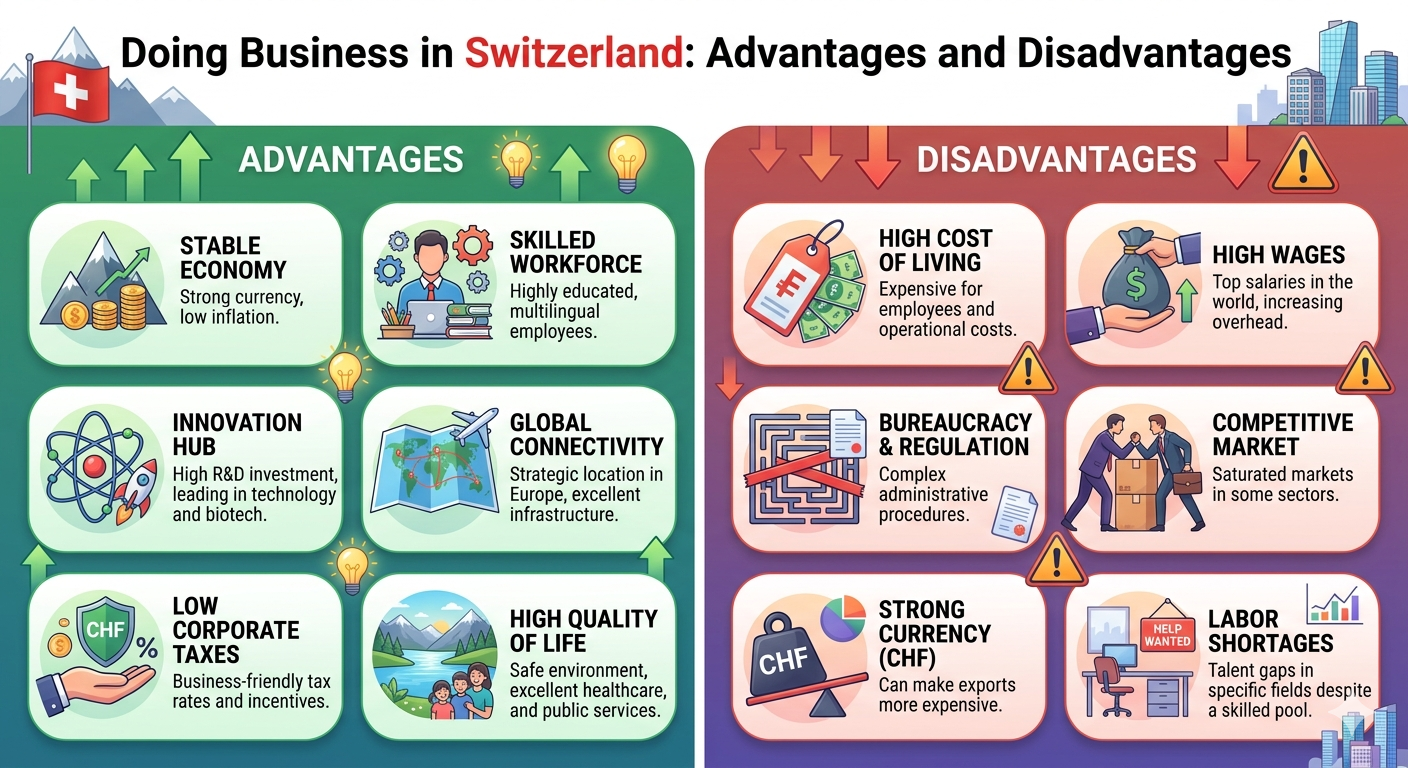

Switzerland is one of the most respected business jurisdictions in the world. It is associated with political stability, legal certainty, reliable banking, high-quality services, innovation, and strong international credibility. For foreign investors, entrepreneurs, consulting firms, IT companies, holding structures, trading businesses, and private investment projects, Switzerland can become a strategic location for long-term business development.
At the same time, doing business in Switzerland requires serious preparation. The country is not a low-cost jurisdiction. Company formation, accounting, legal support, office rent, salaries, insurance, local representation, and banking compliance may be more expensive than in many other European countries. Switzerland is best suited for companies that value reputation, stability, market trust, and professional business infrastructure.
This article explains the main advantages and disadvantages of doing business in Switzerland and helps foreign entrepreneurs understand whether this jurisdiction is suitable for their goals.
Why Switzerland Attracts Foreign Investors
Switzerland has a unique position in the global economy. Although it is not a member of the European Union, it has close economic relations with the EU and strong links with international markets. The country is home to banks, pharmaceutical corporations, commodity traders, financial companies, technology firms, research centres, consulting businesses, and international headquarters.
Foreign investors often choose Switzerland because it offers:
- stable political and legal institutions;
- strong protection of property and contracts;
- a prestigious company image;
- reliable banking and financial infrastructure;
- access to qualified professionals;
- competitive taxation depending on the canton;
- excellent transport and digital infrastructure;
- high purchasing power;
- strong opportunities for innovation and research.
For companies that depend on trust, a Swiss legal entity can be a valuable business asset. It may improve credibility with banks, investors, suppliers, clients, and international partners.
Main Advantages of Doing Business in Switzerland
Strong International Reputation
One of the main advantages of Switzerland is its global reputation. The country is associated with reliability, quality, precision, financial discipline, confidentiality, and legal stability. A company registered in Switzerland may be perceived as more trustworthy than a company incorporated in a low-reputation or offshore jurisdiction.
A Swiss company may be suitable for:
- international consulting;
- investment and holding structures;
- IT and software development;
- commodity trading;
- financial and advisory services;
- pharmaceutical and biotech projects;
- engineering and industrial services;
- luxury goods and premium brands;
- cross-border trade and distribution.
This reputation can help during negotiations with clients, banks, investors, and partners. For businesses that sell high-value services or work internationally, the Swiss image may become an important competitive advantage.
Political and Legal Stability
Switzerland has one of the most stable political systems in Europe. Its legal framework is predictable, transparent, and business-oriented. Corporate governance, contracts, employment relations, property rights, taxation, and commercial disputes are regulated by clear rules.
For investors, legal certainty is a key factor. It reduces the risk of sudden regulatory changes, weak enforcement, political instability, or unpredictable administrative decisions. This is especially important for companies that plan long-term operations, investment projects, intellectual property protection, or international asset management.
Switzerland also has a federal structure. Many practical business and tax issues depend on the canton. This gives investors flexibility, but it also requires careful planning before choosing the location of the company.
Favourable Business Environment
Switzerland offers an efficient and structured business environment. Company registration is clear, public administration is generally reliable, and professional advisers can organise most procedures for foreign founders.
The most common legal forms for foreign investors are GmbH/SARL and AG/SA. A GmbH is often used by small and medium-sized businesses, family companies, and operating entities. An AG is more suitable for larger companies, holding structures, investment projects, and businesses that need a flexible shareholding model.
The choice of legal form affects share capital, liability, management, shareholder structure, reporting, taxation, confidentiality, and future restructuring. Therefore, it should be made before incorporation with proper legal and tax advice.
Competitive Tax Environment
Switzerland is not a tax-free country, but it can offer a competitive tax environment compared with many developed jurisdictions. Corporate taxation includes federal, cantonal, and municipal levels. Because tax rates differ by canton and municipality, the company’s location can significantly influence the overall tax burden.
Some cantons are attractive for holding companies, trading businesses, headquarters, technology firms, and international service providers. However, tax planning must be compliant and realistic. Swiss authorities expect proper accounting, transparent documentation, economic substance, and a clear business purpose.
A Swiss company may benefit from predictable taxation, double tax treaties, cantonal tax differences, participation relief in certain cases, and relatively low VAT compared with many European countries. Professional tax planning is essential to avoid risks and banking problems.
Reliable Banking System
Switzerland is one of the world’s leading financial centres. Swiss banks are known for reliability, compliance, risk management, international experience, and professional service. For companies involved in trade, consulting, investment, asset management, technology, or high-value transactions, this can be a major advantage.
However, opening a bank account is not automatic. Banks usually check beneficial owners, ownership structure, source of funds, business model, expected transactions, contracts, tax residency, and economic substance. This strict approach protects the reputation of the Swiss financial system, but it also means that foreign founders must prepare documents carefully.
Skilled and Multilingual Workforce
Switzerland has a highly educated workforce. The country is strong in finance, pharmaceuticals, engineering, technology, science, law, logistics, management, and international trade. Many professionals speak several languages, including German, French, Italian, and English.
This is useful for companies that operate across different European and global markets. A Swiss-based team can support German-speaking, French-speaking, Italian-speaking, and international clients. Skilled employees help improve service quality, manage complex projects, reduce operational risks, and meet high customer expectations.
The disadvantage is cost. Salaries and employer expenses in Switzerland are among the highest in Europe.
Excellent Infrastructure and Innovation
Switzerland has modern transport, digital, office, banking, and logistics infrastructure. Zurich, Geneva, Basel, Lausanne, Zug, Bern, and Lugano are important business centres with strong international connections.
The country is also one of Europe’s leading innovation hubs. It has respected universities, research institutions, pharmaceutical companies, biotech centres, technology clusters, engineering firms, and startup ecosystems. This creates opportunities for companies in software, medtech, biotechnology, artificial intelligence, clean technology, fintech, precision engineering, and intellectual property development.
For businesses focused on quality, research, premium products, or advanced services, Switzerland can provide a strong foundation for growth.
Main Disadvantages of Doing Business in Switzerland
High Operating Costs
The main disadvantage of Switzerland is the high cost of doing business. Salaries, rent, accounting, legal services, insurance, compliance, office maintenance, and professional support are expensive compared with many other jurisdictions.
Typical expenses may include:
- company formation and notary costs;
- registered office or physical office expenses;
- accounting and tax reporting;
- legal support;
- payroll and social contributions;
- bank account maintenance;
- insurance;
- translation and certification of documents;
- local representative services.
Switzerland is not ideal for every startup or small business with a limited budget. It is better suited for companies that can justify higher costs through reputation, margins, strategic value, or access to premium clients.
Strict Banking Compliance
Swiss banks apply detailed due diligence procedures. They must understand who owns the company, where the money comes from, what the company does, and what transactions are expected.
Foreign founders may need to provide passports, proof of address, corporate documents, beneficial ownership information, source-of-funds explanations, business plans, contracts, tax residency details, and information about clients and suppliers.
Companies with offshore shareholders, complex ownership structures, unclear business models, high-risk industries, or insufficient documentation may face delays or refusal. Proper preparation before bank application is essential.
Requirement for Swiss Representation
For common company forms such as GmbH/SARL and AG/SA, Swiss law generally requires at least one authorised representative residing in Switzerland. This person must be able to represent the company.
For foreign entrepreneurs who do not live in Switzerland, this requirement creates an additional organisational step and may increase costs. It may be necessary to appoint a local director, manager, board member, or authorised representative.
This issue should be considered before registration, because it directly affects the company structure and ongoing administration.
Federal and Cantonal Complexity
Switzerland’s federal structure gives flexibility, but it also creates complexity. Business rules, taxes, permits, and administrative practices may differ between cantons and municipalities.
The choice of canton should not be based only on tax rates. Investors should also consider language, office costs, banking options, employee availability, industry clusters, transport connections, local administration, and reputation of the location.
A company in Zug, Zurich, Geneva, Basel, Ticino, Vaud, or another canton may have different practical and tax implications. Careful planning is necessary before choosing the jurisdiction within Switzerland.
Labour Costs and Employment Rules
Swiss employees are highly qualified, but labour costs are high. Employers should calculate salaries, social contributions, pension obligations, accident insurance, payroll administration, working hours, termination notices, and employee rights.
Although Swiss labour law is often more flexible than in some neighbouring European countries, employers still need to follow formal rules. For businesses that require many employees, such as retail, hospitality, logistics, production, or local services, labour costs may significantly affect profitability.
Small Domestic Market
Switzerland is wealthy, but its domestic market is relatively small. For many businesses, Switzerland alone may not provide enough scale for rapid growth. Companies often need an international strategy from the beginning.
This is especially important for manufacturers, technology companies, online platforms, wholesalers, and service providers that depend on volume. Switzerland can be an excellent headquarters, holding, investment, or premium service location, but expansion beyond the domestic market may be necessary.
Switzerland Is Not an EU Member State
Switzerland has close economic ties with the European Union, but it is not an EU member. This can create additional considerations for companies that need direct EU market access, EU licences, customs procedures, VAT registration in EU countries, or regulatory recognition.
For some business models, an EU company may be more practical. For others, Switzerland may be better as a headquarters, holding, trading, investment, or premium service jurisdiction. The decision depends on the company’s industry, clients, tax position, and operational needs.
Company Registration in Switzerland
Company registration in Switzerland usually includes choosing the legal form, selecting the canton, preparing corporate documents, appointing directors or managers, arranging share capital, notarising incorporation documents, registering with the Commercial Register, obtaining tax registrations, and opening a bank account.
For non-resident founders, it is important to check whether the company needs a local representative, what documents the bank will request, whether the activity requires a licence, and which canton is most suitable for the business model.
In practical terms, if you are interested in registering a company in Switzerland, the Zigma Law Firm will provide extensive advice and help you prepare and submit all necessary documents.
When Switzerland Is a Good Choice
Switzerland may be an excellent jurisdiction when a company needs reputation, legal stability, banking reliability, international credibility, qualified specialists, or a strong headquarters location.
Switzerland is especially suitable if:
- the business works with international clients;
- reputation is important for sales and partnerships;
- the company needs reliable banking;
- the project has sufficient margins;
- the founder wants a respected European structure;
- the activity involves consulting, IT, finance, trading, pharmaceuticals, research, or investments;
- the business is focused on long-term development.
In these cases, Switzerland’s advantages may outweigh its higher costs.
Conclusion
Doing business in Switzerland offers major advantages: strong international reputation, legal stability, reliable banking, competitive tax planning opportunities, skilled professionals, excellent infrastructure, innovation potential, and access to a premium market. For serious entrepreneurs and investors, Switzerland can become a powerful platform for international growth.
At the same time, Switzerland has disadvantages that must be considered. Operating costs are high, banking compliance is strict, local representation may be required, cantonal rules can be complex, labour is expensive, and the domestic market is relatively small.
Switzerland should not be viewed as a cheap or simple registration destination. It is a premium business jurisdiction for companies that need credibility, structure, stability, and long-term value. With proper legal support, tax planning, banking preparation, and a clear commercial strategy, Switzerland can provide a reliable foundation for sustainable international business development.