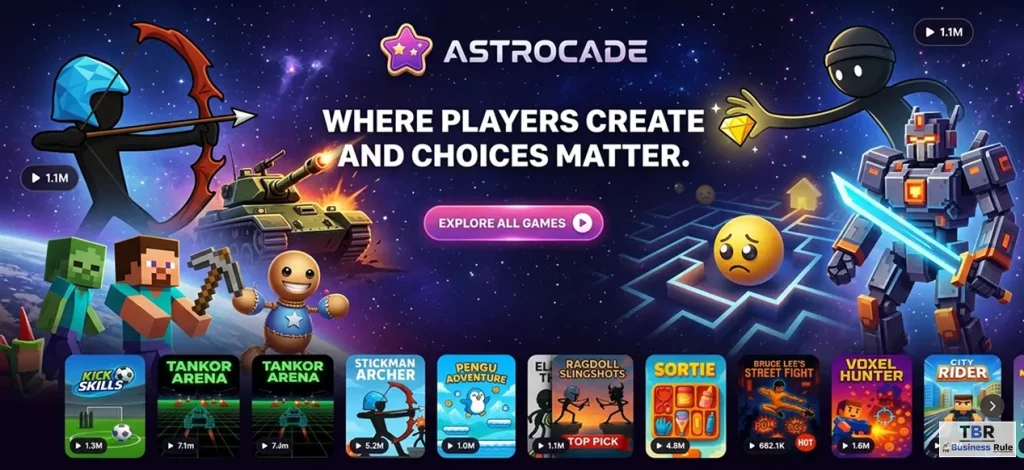

Multiplayer game development has a reputation for being the hardest category of game creation to attempt without technical knowledge. That reputation is not entirely undeserved. Real-time networking, server infrastructure, session management, latency compensation, and synchronization between multiple clients simultaneously are genuinely complex technical challenges that professional developers spend years learning to handle well.
What has changed is that you no longer need to understand any of that to build a multiplayer game that works. The technical infrastructure that makes multiplayer function has been abstracted away by modern creation platforms to the point where adding multiplayer to a game you are building is increasingly a configuration decision rather than an engineering challenge. You define how you want the multiplayer experience to work. The platform handles the implementation of that definition without requiring you to understand the networking code underneath it.
This shift has real implications for independent creators and first-time game makers who have avoided multiplayer concepts because the technical barrier felt insurmountable. That barrier is not gone entirely, but it is lower than it has ever been, and the path through it is clearer than most people who have not recently explored the space realize.
Why Multiplayer Games Are Worth the Additional Effort
Before getting into how to build a game with multiplayer functionality without development experience, it is worth establishing why the additional complexity is worth taking on in the first place. Multiplayer adds layers to the creation process that single-player games do not involve, and understanding the specific value it returns helps you decide whether it is the right choice for your particular project.
The most straightforward reason is retention. Multiplayer games keep players coming back at significantly higher rates than single-player equivalents in the same genre. When the experience involves other people, the unpredictability of human behavior generates variety that no amount of designed content can fully replicate. Two players will never interact with a game in exactly the same way twice, which means multiplayer sessions are inherently non-repetitive in a way that single-player sessions eventually are not.
The social dynamic of multiplayer also creates community around games in ways that single-player experiences rarely achieve organically. Players who compete against each other, cooperate toward shared goals, or simply share the same game space develop connections to each other through the game that extend the game’s relevance in their lives beyond the time they are actively playing. Those connections make the game worth returning to independent of whether new content has been added.
From a distribution perspective, multiplayer games also spread more naturally than single-player titles. When a player invites a friend to join a session, they are simultaneously introducing that friend to the game. Word of mouth is built into the experience structure rather than being something that needs to happen separately after the fact.
Understanding What Multiplayer Actually Requires at a Technical Level
You do not need to implement the technical requirements of multiplayer to build a multiplayer game, but understanding what those requirements are helps you make informed decisions about which platforms and tools can genuinely handle them and which ones are overpromising.
Real-time multiplayer requires a server that mediates communication between players, synchronizes game state across all connected clients, and manages the session lifecycle from creation through completion. In traditional game development, setting up and maintaining this server infrastructure is a significant engineering undertaking that requires ongoing maintenance, cost management, and technical expertise.
Modern game maker online platforms handle this infrastructure as part of their service. When you build multiplayer functionality on these platforms, you are configuring how your game uses infrastructure that already exists and already works rather than building that infrastructure yourself. The distinction is enormous in terms of what it requires from you as a creator.
Turn-based multiplayer is technically simpler than real-time because it does not require continuous state synchronization. Players take actions sequentially, the game state updates between turns, and each player receives the updated state when their turn begins. If your multiplayer concept can work in a turn-based format, it is a meaningfully easier technical challenge for the platform to handle and therefore more reliably available through free tiers of creation tools.
Real-time multiplayer, where all players exist in the same game space simultaneously with synchronized movement and interaction, is more demanding but increasingly well-supported by browser-based creation platforms that have invested specifically in making this capability accessible to non-technical creators.
Cupcake Studio: What Cozy Cooperative Design Looks Like
Not every multiplayer game needs to be competitive, and understanding the range of social experiences multiplayer can create helps you think more creatively about what kind of multiplayer game you actually want to create a game around. Cupcake Studio on Astrocade represents a design philosophy that is worth understanding before assuming that multiplayer means competition.
The game is a cozy baking simulator where players design and create their perfect cupcake from scratch, working through each step of the process with satisfying tactile controls and beautifully detailed animations that make every phase of the baking process feel genuinely pleasurable to engage with. It leans completely into the cozy game trend, delivering a calm, creative experience that prioritizes relaxation and personal expression over challenge or competition.
What Cupcake Studio demonstrates for creators thinking about multiplayer is that shared creative experiences can be as socially engaging as competitive ones, sometimes more so for specific audiences. The appeal of showing someone else what you made, comparing creative choices, and experiencing the same satisfying process in parallel is a social dynamic that does not require scoring, winning, or any form of direct competition to generate genuine engagement between players. For creators whose game idea centers on creativity, expression, or collaborative activity rather than competition, the multiplayer question becomes less about how to make players compete and more about how to make the shared experience of creating something feel meaningful and connected. Cupcake Studio answers that question with a clarity that is instructive regardless of what kind of game you are planning to build.
The Types of Multiplayer You Can Build Without Technical Skills
Multiplayer is not a single feature with one implementation. It is a category of experiences that includes several distinct formats, each with different technical requirements and different creative possibilities. Understanding which format fits your game concept helps you choose tools and platforms appropriately and set realistic expectations about what you are building.
Asynchronous multiplayer involves players interacting with each other’s game states without being in the same session simultaneously. Leaderboards are the simplest form: you play your session, your score is recorded, other players see your score and compete against it in their own separate sessions. Ghost systems in racing games are another form: your recorded run appears as a ghost in other players’ sessions, creating a sense of competition without requiring simultaneous connection.
This format is the most accessible for non-technical creators because the infrastructure requirements are minimal and the design complexity is manageable. Many no-code game maker platforms support asynchronous multiplayer features as standard components that require configuration rather than custom implementation.
Session-based multiplayer brings players together in shared game spaces for defined periods. Lobby systems create sessions, players join, the game runs, the session ends. This is the format most people picture when they think of multiplayer games, and it is increasingly supported by browser-based creation platforms through pre-built networking components that handle the session lifecycle without requiring creators to manage it manually.
Persistent world multiplayer, where a shared game world exists continuously and players come and go, is the most technically demanding format and the least accessible through no-code tools currently. If your concept requires this format, you may encounter limitations with fully no-code approaches that the other formats do not present.
Choosing a Platform That Actually Supports Multiplayer Without Code
The difference between platforms that claim to support multiplayer and platforms that actually deliver functional multiplayer through accessible no-code interfaces is significant and worth investigating carefully before committing development time to a specific tool.
The claim that a game builder supports multiplayer appears frequently in platform marketing. What it means in practice varies enormously. Some platforms offer deep, reliable multiplayer functionality through visual configuration interfaces that make real-time session management genuinely accessible to non-technical creators. Others offer multiplayer features that are technically present but practically inaccessible without programming knowledge to configure them properly. Still others support only the simplest forms of multiplayer, like leaderboards, while using language that implies broader multiplayer capability.
The honest evaluation process involves building a simple prototype with the multiplayer feature you need and testing whether it actually works the way you need it to before investing significant creative time in a platform. A platform whose multiplayer functionality fails basic reliability tests at the prototype stage will not become more reliable as your game becomes more complex.
Questions worth investigating before committing to a platform for a multiplayer project:
- Does the platform’s multiplayer work through visual configuration without requiring any code or scripting
- What is the maximum number of simultaneous players supported in a single session on the free tier
- Is session creation and management handled automatically or does it require manual configuration for each session
- How does the platform handle players dropping out mid-session without breaking the experience for remaining players
- Are there working examples of multiplayer games built by non-technical creators on this platform that you can play and evaluate
Designing Multiplayer That Works for Your Specific Audience
Technical implementation is only half of building a successful multiplayer game. The design of the multiplayer experience, how players interact with each other, what motivates them to play together, and what makes sessions feel worth the time invested, determines whether the game is actually enjoyable once the technical challenges are solved.
Making games with multiplayer requires thinking about the social dynamics of your specific player audience before deciding which multiplayer format to build. A competitive format that works brilliantly for an audience of engaged gamers looking for challenge can completely alienate a casual audience looking for social entertainment without high stakes. The multiplayer design needs to match the audience as precisely as the game mechanics match the genre.
Consider what you want players to feel during a shared session. Competition creates engagement through the desire to win and the tension of uncertainty about the outcome. Cooperation creates engagement through shared challenge and the satisfaction of coordinated achievement. Creative sharing creates engagement through self-expression and the pleasure of experiencing what others create. Social chaos creates engagement through unpredictability and the humor of unexpected interactions.
Each of these social dynamics can be designed toward deliberately, and the one you choose should be the one that fits both the core mechanic of your game and the audience you are building for. Multiplayer that feels like a natural extension of what makes the single-player experience compelling will almost always outperform multiplayer that feels like a separate feature added to a game that was not designed with it in mind.
The Specific Challenges of Multiplayer Game Balance
Single-player games need to be balanced against the designer’s intention for how the game should be experienced. Multiplayer games need to be balanced against the unpredictable range of ways that human players will interact with the system when competing against or cooperating with each other. This is a meaningfully different and more complex design challenge.
In single-player games, you test your own game and observe whether it feels right. In multiplayer games, the balance depends on emergent interactions between players that you cannot fully anticipate or reproduce in testing because you cannot fully replicate the behavior of actual players competing with real stakes.
The practical implication for creators using a no-code game maker to create game experiences with multiplayer is that extensive playtesting with real players is even more critical than for single-player projects. Balance problems that are invisible in single-player testing become immediately apparent when actual players start finding and exploiting them, and finding those problems before publication rather than after saves significant redesign work.
Starting with simpler multiplayer designs that have fewer exploitable edge cases is another practical approach. A game with one clear multiplayer mechanic and minimal complexity has fewer balance problems to discover than a game with interconnected systems that interact differently under multiplayer conditions than they did in single-player testing. Simplicity in multiplayer design is not a creative limitation. It is a practical strategy that produces more reliable results for creators without extensive multiplayer design experience.
Using an AI Game Maker to Accelerate Multiplayer Development
The specific challenges of multiplayer game development are ones where AI game maker assistance delivers meaningful practical value beyond what it offers for single-player projects. The additional complexity of multiplayer design creates more opportunities for AI assistance to save time and reduce the cognitive load on the creator.
AI-assisted behavior configuration is particularly valuable for multiplayer because defining how game elements should behave when multiple players are simultaneously interacting with them is more complex than defining single-player behavior. Describing the intended behavior in natural language and having AI translate that description into working game logic reduces the chance of implementation errors that create inconsistent experiences for different players.
Asset generation is equally valuable in multiplayer contexts because multiplayer games often need more visual differentiation between players than single-player games require. Character customization, distinct visual identities for different players, and clear visual communication of game state to multiple simultaneous viewers all require more asset variety than single-player equivalents. AI generation of these assets at the volume required without needing a dedicated artist is a meaningful practical advantage for solo creators building multiplayer experiences.
Testing simulation tools that use AI to approximate the behavior of multiple players in your game before you have access to real testers are also increasingly available through advanced creation platforms. These tools cannot fully replace real player testing, but they can identify obvious balance problems and interaction errors early enough that real player testing focuses on refinements rather than fundamental issues.
Publishing and Growing a Multiplayer Game
The post-publication phase of a multiplayer game has specific challenges that single-player games do not face. The most fundamental is the cold start problem: a multiplayer game with no players provides a worse experience than a multiplayer game with an active player base, which means new games need to reach critical mass quickly enough that new players arriving find active sessions rather than empty lobbies.
Building on a platform with an existing player community addresses this problem more effectively than independent distribution. Platforms like Astrocade that connect creators with an existing audience mean that publication connects immediately to players who are already looking for new games to try rather than leaving distribution entirely to the creator’s own promotional efforts.
The social nature of multiplayer games also makes community building particularly important after publication. Players who connect with each other through your game become advocates for it in ways that solo players rarely do. Facilitating those connections through community features, encouraging players to share their experiences, and being responsive to community feedback creates a self-reinforcing growth dynamic that makes multiplayer games easier to grow organically than single-player equivalents once they reach an initial critical mass.
Conclusion
Building a multiplayer game without being a developer is genuinely achievable through the combination of modern no-code creation platforms, AI-assisted development tools, and integrated publishing infrastructure that connects your finished game to real players immediately. The technical complexity that made multiplayer development the exclusive domain of experienced engineers has been abstracted away by platforms designed specifically to make these capabilities accessible to creators at every technical level. What remains is the creative work: designing a multiplayer experience that gives players genuine reasons to play together, balancing the experience through real player testing, and publishing on a platform that connects your game to an audience that can discover it. Make your own game with multiplayer at its center, invest in the design thinking that makes shared experiences worth having, and the technical side of making it work is more solved than it has ever been.