
For telecom providers, churn is expensive in ways that rarely show up in quarterly reports.
Losing a subscriber does not just mean losing one monthly payment. It means losing future upgrades, bundled services, roaming revenue, and referral potential. In mature telecom markets where customer acquisition costs are already high, replacing a lost subscriber often costs far more than keeping an existing one.
That is why major operators like Vodafone, AT&T, as well Deutsche Telekom continue investing heavily in AI-driven retention systems and real-time customer intelligence platforms.
Most telecom companies already have the raw data. The problem is that data sits across billing systems, CRM platforms, call center software, mobile apps, and network monitoring tools that were never designed to work together.
That fragmentation is one reason telecom providers increasingly invest in custom telecom analytics software instead of relying entirely on off-the-shelf reporting tools.
The shift matters because retention strategies built on generic dashboards and delayed reporting are starting to fail. Customers move faster now. Switching carriers no longer feels disruptive, especially in markets where eSIM adoption is growing and plan comparisons take seconds.
A retention team that reacts after a cancellation request arrives is already late.
Most churn signals appear weeks before a customer leaves
Subscribers rarely disappear without warning.
The warning signs are usually small at first. Data usage drops. Support tickets increase. Payments become inconsistent. Mobile app engagement declines. A customer who used to upgrade devices regularly suddenly stops responding to offers.
Individually, none of those signals guarantees churn. Together, they often do.
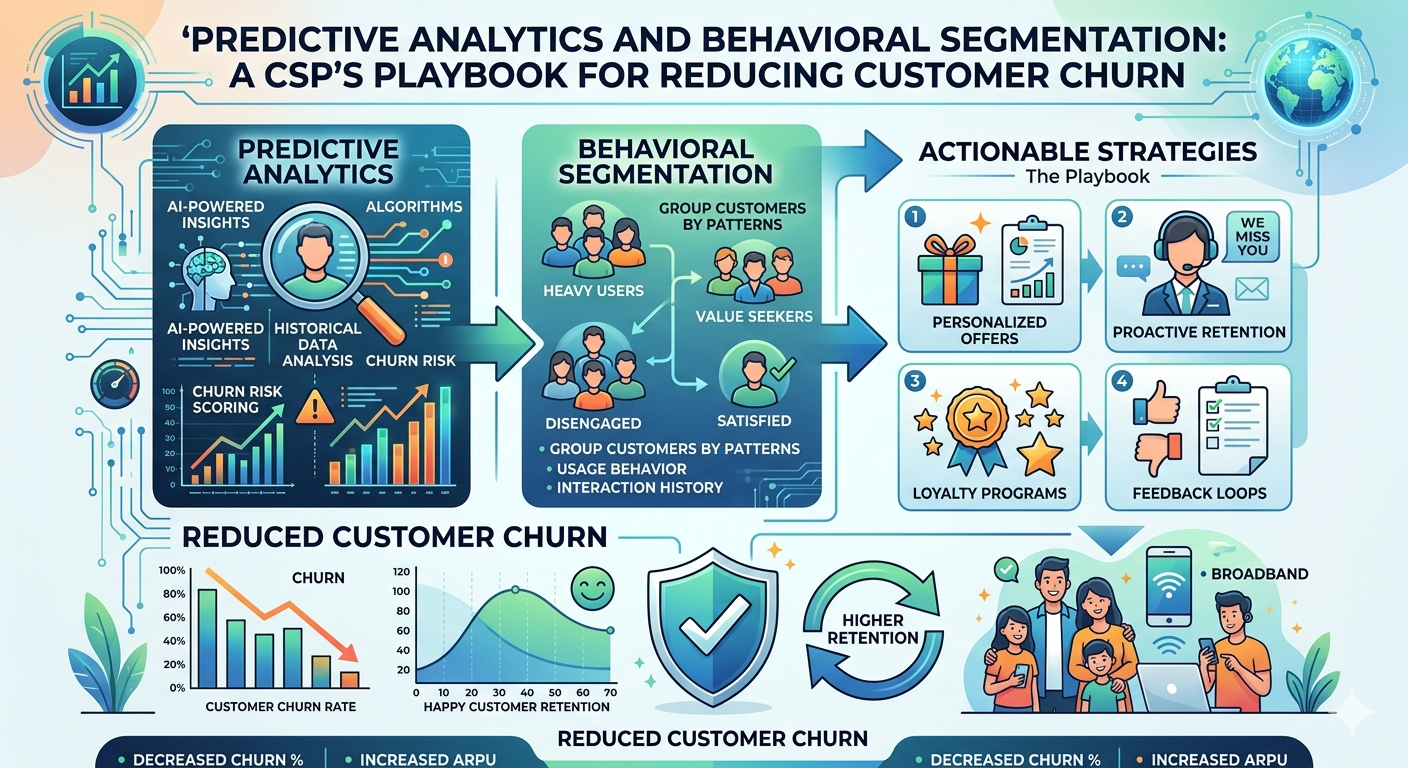
This is where customer churn prediction models have become valuable for CSPs. Instead of treating churn as a historical metric, telecom companies now treat it as a probability problem.
Machine learning systems analyze patterns linked to previous cancellations and compare them against current subscriber behavior. The output is not a perfect forecast. It is a risk estimate.
That distinction matters.
A predictive model can identify likely churn candidates, but it cannot fully explain motivation. Telecom providers that ignore this limitation often end up over-automating retention workflows and flooding customers with irrelevant offers.
Some operators learned that the hard way.
In 2024, analysts at McKinsey & Company noted that telecom companies adopting AI-based retention programs frequently struggled with false positives because many models were trained on incomplete customer data. A subscriber contacting support twice in one week may indicate frustration. It may also mean they are setting up a new device.
Context changes everything.
Demographics tell telecom providers almost nothing about churn risk
For years, telecom marketing teams relied heavily on demographic segmentation.
Age, household income, location, as well as device ownership were used to organize subscribers into broad audience groups. That still works for brand campaigns and regional promotions. It does not work particularly well for retention.
Two subscribers with similar demographic profiles can behave in completely different ways.
One customer may stream Netflix daily, purchase international roaming add-ons, and upgrade devices every year. Another may barely use mobile data and only care about stable pricing.
Treating both customers the same usually leads to wasted retention spending.
That is why behavioral segmentation became central to modern telecom analytics.
Instead of grouping customers by static attributes, telecom providers analyze how subscribers actually interact with services over time. Usage frequency, payment consistency, support history, app engagement, upgrade behavior, and response to promotions all become part of the customer profile.
The concept sounds straightforward. The execution is not.
Large operators process billions of events every day across mobile networks, CRM systems, apps, as well as customer support platforms. Building reliable behavioral profiles requires clean infrastructure and strong governance. Many telecom environments still operate on legacy systems that were never designed for real-time analytics.
That limitation matters more than most vendors admit.
A churn model built on fragmented data can easily produce misleading results. A subscriber flagged as high-risk may simply be traveling abroad and temporarily changing usage behavior. A customer receiving repeated retention offers may not be dissatisfied at all.
This is one reason telecom companies like T-Mobile and Verizon continue investing heavily in centralized data platforms and AI infrastructure instead of relying exclusively on isolated CRM reporting.
The retention logic is only as good as the operational data behind it.
Telecom companies are shifting from mass retention campaigns to precision targeting
Traditional retention campaigns were blunt instruments.
A telecom provider would identify a broad customer group with elevated churn rates and send discount offers to nearly everyone in that segment. Sometimes the strategy worked. Often it trained customers to wait for discounts.
That approach becomes expensive very quickly.
A provider offering retention discounts to thousands of low-risk subscribers can burn through marketing budgets without improving subscriber retention in a meaningful way.
Modern predictive analytics in telecom works differently.
Instead of targeting entire customer groups, operators increasingly focus on individual churn probability combined with behavioral context.
For example, a subscriber experiencing repeated network issues may respond better to proactive technical support than to a pricing discount. A price-sensitive prepaid customer may react positively to flexible plan options but ignore premium content bundles entirely.
This level of targeting depends on combining predictive modeling with operational data in near real time.
Some telecom operators already use streaming analytics infrastructure built on technologies like Apache Kafka, Databricks, Snowflake, as well as Google BigQuery to process customer events continuously instead of relying on overnight batch reports.
The technical investment is substantial.
The alternative is slower decision-making and stale retention data.
Churn reduction alone is a weak business metric
A telecom company can reduce churn rates and still make poor retention decisions.
That sounds counterintuitive until customer economics enter the conversation.
Not every subscriber contributes the same long-term value. A customer with broadband, mobile, family plans, and roaming services generates far more revenue over time than a low-engagement prepaid user who changes providers every few months.
That is why serious retention programs integrate customer lifetime value directly into retention modeling.
Without that layer, operators often overspend on low-value subscribers while failing to protect their most profitable accounts.
The math becomes difficult during economic downturns or pricing wars.
In highly competitive telecom markets, some providers aggressively discount plans to keep churn numbers low. The strategy may improve short-term retention metrics while damaging long-term margins.
Telecom executives rarely discuss this publicly, but many retention campaigns are designed around profitability thresholds rather than churn elimination.
Some churn is unavoidable.
Some churn is financially acceptable.
The more important question is whether retention spending produces sustainable revenue over time.
This is also where predictive analytics in telecom becomes more useful than traditional reporting.
A static churn dashboard tells operators what already happened. Predictive systems help estimate which customers are worth proactive intervention before revenue loss occurs.
Real-time retention sounds impressive. It is also difficult to execute
There is a reason telecom executives talk constantly about real-time analytics.
Timing matters.
A retention offer delivered after a customer has already ported their number is almost useless.
Modern retention systems attempt to detect churn signals early enough to trigger intervention before dissatisfaction hardens into a final decision.
That could mean:
- escalating unresolved support tickets
- sending service recovery credits
- adjusting pricing plans automatically
- routing high-value customers to specialized support teams
But real-time analytics introduces operational complexity that many CSPs underestimate.
Streaming infrastructure is expensive to maintain. Data quality issues spread faster in real-time systems. Integration failures between CRM tools and analytics pipelines can create incorrect churn scores within minutes.
Even the models themselves degrade over time.
Subscriber behavior changes constantly due to economic conditions, competitor pricing, device trends, and regional service quality issues. A model trained two years ago may become unreliable if market conditions shift significantly.
That means retention systems require continuous retraining, monitoring, as well as validation.
There is no “set it and forget it” version of predictive retention.
Telecom providers are using retention analytics to uncover operational problems
One of the more interesting side effects of predictive analytics is that it exposes weaknesses outside the retention department.
A spike in churn risk within one geographic region may point to deteriorating network quality. Increased cancellation probability among certain customer groups may trace back to billing confusion or poor support experiences.
The analytics layer becomes a diagnostic tool.
That is partly why predictive retention initiatives now involve engineering, customer support, data science, operations, and marketing teams simultaneously.
The companies getting the best results are not treating retention as a standalone campaign function anymore.
They are treating it as an operational intelligence problem.
And that changes how telecom organizations invest in infrastructure, analytics, and customer experience.
The telecom providers that continue relying on static reporting and generic discount campaigns will probably keep losing subscribers at predictable rates.
The providers building stronger behavioral intelligence systems have a better chance of understanding which customers are at risk, why they are leaving, and when intervention still has a realistic chance of working.