
Imagine an organization that automates its purchasing approval workflow. Requests move between departments faster, yet employees still face unnecessary approval requirements, suppliers experience payment delays and purchasing costs remain unchanged. The technology performs as intended, but the underlying business problems persist.
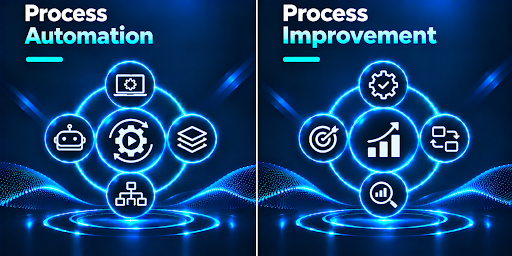
This illustrates an important distinction between process automation and process improvement. One focuses on reducing manual intervention, while the other examines whether activities contribute effectively to business objectives.
Organizations that combine these disciplines can achieve benefits beyond faster transaction processing. They can eliminate unnecessary work, strengthen operational controls and build business processes that respond effectively to changing enterprise requirements.
Understanding the difference between automation and improvement
Process automation uses technology to perform repetitive activities, execute predefined workflows and reduce manual intervention. Examples include automated invoice matching, employee record updates and service request routing.
Process improvement involves evaluating and redesigning existing workflows to improve efficiency, quality, responsiveness and business outcomes. It examines whether activities are necessary, how resources are utilized and where operational bottlenecks originate.
The distinction matters because automating an inefficient activity does not necessarily make the overall business process effective.
For instance, automating the preparation of an unnecessary report saves employee time, but eliminating the report altogether may deliver greater value.
Why organizations should challenge existing workflows before automating them
Business processes often accumulate complexity over time. Additional approval requirements, reporting obligations and manual checks may be introduced in response to individual problems without considering their cumulative impact.
Eventually, employees spend considerable time navigating procedures that no longer serve their original purpose.
Process improvement helps organizations distinguish essential controls from outdated practices. It also identifies activities that can be consolidated, standardized or eliminated.
Once these opportunities are understood, process automation can support a redesigned workflow rather than reinforce existing inefficiencies.
This approach can reduce implementation costs because organizations avoid developing technology solutions for activities that should no longer exist.
Four signs that a business process needs redesign
Not every operational challenge requires advanced technology. Organizations should recognize the symptoms of underlying process weaknesses before committing to automation.
Excessive handoffs
When activities move repeatedly between departments, employees may spend more time coordinating work than completing it. Redesigning responsibilities can reduce delays and strengthen accountability.
Recurring exceptions
Frequent transaction errors or unresolved cases may indicate inconsistent data, unclear policies or inadequate controls. Automating exception handling without addressing these causes can preserve the problem.
Duplicated information
Employees entering identical information into multiple systems often face unnecessary workloads. Integrated applications and standardized data management can eliminate repetitive activities.
Unclear performance ownership
When departments optimize individual activities without considering end-to-end outcomes, operational problems can remain unresolved. Process improvement establishes clearer accountability for overall performance.
Choosing the right intervention for each business problem
Organizations should determine whether a performance challenge requires elimination, simplification, standardization or automation.
| Business challenge | Appropriate intervention |
| Unnecessary reporting requirements | Eliminate activities that provide limited value |
| Complex approval structures | Simplify decision rights and approval levels |
| Inconsistent departmental procedures | Standardize common workflows |
| Repetitive data entry | Introduce process automation |
| Fragmented enterprise information | Integrate applications and data sources |
| Complex knowledge-intensive activities | Introduce AI-supported decision-making |
This distinction helps leadership teams allocate technology investments according to operational requirements rather than treating automation as the default solution.
How automation and improvement work together across business functions
Finance: Reducing invoice processing complexity
Accounts payable teams may experience delays because invoices contain inconsistent information or require unnecessary approvals.
Process improvement can address supplier submission requirements, purchasing policies and exception ownership. Automation can then support invoice validation, matching and approved payment workflows.
The combined approach can reduce processing effort while maintaining financial controls.
Human resources: Simplifying employee administration
Employee onboarding frequently involves documentation, system updates and coordination between multiple departments.
Redesigning the onboarding journey can eliminate duplicated information requests and clarify responsibilities. Process automation can then coordinate notifications, documentation and authorized administrative activities.
Procurement: Accelerating purchasing decisions
Lengthy purchasing cycles may result from unclear approval thresholds or inconsistent sourcing procedures.
Standardized purchasing policies can reduce unnecessary reviews, while automated workflows can route requests according to established business rules.
Supply chain: Improving operational responsiveness
Supply chain teams frequently manage exceptions involving inventory, suppliers and customer orders.
Process improvement can establish clearer exception management procedures, while intelligent automation can identify deviations and initiate approved responses.
How artificial intelligence is expanding automation capabilities
Traditional automation performs activities according to predefined instructions. Artificial intelligence extends these capabilities by supporting pattern recognition, information interpretation and contextual decision support.
Generative AI can summarize documents, explain operational exceptions and retrieve relevant enterprise knowledge. AI agents can coordinate approved multistep activities across business applications.
These developments allow process automation to support increasingly complex workflows that previously required substantial manual coordination.
However, organizations must distinguish between activities that can be executed independently and decisions requiring human judgment.
For example, an AI agent may investigate an invoice discrepancy and prepare supporting information, while an authorized finance professional retains responsibility for approving payment adjustments.
Measuring value beyond the number of automated activities
The success of process automation should not be measured solely through automation rates or hours saved.
Organizations need to establish whether operational changes produce meaningful financial and service improvements.
Relevant performance indicators include:
- End-to-end process cycle time.
- Operating cost per transaction.
- Employee productivity and capacity utilization.
- Transaction error and exception rates.
- Customer and employee satisfaction.
- Service-level performance.
- Return on technology investment.
Process improvement should also be evaluated through the elimination of unnecessary activities and reductions in operational complexity.
Released employee capacity creates financial value only when it supports additional productive work, avoids future expenditure or contributes to actual cost reductions.
Making continuous improvement part of everyday operations
Business requirements, customer expectations and technology capabilities continue to evolve. A workflow that performs effectively today may become inefficient as transaction volumes increase or organizational structures change.
Organizations should establish mechanisms for monitoring performance, collecting employee feedback and identifying emerging bottlenecks.
Process automation can provide operational data that reveals recurring delays, exceptions and variations in workflow performance.
These insights can inform future process improvement initiatives, creating an ongoing relationship between technology-enabled execution and organizational learning.
Rather than treating transformation as a one-time project, businesses can establish continuous improvement as a management discipline supported by clear ownership and performance accountability.
Conclusion
Process automation creates opportunities to reduce manual effort, accelerate workflows and improve operational consistency. Process improvement ensures these capabilities address the right business problems.
The strongest results emerge when organizations question existing practices before introducing technology, evaluate investments against business outcomes and continuously monitor performance.
By focusing on the effectiveness of complete business processes rather than the speed of individual activities, organizations can reduce operational complexity, strengthen service delivery and achieve sustainable productivity improvements.