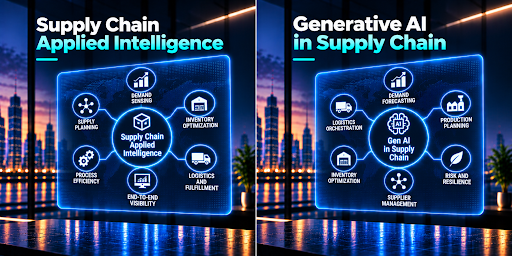

Supply chain organizations have access to unprecedented volumes of information, from real-time inventory records and supplier communications to customer demand signals and transportation updates. Yet having more information does not necessarily lead to better operational decisions. The challenge lies in interpreting relevant signals, understanding their business implications and responding before problems escalate.
Supply chain applied intelligence addresses this challenge by connecting analytical capabilities, operational expertise and intelligent technologies with business processes. Generative AI in supply chain strengthens this approach by making complex information easier to interpret and act upon.
Together, these capabilities can help organizations close the gap between identifying operational problems and implementing effective responses.
The problem with information-rich but insight-poor supply chains
Modern supply chains generate information across enterprise resource planning systems, manufacturing platforms, warehouse applications and supplier networks. However, these systems often provide separate views of operational performance.
A planner investigating a potential stock shortage may need to examine purchase orders, demand forecasts, production schedules and supplier communications before determining the appropriate response.
Supply chain applied intelligence connects these information sources with analytical and decision-support capabilities.
Generative AI in supply chain can reduce the investigative burden by synthesizing relevant information and presenting findings in a format that specialists can readily interpret.
The objective is to shorten the distance between operational signals and informed decisions.
What is supply chain applied intelligence?
Supply chain applied intelligence is the practical use of artificial intelligence, advanced analytics, automation and operational knowledge to improve supply chain performance.
It combines technologies such as predictive analytics, machine learning, mathematical optimization and intelligent workflows to address specific business challenges.
Unlike isolated analytical applications, this approach embeds intelligence within operational processes.
For example, an inventory management system may identify excess stock, while analytical capabilities investigate contributing factors and support decisions about replenishment adjustments.
The emphasis is on applying intelligence where it produces measurable improvements in cost, responsiveness and service performance.
What role does generative AI in supply chain play?
Generative AI in supply chain supports activities involving unstructured information, contextual interpretation, knowledge retrieval and communication.
While predictive models estimate future conditions and optimization systems evaluate alternatives, generative models can explain findings and summarize their operational implications.
A supply chain professional could use generative AI to understand why a forecast has changed, retrieve relevant supplier correspondence or prepare an initial disruption assessment.
Within supply chain applied intelligence, these capabilities make specialized analytical findings more accessible to employees across different business functions.
How different forms of intelligence work together
An effective intelligent supply chain combines complementary technologies rather than relying on a single AI model.
| Intelligence capability | Operational contribution |
| Predictive analytics | Anticipates demand fluctuations and potential disruptions |
| Mathematical optimization | Evaluates inventory, production and transportation alternatives |
| Machine learning | Identifies operational patterns and anomalies |
| Generative AI | Explains findings and interprets unstructured information |
| Agentic AI | Coordinates approved multistep workflows |
| Business rules | Enforces established operational policies and controls |
Supply chain applied intelligence integrates these capabilities according to the requirements of individual processes.
Generative AI in supply chain provides a contextual layer that helps specialists understand analytical outputs and evaluate appropriate responses.
Following a supply disruption through an intelligent workflow
Consider a manufacturer receiving notification that a critical supplier will miss an upcoming delivery.
In a conventional environment, employees may need to investigate the issue manually across several systems. An intelligent workflow could coordinate the investigation differently.
Predictive analytics identifies potential material shortages. Optimization systems evaluate alternative production schedules. Generative AI summarizes supplier communications, affected orders and customer commitments. An AI agent routes the findings to relevant decision-makers.
Through supply chain applied intelligence, these capabilities become part of a coordinated response rather than separate analytical activities.
Generative AI in supply chain helps communicate the implications of the disruption, while authorized specialists retain responsibility for sourcing commitments and production changes.
Four opportunities to improve operational decision-making
Demand sensing and forecast interpretation
Demand sensing capabilities can identify emerging changes in purchasing behavior and market conditions. Generative models can explain these changes using relevant commercial information, helping planners understand which assumptions require further investigation.
Inventory allocation
Supply chain applied intelligence can support inventory allocation decisions by connecting stock availability, customer priorities and replenishment constraints. Generative capabilities can explain the trade-offs identified by optimization systems.
Supplier performance management
Generative AI in supply chain can help procurement professionals interpret supplier agreements, quality reports and delivery communications. This provides additional context when investigating supplier performance issues.
Transportation exception management
Intelligent applications can consolidate shipment information, identify affected customer commitments and summarize alternative arrangements for logistics specialists. This can accelerate disruption assessment and response coordination.
Why intelligence must extend across functional boundaries
Supply chain decisions frequently influence financial performance, procurement commitments and customer relationships.
For example, increasing safety stock may improve product availability but restrict working capital. Selecting alternative suppliers may reduce disruption exposure while increasing purchasing costs.
Supply chain applied intelligence helps organizations evaluate these interconnected consequences.
Generative AI in supply chain can prepare contextual summaries for finance, procurement and commercial teams, enabling stakeholders to assess operational alternatives using consistent information.
This broader perspective reduces the risk of improving individual performance indicators at the expense of enterprise outcomes.
Establishing the foundations for reliable intelligent operations
Advanced technology cannot compensate for unreliable information or fragmented operational responsibilities.
Organizations need consistent product and supplier records, integrated planning and execution systems, and clearly defined process ownership.
Supply chain applied intelligence also requires mechanisms for validating analytical findings and monitoring operational performance.
For generative AI in supply chain, additional considerations include authorized information access, source verification, output validation and escalation procedures.
These foundations help ensure intelligent applications support operational decisions without introducing unnecessary risks.
Measuring the value of applied intelligence
Technology usage alone does not establish whether intelligent capabilities improve supply chain performance.
Organizations should evaluate investments against relevant operational and financial measures:
- Demand forecast error and planning productivity.
- Inventory carrying costs and product availability.
- Supplier delivery reliability.
- Exception investigation and resolution time.
- Expedited transportation expenditure.
- Customer order fulfillment performance.
Supply chain applied intelligence should demonstrate improvements across interconnected performance measures rather than isolated activities.
Similarly, generative AI in supply chain should be assessed according to its contribution to faster investigations, better information accessibility and reduced administrative effort.
Implementation and ongoing operating costs must also be considered when evaluating realized returns.
Conclusion
Supply chain applied intelligence represents a shift from collecting operational information to embedding intelligence within business decisions and workflows.
Generative AI in supply chain strengthens this shift by making complex information more accessible, improving contextual understanding and supporting coordinated responses.
The strongest results emerge when generative capabilities work alongside predictive analytics, optimization systems and experienced professionals. By connecting these capabilities with reliable information and accountable decision-making, organizations can build supply chains that are more responsive, economically efficient and resilient to changing business conditions.